
Entry #17 in #EuropeanBios is Charlemagne, aka Charles 1 or Charles the Great. His legend is that of a bold leader, a fearsome warrior, and a pious man but at most one these things is true. The real man seems more like a giant nerd who conquered Europe through sheer persistence.

A hazard of reading so many bios is I begin to start judging the bio itself and not the person in it, so I try to avoid that. But this one was really brilliantly written, with lots of detail without straying from facts. You can find it and the rest here: https://docs.google.com/spread...
There is a LOT of politics in Charlemagne's life. People were constantly getting married and divorced, allying and warring, betraying each other, having kids who upset lines of succession, becoming monks or dying young and so exiting from succession. I will skip almost all of it.
Charlemagne was born in 748, in the middle of the big blank spot in my timeline between Attila's death in 453 and Erik the Red sailing to America in 950. This period is sometimes referred to as the Dark Ages, although that term is used inconsistently. And they were pretty dark!
The Western Roman Empire, i.e. the one actually ruled from Rome, had fully collapsed (the Eastern Roman Empire in Constantinople was doing just fine). Europe was a mess of tiny kingdoms and warring tribes. Art, science, literature, poetry and language were being forgotten.
But also -- and this is important -- there was a bunch of cultural activity happening in the Islamic world, and the Moors colonized and ruled Spain, with many scientific and cultural achievements. European history (and available biographies) ignore this because racism.
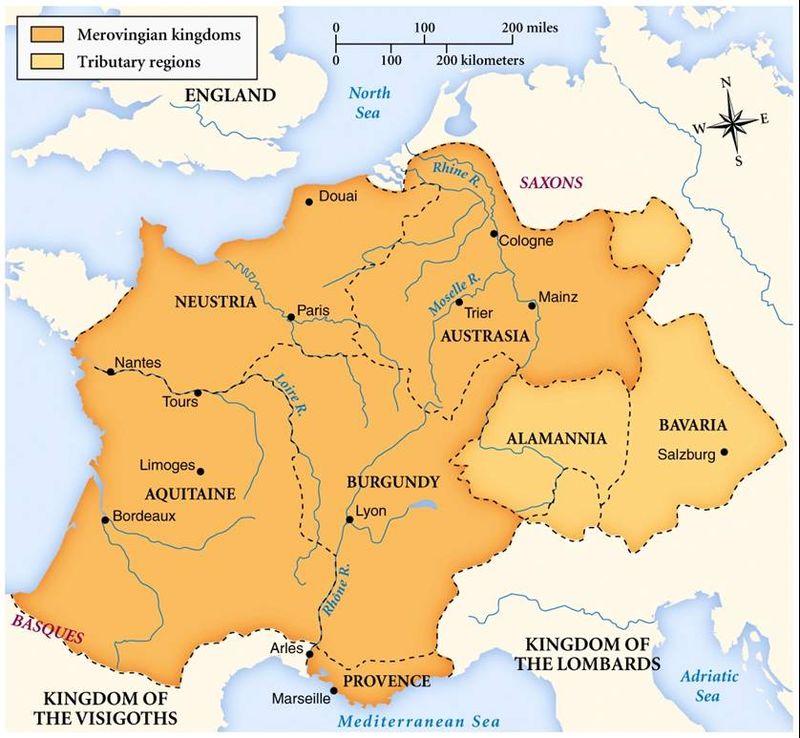
Charlemagne was king of The Franks, who were a bunch of tribes from around Germany who'd been united into a single kingdom by a guy called Clovis around 500AD. Clovis (who sounds interesting but I couldn't find a bio) converted himself and his whole kingdom to Christianity.
Clovis' family ruled the Franks for about 250 years and their dynasty is called the Merovingians. Their kids got worse and worse at running the kingdom until in 751 the last Merovingian was kicked out of office by Pepin the Short. Pepin was Charles' dad.
Charles' mom was called Bertrada and was by all accounts not to be fucked with. Charles was born before she was married to Pepin, making Charles technically illegitimate, but they fixed this later by just ignoring it, which is a thing you can do when you hold absolute power.
Charles and Bertrada were very close, and she appears to have been a shrewd political operator, arranging alliances and marriages and generally being the power behind the throne for at least the early part of Charles' reign. This may explain how Charles became king at all.

Charles was a tall, gangly kid who wasn't very good at archery or sword fighting, was not particularly attractive nor considered particularly clever. He had a high-pitched, squeaky voice. His younger brother Carloman was smarter, a better warrior, more attractive, better liked.
Pepin the Short died in 768 and left half of his kingdom to each of Charles and Carloman. But Carloman died 3 years later, and Charles then took over both halves. This decision not without controversy but he had Bertrada and also lots of dudes with swords to back him up.
It has been suggested that the sudden death of his younger brother 3 years after they split the kingdom between them makes Carloman's death suspicious. But there's not a lot of evidence for this. It was the 700s, life expectancy was about 30 years, Carloman was simply unlucky.
Charles slowly took over Europe. It's not clear what his motivation was, except that he seemed to like things being orderly and there being a mess of tiny kingdoms seemed disorderly. It became a sort of hobby, riding out every year and gobbling up another piece of Europe.
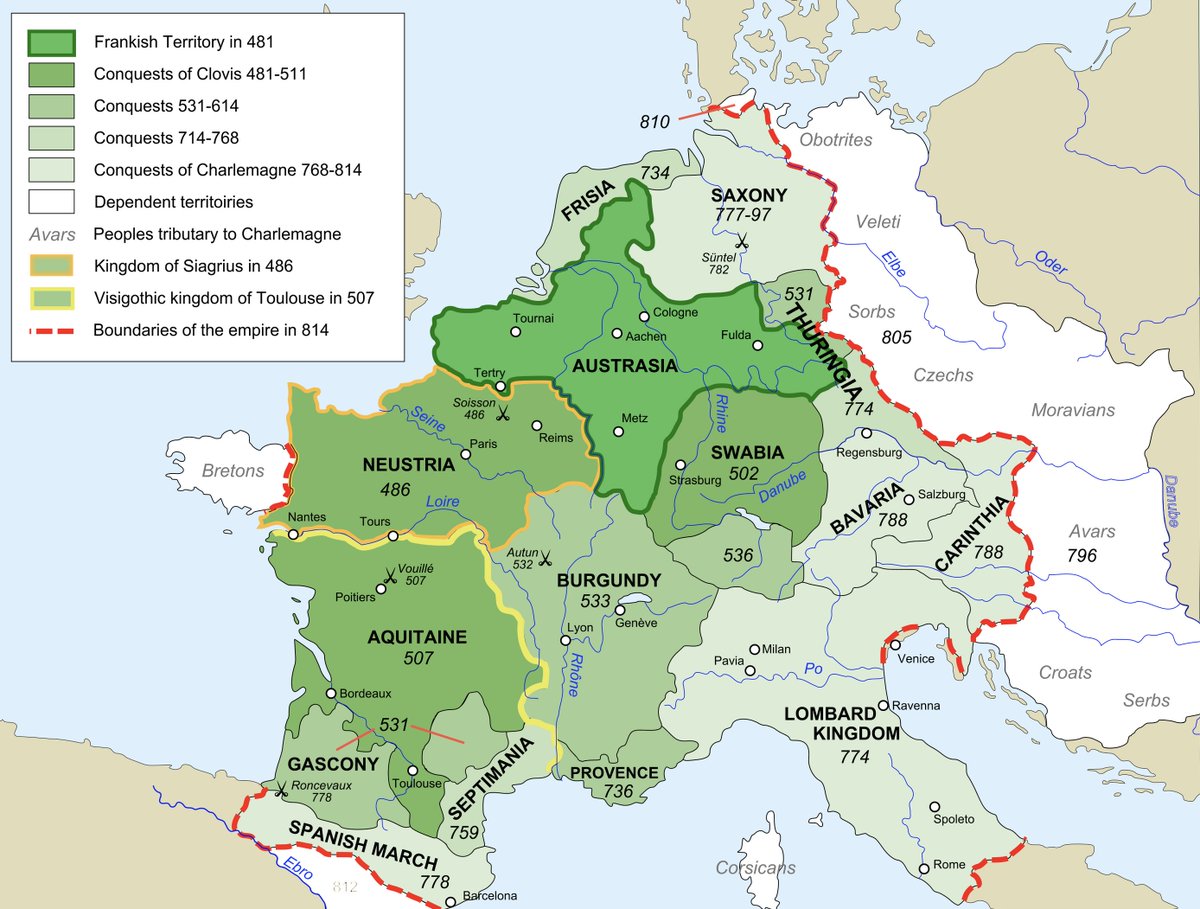
His first big win was Italy. He defeated the Lombards (another Germanic tribe like the Franks) mostly through luck, when he split his army in two to get over a mountain and the sudden appearance of the second half spooked the defenders and they panicked and fled.
Following this victory he made a treaty with Pope Hadrian in Rome, but was tricked into giving control of way more of Italy to Hadrian than he'd realized, because he couldn't read the treaty or speak Latin well enough to understand what Hadrian was proposing. This was formative!
He then tried to take over Spain, under Islamic rule at the time, but was soundly defeated. He made a truce and then pretended like it was a victory and that he'd never meant to take over Spain, he'd just marched an army over there to say hi and see the sights and then come back.
Again: if history were not being written by Europeans here, it's possible "the king of Europe got his ass kicked by the Moors" would be a bigger part of the story and not conveniently ignored.
He also took over Saxony. This took ages. He kept conquering them and then they'd rebel against the Christianity he'd imposed on them and he'd have to come back and re-conquer them. Eventually he got the hang of it but his hold there was always pretty tenuous.
Some time around age 40, Charles became distressed at how intellectual standards were slipping everywhere. Priests spoke Latin but didn't understand what they were saying. Arts like sculpture, painting and goldsmithing, which he'd seen in abundance in Rome, were being lost.
Charles' continent-spanning military travel and empire-ruling power meant that more than anyone alive he had an eagle-eye view of the continent's decline. He decided he was going to fix this, starting with himself. He went looking for teachers.
Part of Charles looking for teachers was to educate his children, of which he had at least 18, via a total of 9 different women, 5 of whom he married, most of whom he outlived. He had sons called Pepin, Carloman and Charles, because being imaginative with names was not his thing.
Fun fact: his first kid, Pepin, had a hunchback. At the time this would usually result in his mistreatment, but Charles apparently treated Pepin with love and favor. Pepin repaid this by deciding (egged on by some nobles) to try and execute a coup and depose Charles. It failed.
Charles had other motivations to go back to school. He'd lost a chunk of Italy to the Pope by being bad at reading. Being unable to read and write meant he had to physically go to places to govern them effectively. As his empire expanded this got less and less practical.
He found several teachers to join his court, notably including Alcuin of York, who had a great influence in improving the king's intellectual life. Alcuin was apparently gay, the only queer note in Charles' otherwise superfluously heterosexual life. https://en.wikipedia.org/wiki/...
It was probably Alcuin who helped achieve one of Charles' most lasting contributions: he pushed to standardize how letters were shaped, creating a style called Carolingian Minuscule. Before this, writing could vary so much from one place to the next as to be indecipherable.
Despite great effort, including taking pen and paper to bed to practice forming letters at night, Charles never properly learned to read or write. He had books read aloud to him, and signed official documents written for him with a mark. But he had immense respect for learning.
Charles poured money into libraries, book copying, monasteries, and other forms of education at the time and the result was a genuine rekindling of the flame of learning in Europe, now called the Carolingian Renaissance. ("Carol" is another form of "Charles", hence the name)
Fun fact: the Eastern Roman empire at Constantinople treated Charles' empire as basically upstart barbarians until he ruled most of the continent, at which point they reluctantly recognized him as emperor. They were ridiculously snooty about it.
Charles also executed reforms of government, taxation, economics, jurisprudence and administration. He was hard-working and dedicated and basically rebooted European culture. He built a magnificent cathedral in his capital at Aachen, which still stands today.

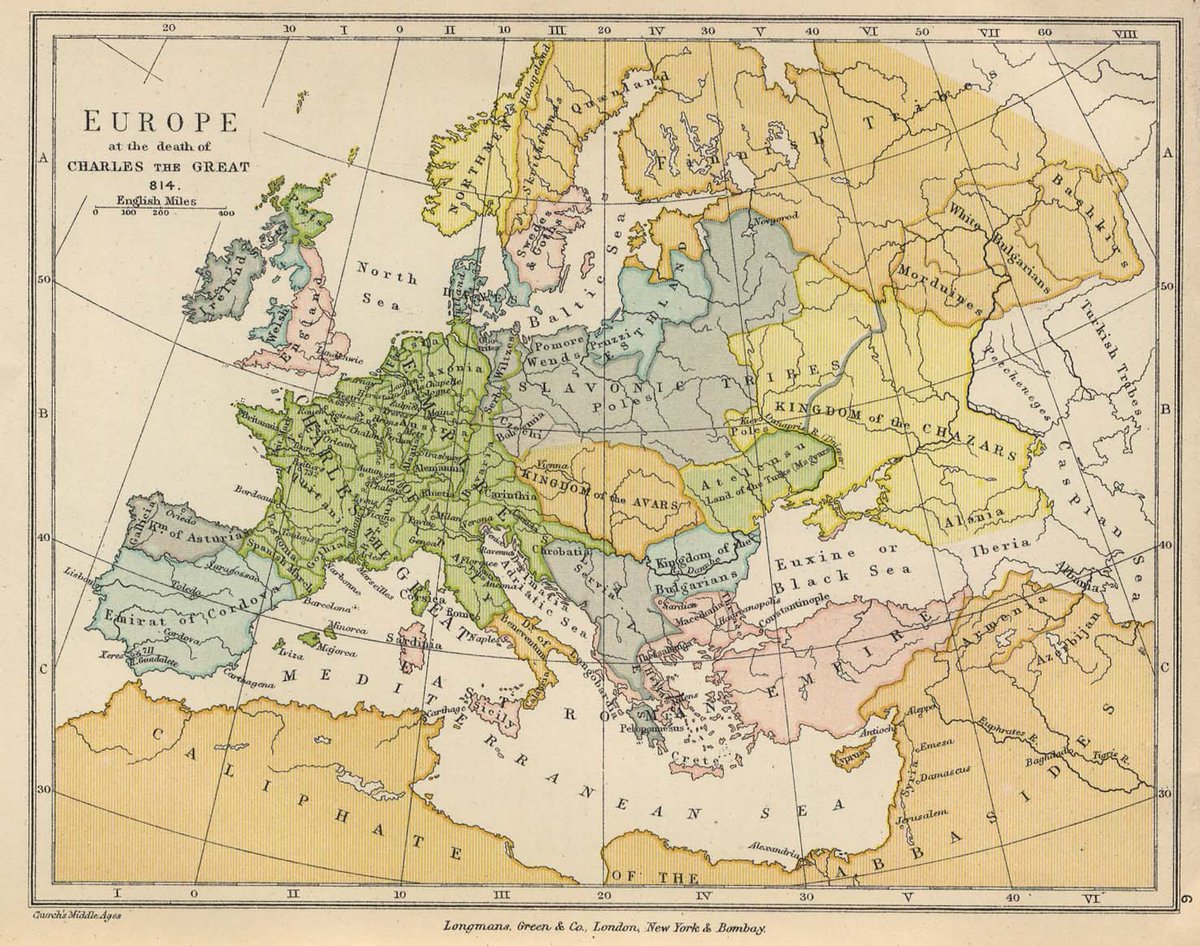
Charles' hard worked was recognized at the time and he remained widely popular up until his death from old age. After his death his kingdom was nibbled at the edges by various foes, especially those pesky Saxons who he'd never really finished conquering, but mostly stayed intact.
@seldo Your history tweets are my favourite tweets
@seldo Squeee! Thanks for this!