
I have already destroyed the #scientific measurement and analysis of democracy. In light of today’s reintroduction of line graphs on the badness of ‘autocracies’ into the Twitter discourse, I will now dive into the #science on democracy’s negation. https://x.com/knrd_z/status/13...
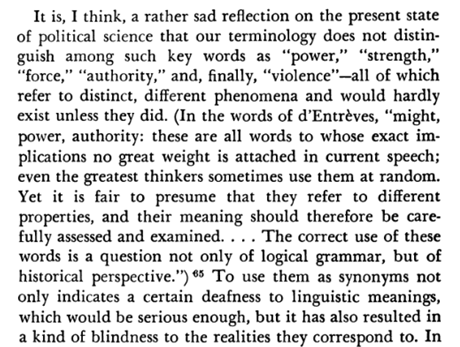
One must first acknowledge the conceptual confusion in #science: autocracy, authoritarianism, dictatorship, totalitarianism, tyranny, non-democracy---all these terms are used interchangeably and flippantly in the regression sciences.
Hannah Arendt recognized this terminological carelessness decades ago and rightly declared that it reveals a “blindness” to the ontological reality that underlies the language. Bayesian measurement models are irrelevant when the concepts are ungrounded.
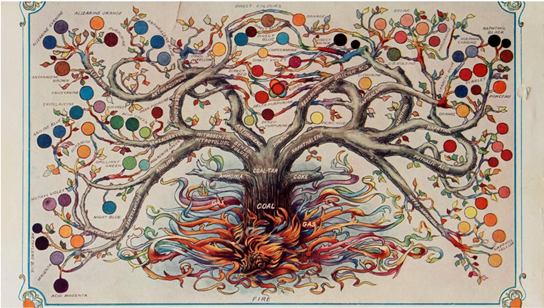
Can you imagine chemists using atom, electron, compound, particle, rock, and tiny stuff all interchangeably? Remember, when you encounter statistically sophisticated research on ‘autocracy’ this is the ontological status of the field’s conceptual apparatus.
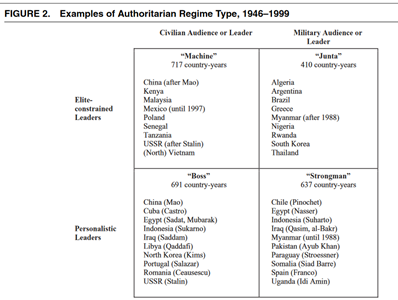
I’ll spare you walking through the many terrible studies. Why is this important? We know the research's purpose is to show democracy is superior. But what if conceptual confusion masks that ‘democracies’ are closer to some ‘autocracies’ than autocracies are to each other?
Everyone has a mental representation of ‘autocracy.’ For most people, this is specifically totalitarianism: Nazi Germany, Soviet Union, Maoist China, Iraq before the war. But you’ll notice that ‘scientific’ typologies don’t include totalitarianism: why is that?

“Oh please, no! Not that queer Frenchman, God no!” Yes, yes, _that_ one. “Gahhhhh! He’s the one that made Woke posttoaster sociotheological critical theowirsismj!” Calm down, friend. Need a smoke?

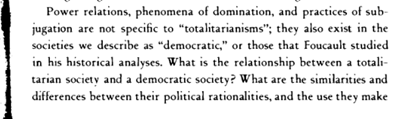
Read, for it will not turn you queer. Democracy and totalitarianism in the modern world are _essentially the same._ Not merely in the obvious sense that, say, Nazism was a popular, mass movement based on democratic notions of participation; their _mechanisms_ are the same.
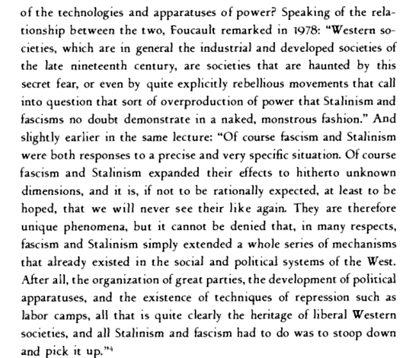
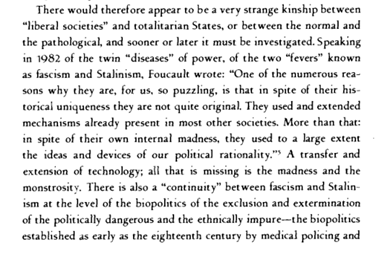

Note in particular Foucault’s “biopolitics,” the demarcation of the “dangerous” and “impure,” notions grounded in #scientific discourse and enforced through de facto state organs. Does this sound familiar?
Do we see similar tendencies in ‘democracies’? In ‘racism’ discourse, sure, but perhaps also in ‘public health crises’ that wage economic warfare against those outside the totalitarian organs themselves? https://x.com/MichaelPSenger/s...
And the left, funnily, discarded its darling theorists, those who might have some reservations about their supposed followers. Foucault, Szasz, Laing, Baudrillard, et cetera---all dead. Ah, except for Agamben! What does he have to say? “Shut up, old man. We’re in power now.”

Totalitarianism was removed from #scientific discourse because it destroys the ‘democracy-autocracy’ division that grounds every study on ‘political regimes’ in the past fifty years. Sure, there are ‘autocratic totalitarianisms’ but we live under ‘democratic totalitarianism.’
Yet, there are non-totalitarian versions of democracy and autocracy. Take, for instance, the US Founders, who were ‘democrats,’ non-totalitarians, and _monarchists._ “Nooo! Washington wanted trans kids to vote!” Calm down, I already covered this. https://x.com/knrd_z/status/13...
And, obviously, Singapore is the great non-totalitarian autocracy example. Read the literature: a hidden theme is that monarchies are pacifistic, developed, and safe. In less ambiguous language, monarchy = non-totalitarian autocracy. (Just one example; there are many).
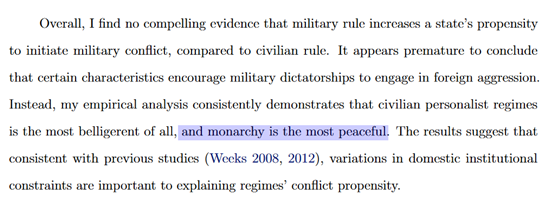
Indeed, the greatest threat to monarchic stability is _democracy_, or totalitarianism whose mechanisms are not distinguishable from those in modern democracies and that rely on “participation,” “mobilization,” “equality,” and other norms bound with our understanding of democracy.
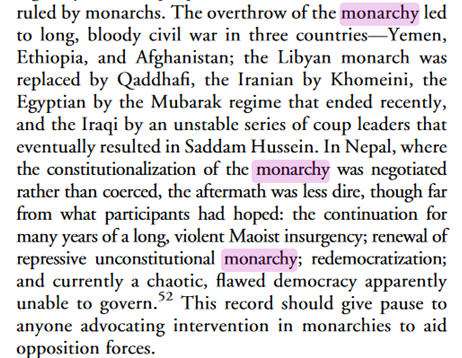
Totalitarianism is evil, I agree. And for that reason I am wary of democracy. Tell this to a “professional” and they will laugh at you. But worry not, for they’ve never interrogated their concepts or read books written before 1993. Tell them to make you a ggplot about it.