
1/ What is an NFT? Wait, what? Isn't this easy? I am not so sure. Let's take a look!
2/ Let's start with the definition: [Non-Fungible] [Token] This is a branding disaster since nobody had ever used the word non-fungible before NFTs. But I think we are stuck with it now, so we need to make it work. Let's address the [Non-Fungible] part first
3/ To understand non-fungible, we must first understand fungible. "(of goods contracted for without an individual specimen being specified) able to replace or be replaced by another identical item; mutually interchangeable." -Oxford English Dictionary
4/ One important observation is that very few things in life are fungible. Look around you. Your table, your ham sandwich, your husband or wife, your dog, your goldfish, your kid, your t-shirt, your rosebush, your neighbor, your car All non-fungible
5/ We mostly encounter fungible objects in financial matters where fungibility is a simplification to make things efficient. If you buy 10 shares of Google from your broker, you don't care which 10 shares you received, they are all 'mutually interchangeable'
6/ If you go to deli and buy a bagel with cream cheese and you pay with cash, neither you nor the deli owner care which specific $5 bill you are giving him. BTC and ETH are the same way. When you pay for gas to snipe a Golden Snail, you don't care which ETH you are using
7/ OK, so all of that above is WRONG. Bank Notes are actually non-fungible. See that serial number in the top left. That is a unique identifier that tells you all types of things about the bank note https://www.uscurrency.gov/den...
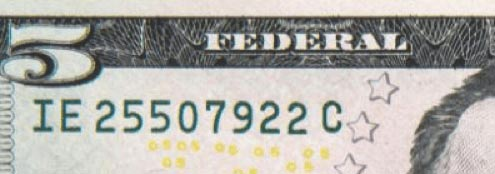
8/ Google shares also are numbered. The precise way to think about bank notes and company shares is that they are: 1) non-fungible financial instruments 2) that we have all socially decided to treat as fungible OK, is that it? No there is more
9/ Money is not truly fungible, primarily due to anti-money-laundering regulations Trying taking $1M in cash to your local Citibank branch and see how fungible it is Or try wiring USD to/from North Korea Or even, in a market far from the USA, try trading a torn bank note.
10/ OK, fine, what about grain? That is another fungible good. Sure, we treat it as fungible for convenience, but it is certainly non-fungible. If we had the technology to analyze every single grain of wheat in silo in an fast way, we would see they are all different.
11/ So the precise way to think about fungible objects IRL is that, typically, they are: a) non-fungible objects b) that we have decided to treat as fungible for convenience c) except, in some cases, when we treat them as non-fungible after all
12/ Almost everything is non-fungible. In a different path of history, NFTs would just have been called "tokens" and in the few cases that we want them to be fungible, we would have invented FTs ("fungible tokens"). But, here we are, so we proceed
13/ So what does a 'non-fungible' token mean in a crypto context? It means something very simple. It has a number. This is Fidenza #313 on the ArtBlocks contract. You see that "313" at the end of the URL? That is the token number that ends in "313" https://opensea.io/assets/0xa7...
14/ Here is the Etherscan of the tx when the 6529 Museum acquired 313 What you are seeing is that two wallets swapped: [1,000 Ether Tokens] for [1 Art Blocks token 78000313] https://etherscan.io/tx/0x41c7...

15/ Go down one, and you get Fidenza token 312 https://opensea.io/assets/0xa7...
16/ Go up one, and you get Fidenza token 314 NFTs are just numbered tokens. #312 is a different number than #313 that is a different number than #314. It is that simple. https://opensea.io/assets/0xa7...
17/ OK, but where is the art? What art? NFTs are TOKENS. Tokens can be used to represent anything, not just "art" I could issue 100 6529PartyTokens and say "whoever has one, can come to my party on Saturday night" And the lower the number, the more priority you get in line.
18/ I know this sounds dumb, but it is very deep. NFTs are tokens. What you are buying, selling, storing in your Ethereum wallet is the token, nothing more and nothing else. Once you understand this, you will actually understand everything about NFTs
19/ So back to Fidenzas. How do we know that these specific tokens on this specific Ethereum contract represent the true and genuine Fidenza tokens? Well because @artblocks_io (the platform) and @tylerxhobbs (the artist) told us, that is why. This is also that simple.
20/ OK, but where is the art? Well, this depends on the specific implementation. Let's go through in order from more to less centralized. An NFT token has a URI (Uniform Resource Identifier) which you can think of as a URL
21/ In the most centralized implementation of an NFT, that URL will point to someone's website with an image of the art. So the model here is: a) this token b) points to this URL c) at this URL is this JPG Wait, what? This sounds fake? You are buying a URL?!
22/ No, you are not buying a URL. You are buying a piece of art and the token is the certificate of authenticity. Just like when you buy 6529PartyToken, and the URI has the address to my bar, you are not buying a URL, you are buying good times at my bar
23/ I bought an Andy Warhol Tomato Soup Can print a few years ago. But there are also posters, replicas, fake Warhol prints and so on. How did I know I was spending six figures on "the real one"? Well, it is kindof disconcerting if you come from crypto land

24/ [Nice man at the gallery] See, this is Andy Warhol's signature on the back. [6529] Cool! But how do I know this signature is real? [Gallery Man] Here is this piece of paper where my gallery says it is real [6529] How do you know? [GM] We are a top gallery, etc, etc
25/ For someone used to cryptographic signatures, a piece of paper and some hand-waving was an utterly alarming confirmation on which to spend six figures. But I wanted a soup can, the gallery is legit, I swallowed hard and bought it, counting that the social consensus was real
26/ By IRL art world standards, the provenance assurances for NFT art are so lol better that it is like comparing a rocket ship to a horse. There are hundreds of thousands, soon to be millions of people, soon to be hundreds of millions who know @tylerxhobbs & Fidenzas
27/ And even if Tyler and the art blocks team are captured by aliens tomorrow, we are not all going to forget on which contract Fidenzas were issued. Unlike with soup cans where I relied on an opaque assurance from an insider, anyone can check which wallet has Fidenza 313 token
28/ So back to where the art is? Pointing to a centralized website is ok, not great. Why not great? Well someone, ideally, will keep the website running for a long time and people are bad at that. Now, it is not as tragic as people make it out to be
29/ Why is the URI useful? It is useful for automated services, progressively metaverse-like. The reason that @opensea and @oncyber_io know what to display on their website/gallery is that they follow the URI. If the site goes down, the automated system will fail
30/ OK, that sounds bad? It is bad for unknown art. If this happened for a famous piece of art, for which there is broad and practical social consensus about what the art is, it would not matter. People would link to somewhere else with a copy of the art and life goes on.
31/ OK, what is better than that? The next step in decentralization of the art itself is to point the URI to decentralized storage like IPFS instead of to a website. Now you are not relying on one website to stay up and anyone, including the buyer, can replicate