
#RS is an indicator which helps in finding strong stock or index in the market. This learning thread would be on "𝙐𝙨𝙚𝙨 𝙤𝙛 𝙍𝙚𝙡𝙖𝙩𝙞𝙫𝙚 𝙎𝙩𝙧𝙚𝙣𝙜𝙩𝙝" Shared some strategy. Like👍 & Retweet🔄for wider reach and for more such learning thread in the future. 1/22
Most of us would confuse it with Relative Strength Index (RSI) but Relative Strength is a different indicator. We have already covered about "Uses of RSI" in below thread👇 https://x.com/YMehta_/status/1... One can go through this if you haven't. 2/22
Now coming to Relative Strength (RS). It is basically a strategy used in momentum investing which shows strength or weakness between two asset classes (two stocks, index, commodity). One can read about this in below link👇 https://www.investopedia.com/t... 3/22
As of now, I am using this indicator on .@tradingview platform. It's free and one can add it in their Tradingview account as well, using this link👇 https://in.tradingview.com/scr... There are multiple variants in this as well. Some traders use multiple time frame RS. 4/22
RS basically compares returns of one stock/index with the returns of benchmark stock/index at a particular time horizon. Let's say, I want to analyze TCS and Benchmark Index is Nifty. 5/22
TCS gave 13% returns and Nifty gave returns of 10% in 1 month. Then RS would of TCS would be 13%-10% ~ 3% (approximated). Actual value/forumula be ((1+13%)/(1+10%)-1) = 2.7%. This means TCS had outperformed Nifty in one month by 2.7%. 5/22
Let's see how this indicator looks and how it functions. This is the general inputs for RS. Two important inputs here are: 1. Comparative Symbol- This means which would be the benchmark index/stock one want's to compare their stock/index. 6/22
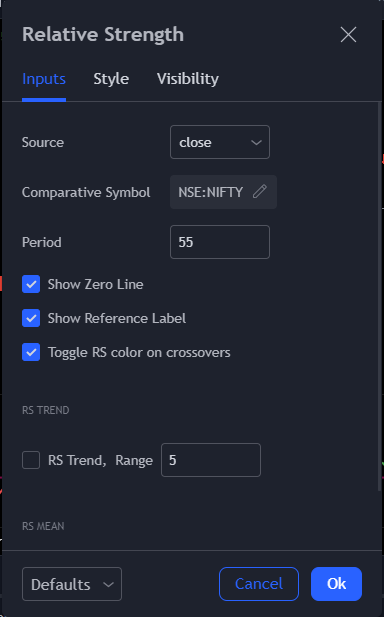
In Indian stock market, use Nifty as a benchmark as it includes all the major sectors. 2. Period: This is the time horizon over which one wants to compare the strength or weakness. General period that is used is: 55- (3 months) 123- (6 months) 252 - (1 year) 7/22
Comparative Symbol and Period are highly customizable and use the values that suit your style. This is a sample RS chart of Asian Paints v/s Nifty. Green RS means stock has outperform and Red RS indicates underperformance. Pink line is 0 line which is highly important. 8/22

General definition of RS says:, If RS line is above 0, then it shows stock will outperform and if RS is below 0, then it shows stock will underform. Let's look at the same example: When RS line closed below 0 line, Asian Paint stock went down from 2600 to 2200 (-15% down). 9/22
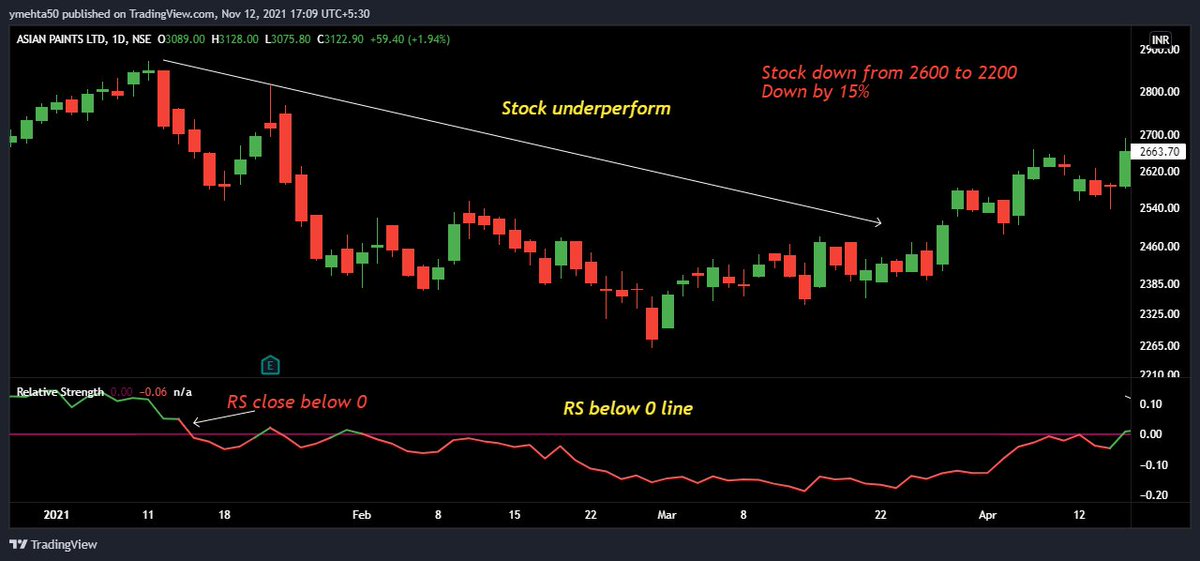
Similarly, for bullish setup. When RS closes above 0 line, price of Asian Paints moved up from 2550 to 3000 (18% up). Simple Rule of RS is: 1. Buy if RS > 0 2. Sell/Exit if RS < 0 This looks easy, but this is not that easy. 10/22

Above setup that was shared was only when RS worked well. There can be a lot of whipsaws in real life and using RS as a standalone will give you a lot of entry and exit in a stock. This will lead to minor loss plus additional trading cost. What can be done now? 11/22

One of the setup that I am using and practicing based on Relative Strength was gifted by @vivbajaj sir. One can watch the video as he had explained everything about simple Relative Strength setup in detail👇 https://www.youtube.com/watch?... 12/22
Setup is simple. Use following indicators: 1. Relative Strength (RS) - Period = 55, Benchmark = Nifty 2. Supertrend - Default Setting 3. Relative Strength Index (RSI) - Default Setting Price Action is used as it is the supreme indicator in trading. 13/22
Buying Setup (Daily Time Frame): 1. RS above 0 2. Price above Supertrend 3. RSI > 50 Once all these conditions satisfy, then wait for price action confirmation. Price should give a breakout on closing basis above previous swing high with good volumes. 14/22
Exit Setup: Use 2 hour time frame chart. If any two of the buying condition gets violated on closing basis, then exit immediately. Why exit is done based on 2 hour chart? Reason is fear in market spreads faster, so if lower time frame is bearish then exit. 15/22
Re-enter again if on 2 hours time frame setup becomes bullish and daily setup is also bullish. Daily and 2 hours combination is for short-term trading. One can use Weekly and Daily combination for positional trading. 16/22
Let's see some case/examples now: Infosys (daily chart) After satisfying all the conditions, entry got triggered at 960 and price rallied from 960 to 1120. Up by 16% in the short term. 17/22

Second example is Pidilite Industry. After fulfilling all the conditions, entry got triggered at 1930 and price rallied from 1930 to 2220. Up by 12% in the short term. 18/22

One example of Positional Trading Setup: Laurus Lab (Weekly Chart) All the conditions got satisfied and price moved from 100 to 530. Stock up by 430%. There would be many examples for this, so I would suggest to check this setup on other stocks and index chart as well. 19/22

Another setup I am practicing was given by .@premalparekh. I would suggest that everyone watch these two face-to-face videos of Premal Sir as well. Link 1: https://www.youtube.com/watch?... Link 2: https://www.youtube.com/watch?... 20/22
Strategy is easy only if one follows all the rule. Key point is to sit with the patience for the returns. As quoted by Livermore: "Sit tight when you are Right" 21/22
I hope everyone understood how Relative Strength can be used. These are not a universal rules one must follow. One can create their rule or follow someone else rules. Only important thing is one must follow a fix rule instead of tweaking or changing setup frequently. 22/22