
Been seeing a lot of these kinds of comments lately: “114.57 BPM? There is never a reason for such a specific BPM!” Yes. There is. (thread)
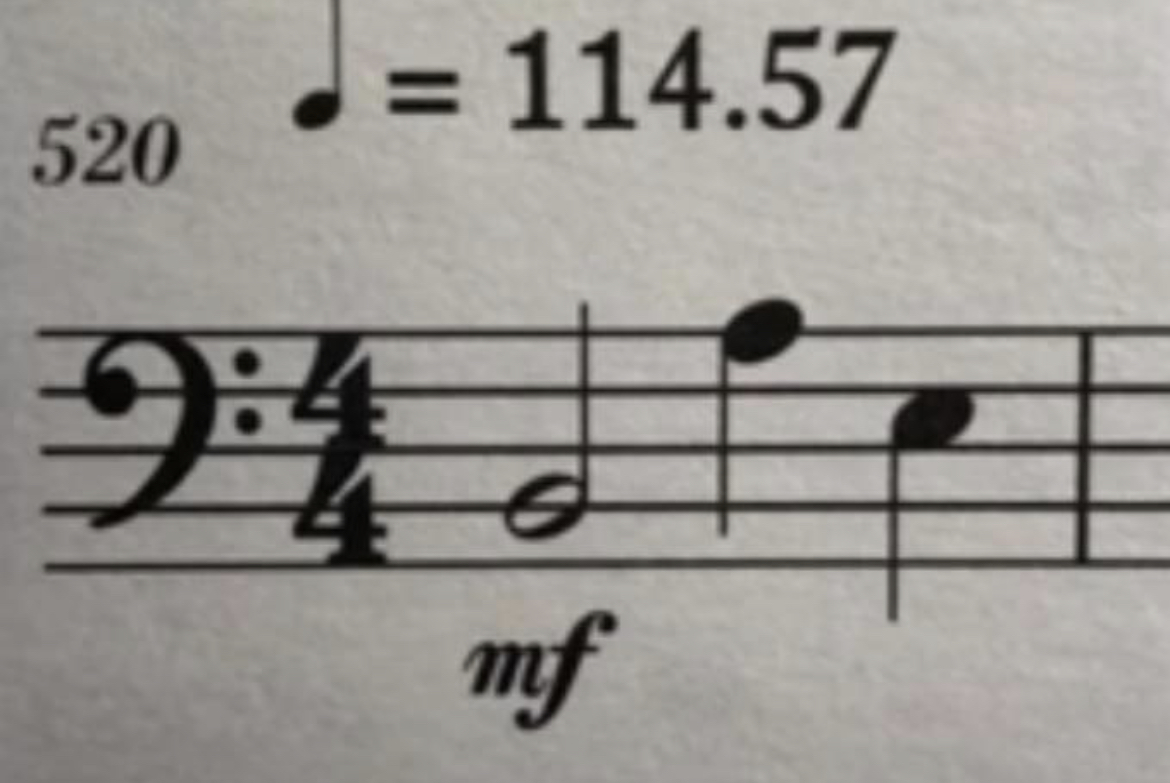
Perhaps the most obvious reason is synchronization with audio-visual mediums (film, games, etc). If a piece of music is 114.57 BPM, it’s probably because rounding up or down would cause a half-second desynchronization with the visual media after only one minute of film/game time
“Okay, so the 114.57 BPM is necessary for the conductor, editors, producers, etc., but why can’t we just display 115 BPM for the bassoon player?” Now this is just disrespectful to bassoon players. Decimals are literally taught in primary/elementary school
Composers really have two choices here: A. Ignorance is bliss. Proactively take the time to hide the decimals from the performers, or B. Respect performers intelligence at the risk of looking a bit fascist by working with decimals
“Okay, but outside of film/game scoring, there’s surely no use for them, right?” There are plenty!
We recently transcribed this tiktok sound https://x.com/incipitsify/stat... where thechromaticmusicteacher played a chromatic scale using all of her boomwhackers at 60 frames per second. We had a few ways to do this:
1. If each note was a quarter note, then 60FPS * 60s = 3600 BPM, which is obviously absurdly fast. At 8th notes, that would be cut in half 36,000/2 = 1800. Sixteenth notes: 1800/2 = 900BPM. 32nd notes, 450BPM. 64th notes, 225BPM… still too fast? 128th notes, 112.5BPM DECIMAL!?
Since the scale is 86 notes ascending and descending, this doesn’t fit into a convenient meter well at all. The obvious meter for it would be 43/128. Or we could write it out in 4/4 and have a “remainder bar” of 42/128 (which reduces to 41/64)
2. OR… we can shimmy 43 notes into a simple 2/4 meter as a polyrhythm! (This is what we opted for)
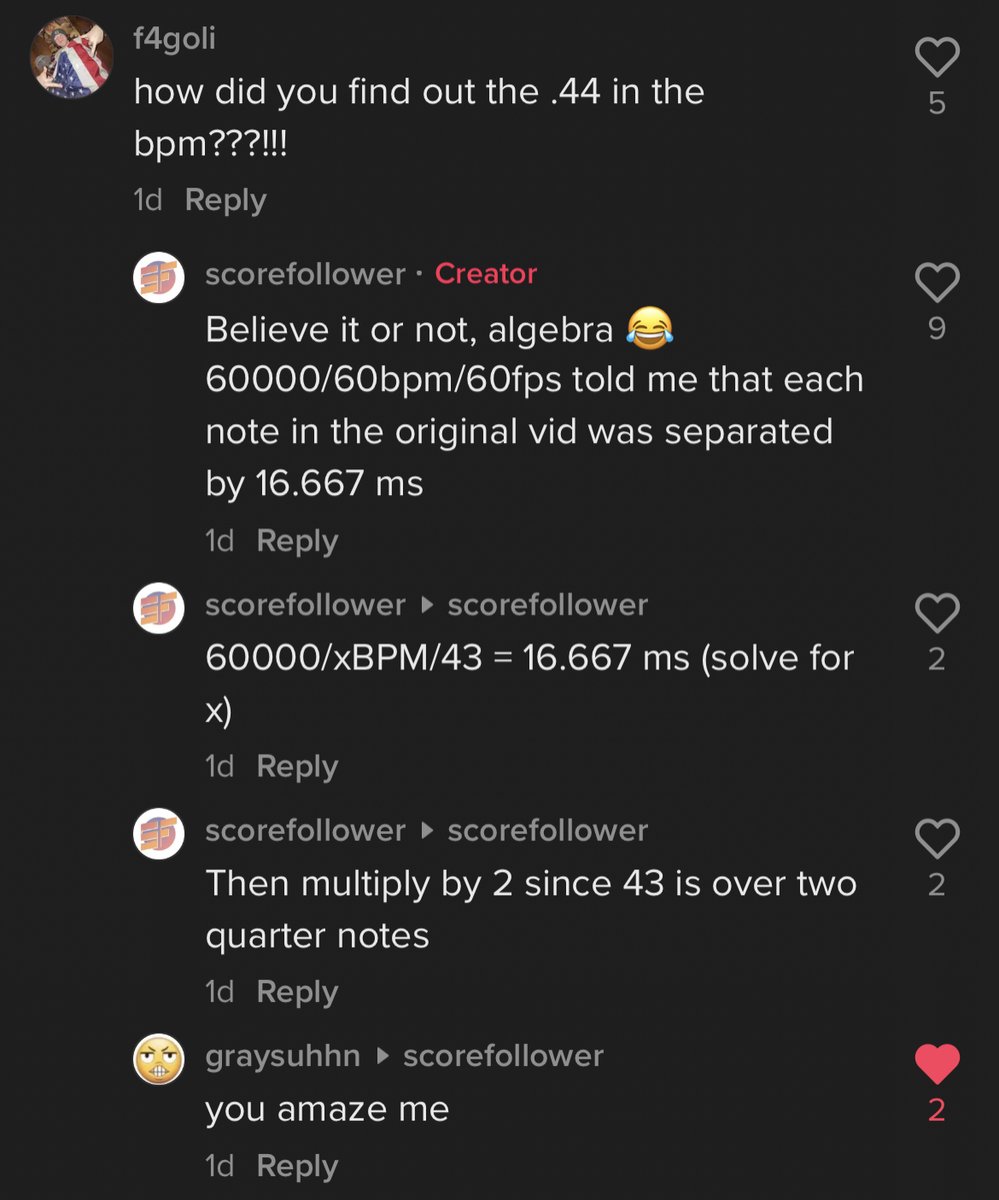
As it turns out, something will look absurd about it, whether it’s the tempo too fast, or too “specific,” the meter, the polyrhythms, etc. (pick your poison) This is because most sounds in this world do not care about how it might look when notated
Composers these days sample/record their microwaves, fire crackling, glaciers melting, etc., and often have to find ways to express those sounds in notation. Just as microwaves don’t always hum in A440 tuning system, water dropping off a glacier almost never drips at 120 BPM
Some try to autotune or adjust the timings to fit their samples into the pitch/meter of their music. Some prefer to preserve the idiosyncrasies of the original sample
In these cases, we should expect some weird tempi, meters, microtones, etc. unless of course the composer wants to shield performers from those scary decimals!
I say all this not to suggest we shouldn’t shitpost absurd scores online (arguably the best thing on the internet right now). This is just an attempt to address many of these common comments in the threads!
@incipitsify true, but the JND between 114.57 and 114 is far beyond human perception. Performers just won’t feel the difference. It’s like saying the temperature outside is 61.57° F vs 61°. Sure it might be true and there may be a reason for that level of precision. But don’t be a dork.
@incipitsify Marvelous thread, thank you!
@incipitsify @ThreatNotation But the *reason* these types of metronome markings are frowned upon is it adds complexity to a tempo where it is not reasonable for a human player to have that level of accuracy, certainly not without mechanical/audible assistance.
@incipitsify @MusicalHell People who think there's no need for such a specific number are too young to remember 21 Seconds by So Solid Crew. https://x.com/YMuPr/status/105...
@incipitsify this only applies for the click-track. no musician alive could possibly discern the difference between 114 and 114.57 bpm, so if the musician were playing without click they would be estimating anyway. most metronomes don’t have this degree of accuracy either
@incipitsify 120 BPM is likewise an exact 120.00 BPM
@incipitsify Give me 4/4 120bpm or give me death

@incipitsify Thread can be summed up by, composers being pedantic and notating something unperformable for their egos and pseudo intellectualism. I get the purpose but it’s so beyond practical but to me that’s modern classical music in a nutshell. Gimme Verdi
@incipitsify tl;dr Composers patting themselves in the back for being control freaks
@incipitsify To be fair, you have to have a very high IQ to understand decimal time signatures. The tempo is extremely subtle, and without a solid grasp of theoretical physics most of the beats will go over a typical viewer's head...
@incipitsify i think this is more acceptable if the metronome or click track provided can achieve this. tonal energy can as can DAWs, but if you're working with a conventional metronome (or most phone apps) it cannot. ...which is why you should get tonal energy.
@incipitsify I don't understand the people saying that human perception can't notice when we have just established that other media would go out of sync eventually with a different value... that seems like perception to me!
@incipitsify To add to your other justifications: Metric modulations can also often lead to fractional bpm.
@incipitsify i mean 114.5 is just fine for the human ear/brain, you can chill with the .57 tho most modern and lots of ancient hardware won't even let you fine tune the bpm beyond a 1/10 of a BPM
@incipitsify @heather_roche Thread: Been seeing a lot of these kinds of comments lately: “114.57 BPM? There is never a reason for such a specific BPM!” Yes. There is. (thread)
@incipitsify Since this can only be relevant if you're playing with a click (as others have pointed out), isn't the actual problem that lots of metronomes don't offer that level of precision?
@incipitsify I feel like this is like a difference between mediums All this makes sense in the context of "it's meant to be done this way for a lot of these reasons" but once it's written on score to be given to someone for a less precise purpose, the notation gets lost
@incipitsify Please make the difference between 114.57, 114.58and 114.56 and we'll talk later about snobbish nonesense
@incipitsify This was educational, thanks!