
1/ The benefit of putting the filter on the front (output) of a fan. @sameo416 @DavidElfstrom @JimRosenthal4 @linseymarr @kprather88 @Poppendieck @taraparkerpope @kprabhdeep @WBahnfleth @BrandonBoor PM2.5 reduction of MERV 13 filter on front versus the back of 20 inch box fan:
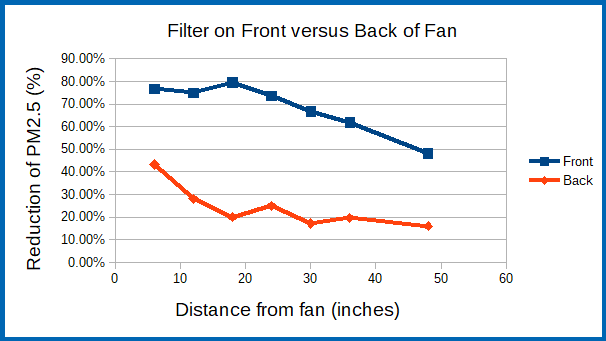
2/ The graph above shows the difference in the efficiency at a distance from the output for the back and front scenarios. When the filter is on the front the efficiency is much higher for a given distance from the fan output.
3/ Putting the filter on the front of a fan lowers the Reynolds number which creates more laminar flow. It greatly reduces the turbulence from the fan blades. This means the air purifier will have a larger throw of clean air at the output.
4/ This is why operating room air purifiers and laminar flow hoods have the filter on the fan output
5/ The video below shows the flow of air when the filter is put on the back of a fan. The fan output is very turbulent and some air even flows backwards.
6/ The video below shows the air flow when the filter is put on the front (output) of the fan. The flow is much more unidirectional. The flow would be even more laminar if the fan speed could be decreased.
7/ If you are designing a desktop or personal air purifier it would be important to put the filter on the front to maximize the throw of clean air towards the individual.
8/ If you are designing a whole room air purifier like a Corsi-Rosenthal box it is not as important which direction the air flows. However, there might be some applications where it is desired to reverse the flow in a CR box and generate laminar flow in 4 directions.
/9 This data only applies within a few feet of the fan output. At greater distances the fan output starts mixing more with room air. Thanks to @DavidElfstrom for encouraging the smoke test.