
1/Radiologist not answering the phone?Just want a quick read on that stat head CT? Here's a little help on how to do it yourself w/a #tweetorial on how to read a head CT! #medtwitter #FOAMed #FOAMrad #medstudenttwitter #medstudent #neurorad #radres @medtweetorials #neurosurgery
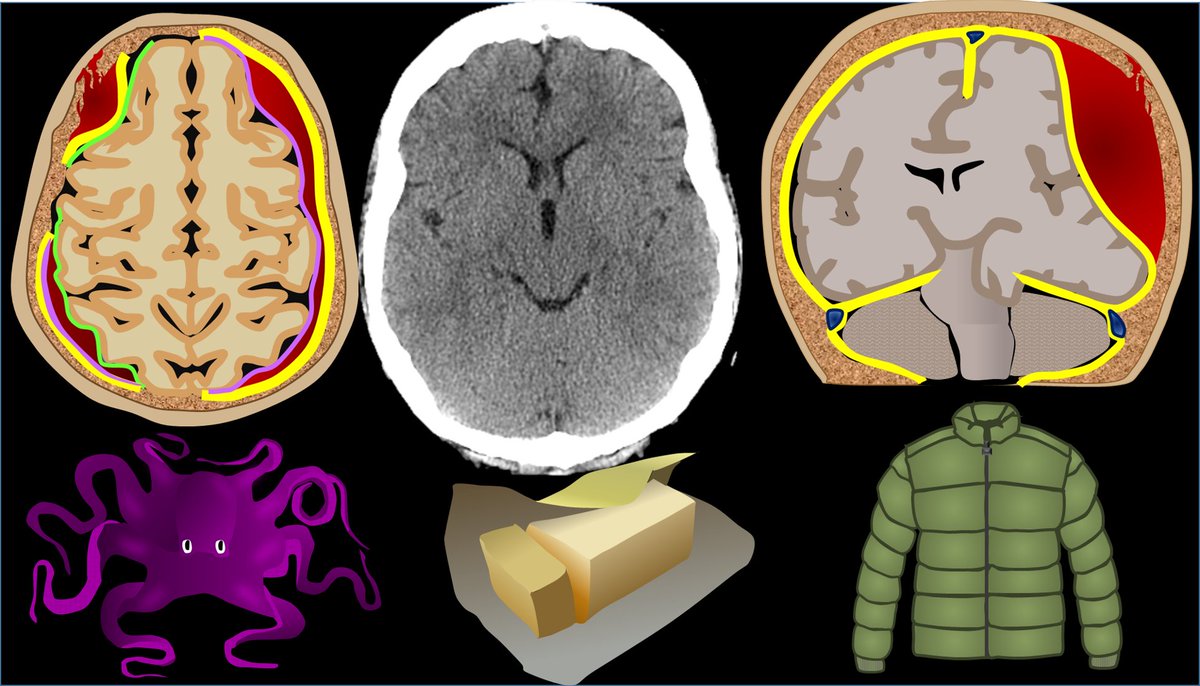
2/In bread & butter neuroimaging—CT is the bread—maybe a little bland, not super exciting—but necessary & you can get a lot of nutrition out of it. MRI is like the butter—everyone loves it, it makes everything better, & it packs a lot of calories. Today, we start w/the bread!

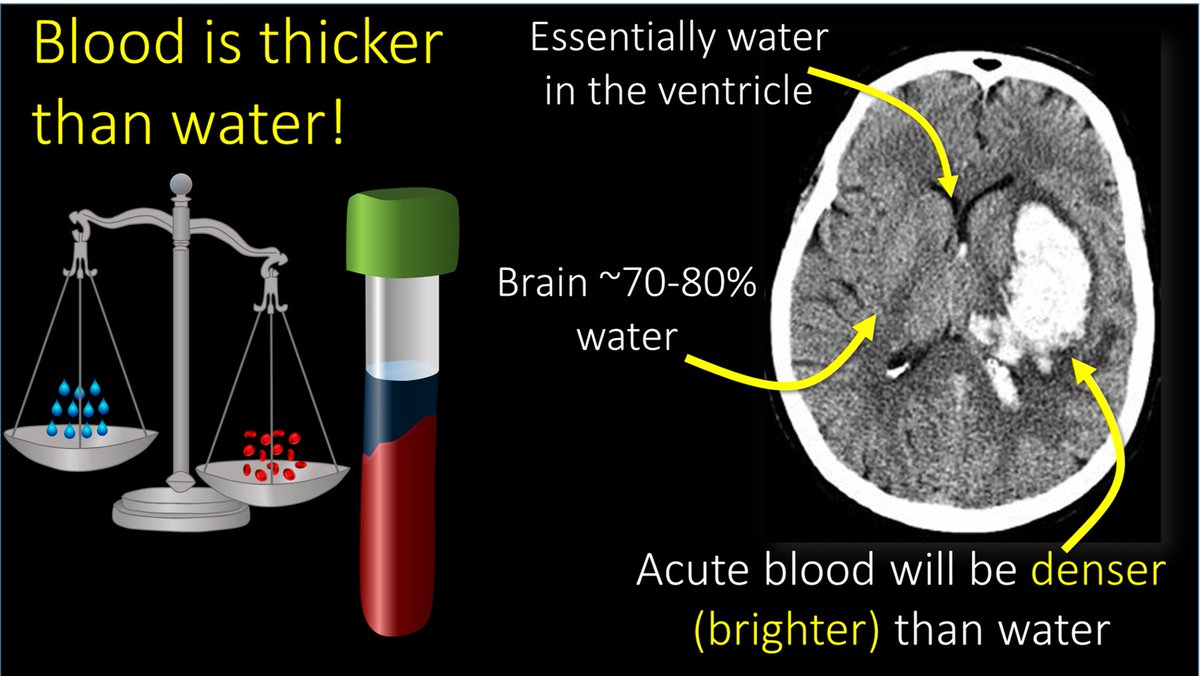
3/The most important thing to look for on a head CT is blood. Blood is Bright on a head CT—both start w/B. Blood is bright bc for all it’s Nobel prizes, all CT is is a density measurement—and blood is denser (thicker) than water and denser things are brighter on CT
4/Once you see blood, the next question is—where is it? To know this, we need to know meningeal layers. Outer most layer is the dura mater. I remember it bc dura mater is DURAble. It is thick like a winter coat. Like a winter coat, it doesn’t hug the curves & hides rolls of fat.

5/Inner most layer is the pia mater. It is thin and hugs the curves of the brain like an adult onsie. I remember it bc pee-ah mater is just a few letters away from pee-jay mater—so it sounds like adult onsie PJs

6/In between these two layers is the arachnoid. It is called that because it contains web like septations like a spider’s web (ARACHnoid like ARACHnophobia). So now you know the meningeal layers. I remember the order bc the meninges “P-A-D” the brain—Pia/Arachnoid/Dura

7/Blood can be anywhere in these layers. EPIdural is beside the dura, or outside all layers. SUBdural is below the dura, but still outside pia & arachnoid. SUBarachnoid is below both dura & arachnoid. I’m skipping intraparenchymal hemorrhage here bc that is relatively obvious.

8/Each of these types of hemorrhage has a unique look on CT. Epidural hemorrhage is called “lentiform” bc it is convex out like a lens or a pregnant belly. Subdural hemorrhage wraps around the brain like a crescent. Subarachnoid hemorrhage is curvy between gyri like a snake

9/So why is intracranial hemorrhage so dangerous? You won’t exsanguinate from intracranial hemorrhage like a retroperitoneal bleed. The reason intracranial hemorrhage is so dangerous is bc the calvarium is a closed space with no give for anything extra.
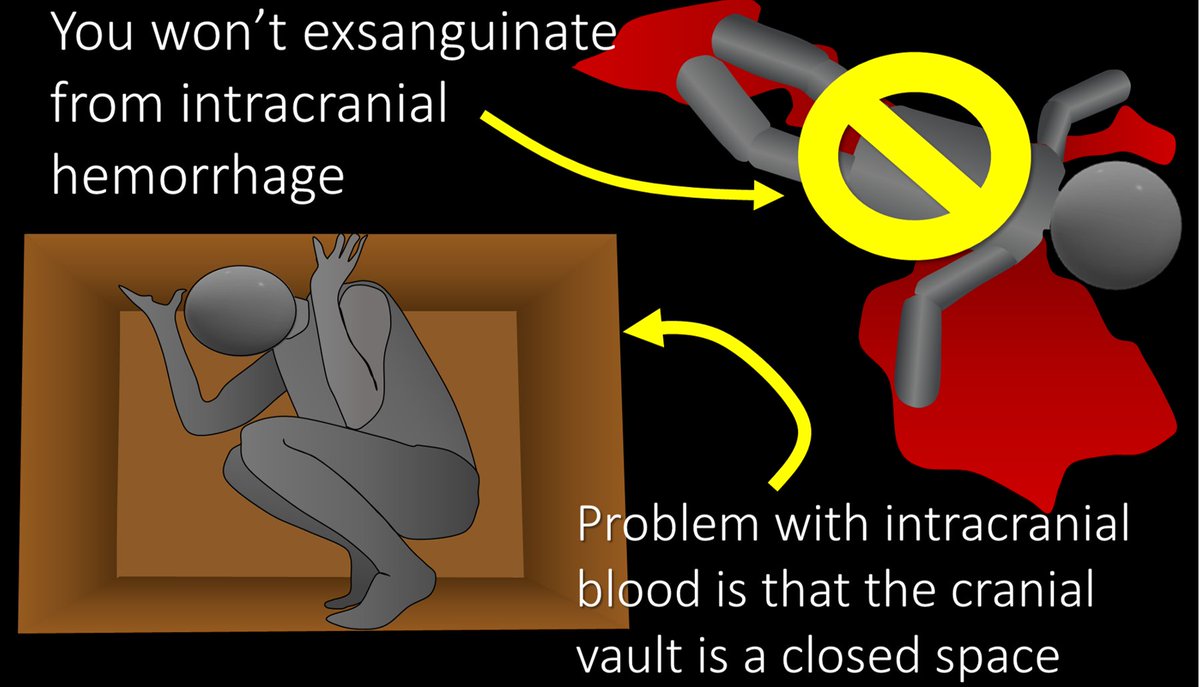
10/So when you add something extra like blood, the calvarium won’t give, and something else has to—and that’s the brain. Blood will push on the brain causing damage from the associated mass effect.

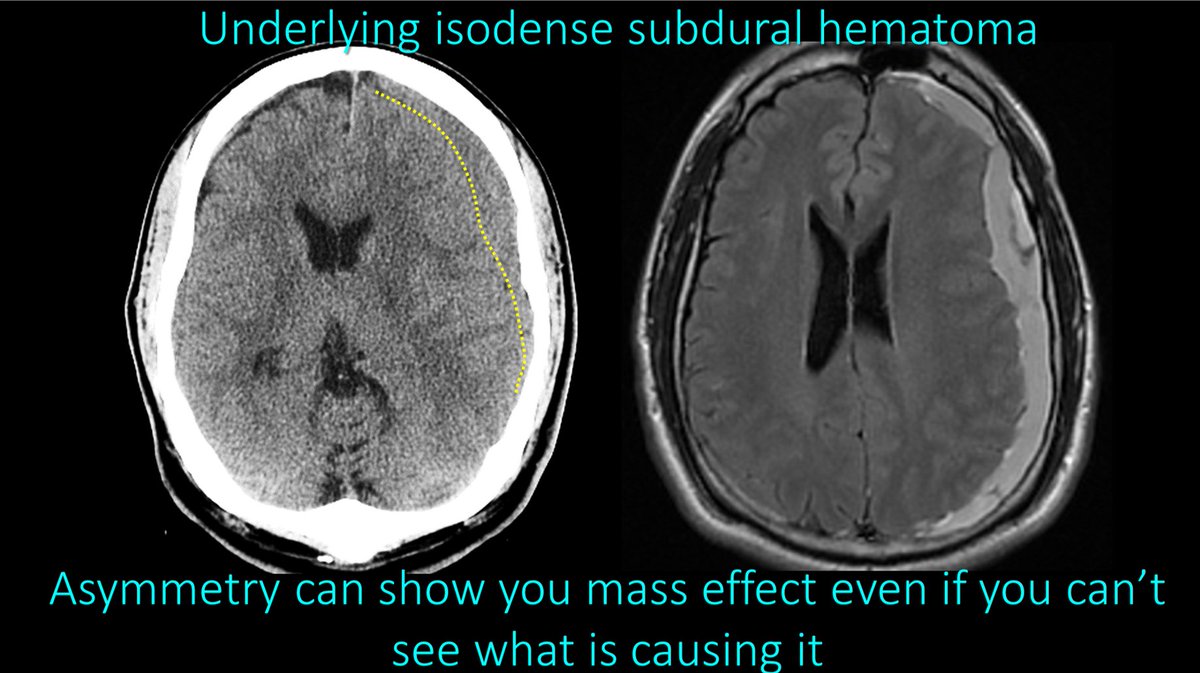
11/Let’s talk about mass effect. Symmetry is beautiful—that’s why Denzel Washington is such the epitome of beauty bc he is perfectly symmetry. The brain on a CT should be symmetric. A CT tech once told me he could make all the findings on CTs bc all he did was look for asymmetry.

12/So on every CT you should look for symmetry—and things that are asymmetric are BAD. If you can’t draw a line down the middle have each side be a mirror image—something is wrong.

13/This asymmetry was from an subdural hemorrhage that was the same density as brain—making it difficult to visualize, but you could tell it was there from the asymmetry it caused. Mass effect causes asymmetry
14/Mass effect can cause brain to herniate into wrong compartments. There are 2 main herniation types. Subfalcine herniation is where one side slides under the falx to the other side. On CT, we call this midline shift—how much one side shifts under the midline to the other side

15/Next is transtentorial herniation—where the supratentorial compartment herniates through the tentorium that separates the cerebral hemispheres from the cerebellum. We see this on CT by effacement of the basilar cisterns—which are CSF spaces at the base of the brain.

16/The two most important cisterns for herniation are the suprasellar cistern—which looks like a pentagon—and the ambient/quadrigeminal cistern that look like the mouth of a semi-evil smiley face with the lateral and third ventricles as the eyes and nose.

17/With transtentorial herniation, we are looking for that pentagon to become a triangle or that smiley to get a Bell’s palsy—with part of it missing. If you see either of those, there is transtentorial herniation.

18/The final thing to look for on a head CT is a stroke. We see this as loss of gray-white differentiation. Normally, the interface between gray and white matter is crisp and looks like long octopus arms of white matter reaching out into the gray matter.

19/With a stroke, this interface gets blurred. It is like some took a painting that had a clear line between the white and gray matter and just smeared the white matter into the gray matter. If I see anywhere where the white matter looks smeared into the gray, I call an infarct

20/So now you know the basics of head CTs! Hopefully now your reads of the bread of neuroimaging will go smoothly like butter!

@teachplaygrub @MedTweetorials Fantastic as always. Can I steal your description of white matter as octopus arms for my Head CT comic?
@StefanTigges @MedTweetorials Absolutely! Glad to share it with such an excellent teacher
@teachplaygrub @MedTweetorials Mam.. that's so great... I am following you since a long time. I have followed some Radiologist who are so efficient in there work, but honestly no one is like you! Even my professor or senior is not like you. You are doing so great! Best of luck... Keep it ! 👍
@DrNishantG11 @MedTweetorials Thank you! I am always so happy to hear that my long time followers are still enjoying my posts! Thank you for believing in me when I just had a few followers--that means a lot
@teachplaygrub @MedTweetorials Wonderful. very useful for #radres and medical students
@gennadanna @MedTweetorials Thank you, as always. You have been such a wonderful support and even though we've never met--you are really like a mentor to me
@teachplaygrub @MedTweetorials Where were you when I was in medskool
@DrPhilG00d @MedTweetorials Ha! Thanks for the great feedback! I don't get to teach med students much anymore, mainly fellows--but I do miss it.
@teachplaygrub @MedTweetorials excellent teaching - great effort to explain CT images of the brain in simple ways to differentiate between different types of intracranial haemmorhage.
@zakioonwala @MedTweetorials Thank you! I used to give this lecture to the medical students when I was at the Pittsburgh and I thought I would share it. Glad you like it! I am working on my intro to MRI one now.
@teachplaygrub @MedTweetorials Thank you 🙏
@mefancym @MedTweetorials Glad you liked it!! It’s from a lecture that I used to teach imaging to medical students.
@teachplaygrub @MedTweetorials Really nice thread and one less talk I have to write
@DAVIDTH76538792 @MedTweetorials Thank you! So glad like it!
@teachplaygrub @MedTweetorials Thank you so much for this! It is truly informative. May I use it to present to paramedic students as part of a brief trauma review session? I will credit and link you as the source if you permit 🙏🏿
@RiaanIsAwes0me @MedTweetorials Absolutely! It’s made for teaching so I love to hear that people are using it!