In 2017 I landed my first brand deal on my YouTube channel. Since then I've made: - $1.2M+ in sponsorship income - 150 sponsored videos Here are 7 must-know concepts for landing brand deals and maximizing your income. An entire business course in a single Twitter thread: 🧵
Here's what you'll learn: - How to get brand deals (even if your channel is small) - How to keep brands coming back (sustainable income) - How to increase your sponsor rate - How brand deals are REALLY priced behind the scenes - How to not get screwed (unlike most creators)
1) It's Not About Views Most YouTubers think "more views = more money". But it's not that simple. Here's why: Brands don't sponsor you because they want views. They want what those views LEAD TO: 💰 Money! 💰
Brands look at you as a marketing channel, and not all marketing channels perform the same. - Video A gets 10M views but only sends 50 sales - Video B gets only 200K views but sends 100 sales - 2x the value! The views don't matter. Want proof? Let's look at the data.
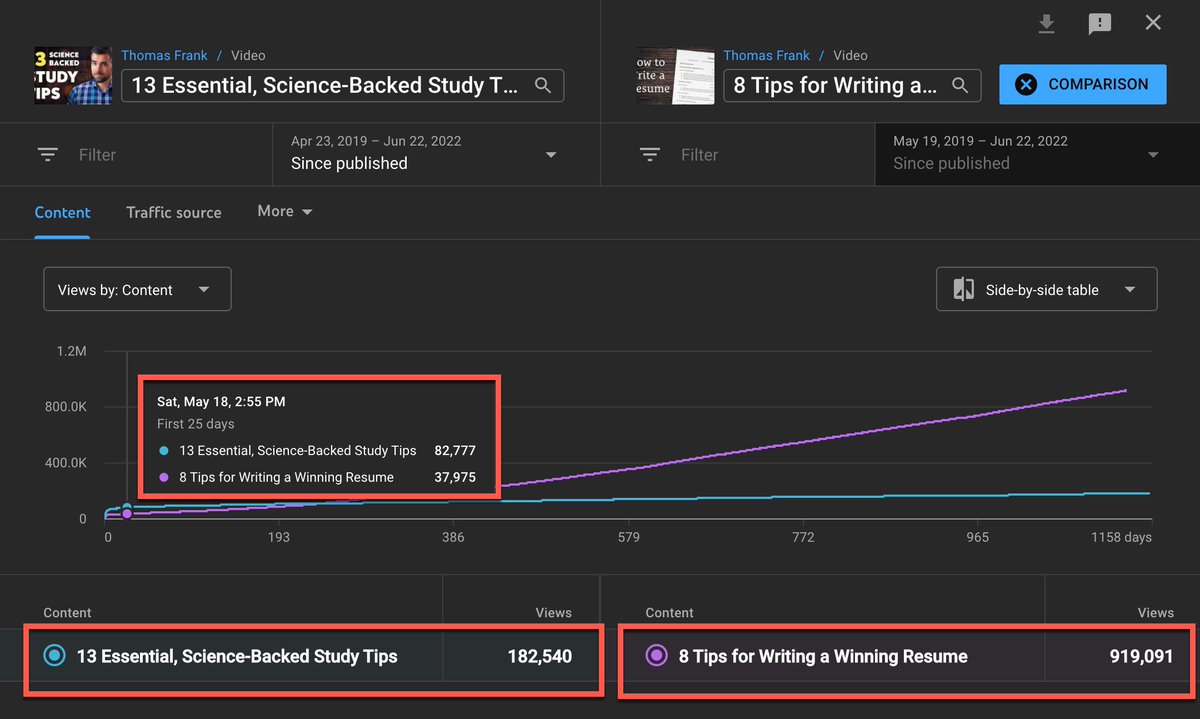
One of my sponsors used to use short-links with publicly-viewable click numbers. So I tracked the CTR (clickthrough rate) for all my videos. Look at these two: 83,000 views ⮕ 622 clicks 38,000 views ⮕ 1,300 clicks P.S. - I got paid $9,000 for each of these videos.

My résumé video had less than half the views... ...but sent more than DOUBLE the clicks to my sponsor. The CTR was over 4x higher! If you read my thread on funnels, you'll know that improvements at every stage of the funnel lead to more $$$ overall: https://x.com/TomFrankly/statu...
Here's another example to drive the point home: This video on my @NotionHQ channel only has 100k views, but has driven over $65,000 in sales. That equates to a $650 CPM - very different to that $0.25-$4 CPM AdSense range they show over on SocialBlade. https://www.youtube.com/watch?...

@NotionHQ This is what most YouTubers fail to understand. From a brand's perspective, the views you get are just the TOP of the funnel. But a brand's revenue comes from the ENTIRE funnel. TL;DR - your audience needs to click and CONVERT to be valuable to a brand.
@NotionHQ P.S. - Your sub count doesn't matter either. Neither does your Twitter following, Instagram following, or any other vanity metric. Algorithms have made these numbers largely irrelevant. https://x.com/dwiskus/status/1...
@NotionHQ But hol' up a minute (to parrot @itsgfreviews): Why exactly did that 38K-view résumé video get so many more sponsor clicks than the 83K-view study tips video?

@NotionHQ @itsgfreviews One factor might be retention. My ads are at the end of the video (as they ~usually~ should be; more on that later). So better retention would mean more people seeing my ad. But these two videos actually have strikingly similar retention, so that's not it.

@NotionHQ @itsgfreviews The true answer is that the résumé video has a much better AUDIENCE FIT for the sponsor. The sponsor on both of these videos is Skillshare. Skillshare markets their catalog of classes primarily to people who want to learn money-making skills and improve their career prospects.
@NotionHQ @itsgfreviews Given that focus, a video on crafting a great résumé is going to do a much better job at bringing in an audience that is primed to convert. Here are both ad reads, which you can study: Study Tips: https://youtu.be/Bxv9lf5HjZM?t... Résumé: https://youtu.be/u75hUSShvnc?t...
@NotionHQ @itsgfreviews P.S. - The long-term performance of these two videos also proves something else: It's not worth freaking out about how your content performs in the short term. I remember feeling a ton of anxiety when the résumé vid initially underperformed. Now it's at nearly 1 million views.
@NotionHQ @itsgfreviews 2) The 3 Most Important Letters in Brand Deals are "CPA" CPA stands for Cost Per Acquisition - a.k.a. how much money it costs to bring in one new customer. This is the ~actual~ stat that brands care about most when they're sponsoring creators.
@NotionHQ @itsgfreviews CPA isn't useful on its own, but it's incredibly valuable when measured against another stat: LTV - Customer Life Time Value LTV answers the question, "How much $$$ do we make over the entire time this customer is with us?"
@NotionHQ @itsgfreviews When a brand knows both of these numbers, they can put them together to get a... ✨ LTV:CAC ✨ I told you, this thread is a business course! LTV:CAC = The ratio of Lifetime Value vs Cost to Acquire a Customer (aka CPA).
@NotionHQ @itsgfreviews Here's an example: In 2018, @Netflix had a LTV:CAC of around 1:1 for their US market... not great. They were spending the same amount ($184) to gain a new customer as they'd ever make off of that customer. https://www.ft.com/content/816...
@NotionHQ @itsgfreviews @netflix Sometimes, this is fine (in the short-term). New companies often have huge piles of VC money to burn (think Uber), so they're happy spending tons of money to acquire new customers. At this stage, their goal is to gain as many users as possible and grow faster than competitors.
@NotionHQ @itsgfreviews @netflix But eventually, every company will be aiming to improve their LTV:CAC. This article recommends aiming for a ratio of 3:1. (E.g. If LTV is $300, spend a max of $100 to gain a customer) https://www.klipfolio.com/reso...
@NotionHQ @itsgfreviews @netflix "Ok Tom I still don't get what this has to do with me, I just make videos about airplanes" 🤷♂️ Here's why all of this is important for you, the creator: When a brand sponsors you, the price they are WILLING to pay is driven by their CPA. (Keyword: "willing" - see lesson 3)
@NotionHQ @itsgfreviews @netflix Every brand has a target CPA they are looking to hit. If a brand's CPA is $20, and you send an average of 500 sales per video, then you should get paid $10,000 per video. $20 * 500 = $10,000.
@NotionHQ @itsgfreviews @netflix I should note that some BIG brands don't always work this way. Sometimes a brand like Coca-Cola really does just want a ton of impressions, perhaps because they're trying to stay-top-of mind. But most of us aren't doing ads for Coke.
@NotionHQ @itsgfreviews @netflix 3) Brands and Agencies Don't Want You to Know Any of This Brands have several advertising options today, including: - Facebook Ads - Google AdSense - Influencer marketing
@NotionHQ @itsgfreviews @netflix FB ads and Google AdSense are controlled by the most data-hungry companies in the world. These companies know EXACTLY what a brand is willing to pay. By contrast, "influencer marketing" is a huge group of unorganized creators - most of whom have never studied business.
@NotionHQ @itsgfreviews @netflix There is a HUGE information imbalance in the world of influencer marketing. Creators generally do not know how much they should be charging. Now what's that old saying? Knowing is half the battle!
@NotionHQ @itsgfreviews @netflix Many brands and agencies try to keep this information hidden from creators. If you don't know a brand's target CPA, one of two things happens: 1. You under-perform, and the brand doesn't come back (or they slash your rate) 2. You over-perform, and they keep coming back...
@NotionHQ @itsgfreviews @netflix ...but they keep paying you less than you should be earning. Worse, many brands work through agencies, which connect the brand to the creator and handle the deal. All agencies take a cut of the sale, but some don't disclose how much they're taking. https://x.com/TomFrankly/statu...
@NotionHQ @itsgfreviews @netflix As a result, there are many creators who: - Are getting paid less than they deserve because brands aren't sharing data - Are letting their agency take a huge % of their money I know a creator who recently found out their agency had been taking 50% of their earnings for YEARS.
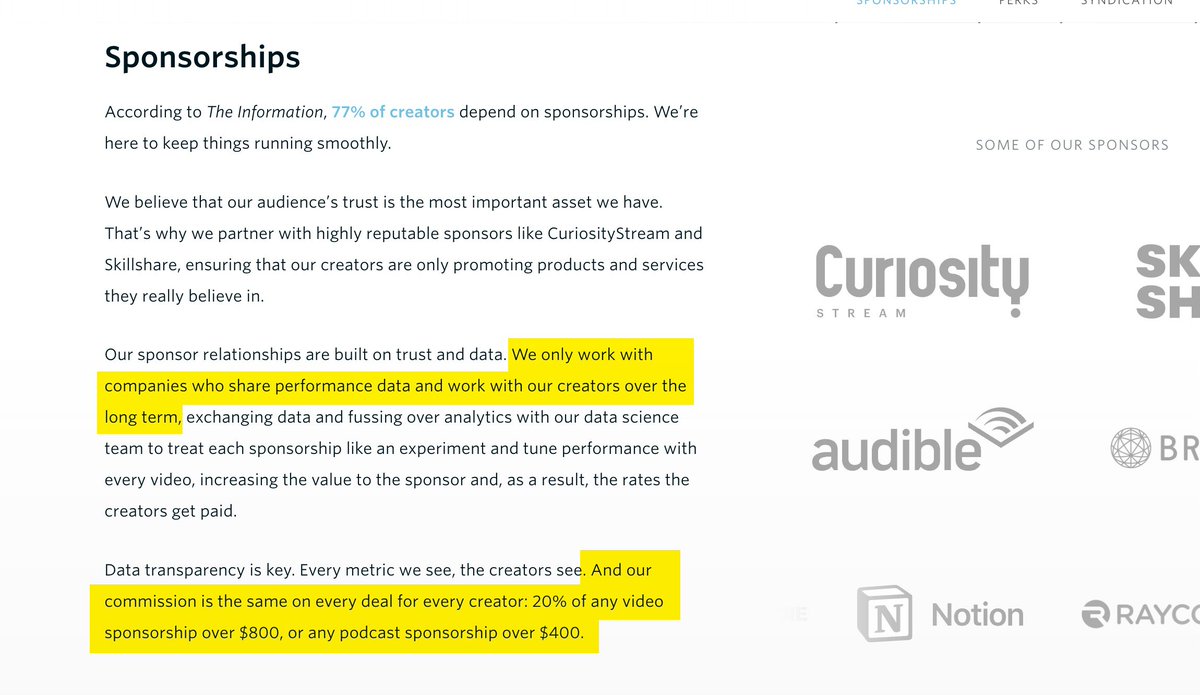
@NotionHQ @itsgfreviews @netflix Here is what you need to know. 1. It's possible to get data. I know this because my agent @dwiskus has spent years fighting brands tooth-and-nail to get conversion data, which is now shared with creators repped by @standardshows. 2. The industry-standard agency cut is 20%.
@NotionHQ @itsgfreviews @netflix @dwiskus @standardshows These facts are spelled out on Standard's website (https://standard.tv/). So when an agency approaches you: 1. Ask what their cut is. If it's over 20%, they're overcharging you. 2. Ask if they obtain and share sponsor data.