Leaving aside Haiti’s neocolonial status, there is part of Haiti that is currently a US colony outright: Navassa Island. A short thread:
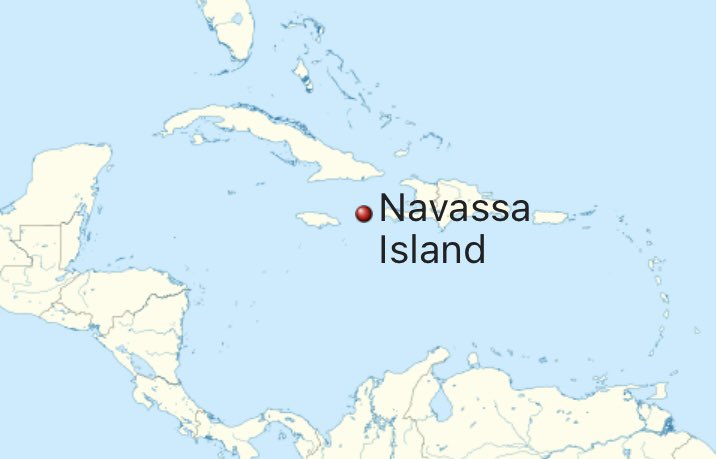

Prior to 1914, when the Haber-Bosch process for synthesizing ammonia became commercially viable, soil exhaustion was an existential problem for the growing US settler colony, and obtaining nitrogen fertilizer to use in agriculture was a great concern for US imperialists.
Many various sources of nitrogen for use as fertilizer were tried, from putrefied animal remains to “poudrette,” a euphemism for human feces. But the most attractive and commercially feasible were the vast accumulations of guano (bird feces) found on uninhabited tropical islands.
In the 1840s, ships carrying guano from Peru arrived and kicked off a craze to locate cheaper sources. The Guano Islands Act of 1856 established that any uninhabited island discovered by a US citizen with guano on it would “be considered as appertaining to the United States.”

Claimed by the US the following year, Navassa Island quickly became the most reliable source of fertilizer for the US, for its guano and its reefs containing tricalcium phosphate. Daniel Immerwahr’s How to Hide an Empire tells the story of its pivotal significance in US history:


Now administered by the US as a wildlife refuge off-limits to the public, Navassa Island is claimed by Haiti, which maintains its claim predates the 1857 US claim as the island was meant to be understood as one of the “other adjacent islands” claimed in Haiti’s 1801 constitution.
I tried to add alt text for the book excerpts but it wouldn’t fit. My apologies. I do highly recommend reading How to Hide an Empire by Daniel Immerwahr, which is also available as an audiobook on Audible. A good history of some aspects of US imperialism.
@babadookspinoza An article about the theft of Haiti's Navassa Island by United States. #NavassaIsland 🇭🇹 https://www.haitianaute.com/20...
@babadookspinoza How to Hide an Empire is such a great read!
@babadookspinoza A good infuriating reading. Very useful to understand this world.
@babadookspinoza Do you have sources so I can read more about it?
@babadookspinoza It’s nice knowing more people read How to Hide an Empire by Daniel Immerwahr too. It’s a great book that shows how far the US’s imperialist actions took it even before the First World War. It also showed how racist and imperialist Presidents like Theodore Roosevelt were.