
Tunic’s been out for a while now, sooooo… Let’s talk about audio secrets!
Spoiler alert, of course. If you haven’t played yet, you might want to turn back now. D: Seriously. Very, very heavy spoilers.
One main goal of Tunic’s overall design was to make it feel like this world isn’t *for* you. You can’t read the language. There is no clear path. You are not the hero. You are small and lost in a land full of mysteries - many of which are hidden in plain sight.

Take Tunic’s glyph language for instance (since dubbed “Trunic” by our players). While we don’t *super* expect players to decipher it, the words ARE there if you choose to take the time.

The "garden path" shortcuts, the secret controller inputs, the functionality of various items and props in the world - it's all there from the beginning. The player just might not yet possess the knowledge required.

Tunic’s audio design was aimed in that same direction. Early in development, we imagined the game having a “voice” of sorts - a voice that the player was not equipped to interpret. SO. I designed a musical cipher - heard throughout the entire game, but never acknowledged.

More on that soon, but first we need to talk about the glyph language, “Trunic”. If you DID take the time to solve it, you would have discovered that its structure is phonetic. Here’s a lil rundown if you weren’t aware…
- Each character represents a consonant/vowel phoneme pair (or just one part by itself).

- The “interior” defines the consonant.

- The “exterior” defines the vowel.

- Pronunciation order is always [Consonant → Vowel], unless you see a little ° under the main glyph, in which case you swap the order, like so:

(The horizontal line is just some flavour to indicate word separations and to make it look nice.)

Learning this language might eventually lead the player to uncover the mysteries of the late-game “Glyph Tower”...

…which, upon solving, leads the player to . (Have a listen!) This is where we finally reveal the existence of the audio language! …sort of.
Downloading and viewing the website’s audio in spectrogram mode shows a series of glyphs.

Importantly, the audio track also features a series of musical arpeggios that occupy the same time-space as the glyphs, and correspond 1:1 in meaning. This is our musical cipher’s Rosetta Stone.
Dubbed “Tuneic” by players, this cipher is the same as "Trunic" in structure. For Trunic, a given phoneme is indicated by the presence or absence of lines within a glyph frame. For Tuneic, it’s the presence or absence of notes over two octaves of a pentatonic arpeggio.

For Trunic, we look at the internal and external components for consonant and vowel. For Tuneic, we look at the lower and upper ranges of notes.

I recognize we’re getting into music theory territory here. We’re definitely gonna get a little technical, so I apologise to those who aren’t as musically versed…but here’s the BRIEFEST tutorial for those who might be a little out of the loop:
A musical *chord* is a selection of musical notes played simultaneously. For an *arpeggio*, the notes that compose a chord are instead broken out and played separately - typically in a rising or descending order of pitch.
I designed Tuneic with numbered notation in mind. That is, considering scale degrees as numbers rather than absolute pitches or note letters. So for a C Major scale, rather than… - C D E F G A B C …we think of it as… - 1 2 3 4 5 6 7 8

As mentioned earlier, “Tuneic” is expressed via selected notes of a pentatonic arpeggio. That said, the pentatonic scale in numbered notation would be as follows:

The consonant is defined by the lower octave, and the vowel is defined by the notes up top.
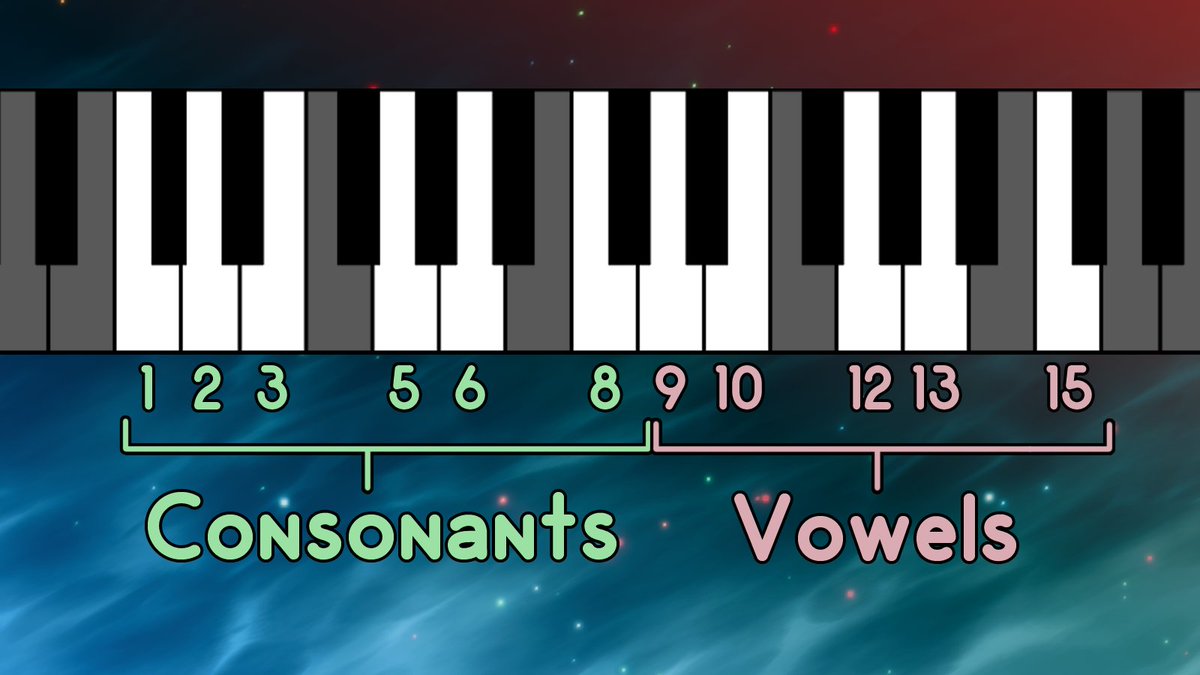
One phoneme in “Tuneic” is one arpeggio. One arpeggio can be (a) a consonant sound, (b) a vowel sound, or commonly (c) a combination of the two, as a phonetic pair. For example, “no” would be [1-2-6] for the “n”, plus [9-12-13] for the “o”. [1-2-6-9-12-13].
By default, phonetic pairs are always ordered [Consonant → Vowel], as an ASCENDING arpeggio like the one above. But, to match the function of the ° in “Trunic”, it’s also possible to express a phonetic pair as [Vowel → Consonant]. Simply use a DESCENDING arpeggio instead.
A pentatonic scale can be built starting from ANY root note, and therefore Tuneic can be written in any key centre. We can even follow along with chord changes. As long as all notes in a given arpeggio move together, it remains decipherable.
Every consonant includes a [1] as part of its encoding. This is because all note numbers are derived by their relative position compared to that [1]. If there’s no [1], it becomes difficult to tell what we’re looking at. (For solo vowels, we still use a [1] as a placeholder.)

Sometimes we’d have a descending arpeggio lead directly into an ascending arpeggio. In this case, we might employ a single [1], serving as a kind of apostrophe connecting the two phonemes.

Furthermore (music theory incoming), since we’re working in terms of numbered notation, the cipher’s design accommodates for all kinds of expressions of tonality.
Major, minor, diminished, mixolydian, whatever - a flat [5] is still a [5] so it’s all fair game. :)

Anyway! “Tuneic” shows up all over the game. It’s in UI sounds, like when you start a new game: