
Noise vs Signal 101 on YouTube. "CTR & AVD are not perfect, but ignoring them is stupid." "The truth is somewhere in between" Right? 🤦 (I swear the fact that I have to make this thread is extremely concerning) Mega thread 👇
Okay, bear with me as I try to calm down while I write this, I apologize in advance if I talk like an arrogant piece of shit. Incompetence and ignorance becoming mainstream drive me crazy. *Deep breath* 😑😤😮💨 😑😤😮💨 Hope it will hold. Sorry if I fail.😂
By the end of this thread, you will clearly understand why these assertions are nothing but incompetence (or ignorance) in disguise: • CTR & AVD are not perfect but ignoring them is stupid • WhY iS yOuTuBe PuShInG tHeM iF tHeY aReN'T vIeWs iNdIcAtOrS? (sorry couldn't help)
Let's start with the VERY BASICS: 👉 What cannot be measured, cannot be improved. You improve by: 1. Removing noise 2. Identifying signal 3. Apply what the signal tells you 4. Improve your understanding of it through trial & error
👉 Accuracy VS Precision You expect a metric to be both: accurate AND precise. Why? Because a metric is used to MEASURE something QUANTITATIVELY. If it's not precise AND accurate, it's not a metric.
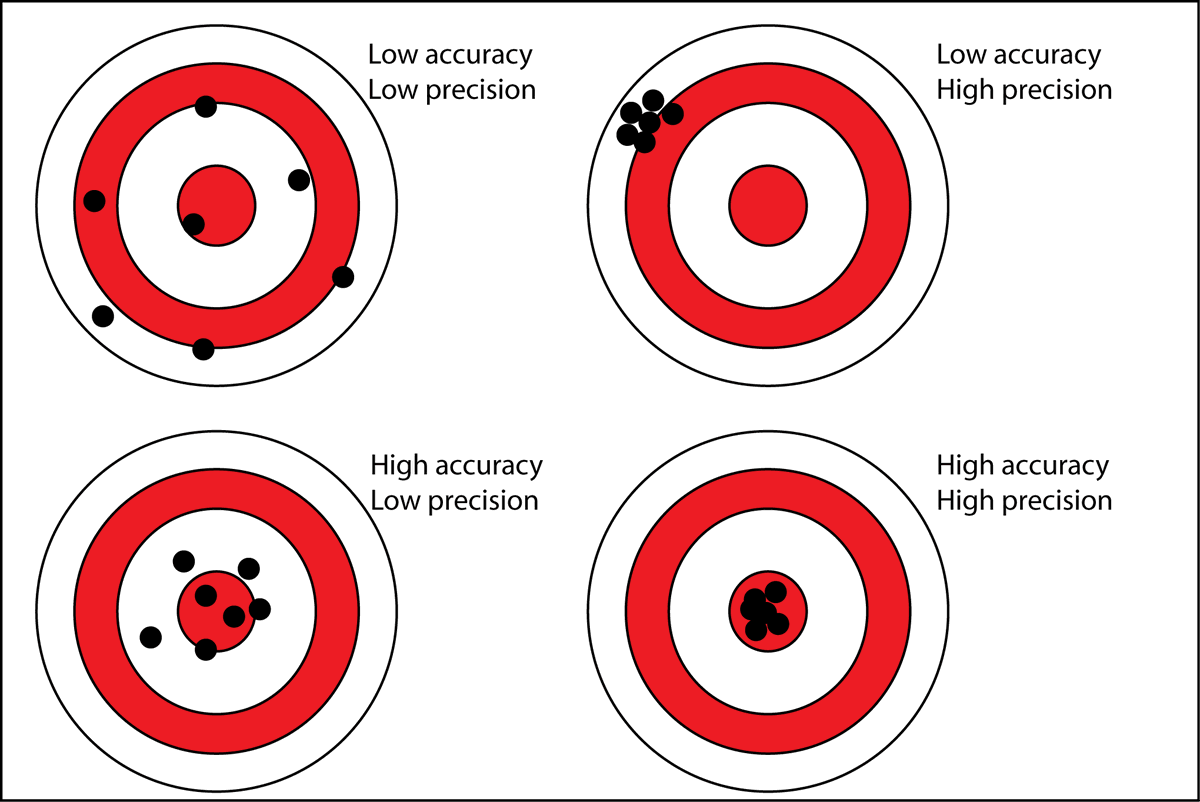
CTR & AVD are METRICS. Do you know what this means? They MEASURE something quantitatively in a precise AND accurate way. But what exactly? We'll see in a moment, bear with me.
Last element 👉 Context. A metric only makes sense in context, otherwise it's just useless information. For instance, if I say: 28° It doesn't make any sense without context.
Let's recap: 👉 You can only improve what you can measure 👉 You measure something with an accurate (and precise if possible) metric 👉 You apply it in a specific context This leads to the following: → I want {x} goal, → in {y} context, → using {z} metric. A bit fuzzy?
Here are 2 easy examples: 1️⃣ → I don't want to be cold (goal); → Should I wear a coat today (context)? → What's the temperature outside (metric)? 2️⃣ → I don't want to get fined (goal) → This road has a speed limit (context) → I should watch my speed (metric).
All good? It's just common sense stuff so far. When we use a metric, we expect it to be accurate and precise so that we can rely on it in a specific context.
Now let's look at two metrics loved by youtube gurus: CTR & AVD Are they metrics? Absolutely 👍 Are they working fine? Absolutely 👍 BUT what are they measuring EXACTLY? (Remember, metrics measure QUANTITATIVELY something)
They measure (precisely and accurately) this: CTR: Measures how often viewers watched a video after seeing an impression. AVD: Measures the total watch-time of a video divided by the number of video views (including replays) a video gets.
If they also are an indicator of views (in their current state) then why is it not working? I'm sorry let me say it again: *ahem* WHY IS IT NOT WORKING??????????????????????????????????? (proofs at the end of this thread)
Do you want to know how many clicks you had per impression? → Look at CTR Do you want to know how much watch time on average a video accumulated? → Look at AVD That's what they measure quantitatively right now. (In their current state, creator side)
Higher CTR &/or AVD = more views is a FAIRY TALE. (again, in their current state) Do you know why my dear clueless youtube gurus? BECAUSE IT DOESN'T WORK IN REALITY!!!!!!!!!!! I'm sorry was I arrogant again? Excuse my french 🤦
Higher CTR = more clicks per impression? Yes ✅ Higher AVD = more watch time per view? Yes ✅ Higher AVD = More views? No ❌ Higher CTR = More views? No ❌ (in their current state)
At this point, this is where youtube gurus say: "But are you stupid? That's not what we said, we said they were important metrics to watch. They are only important in context." And this is where their level of incompetence goes exponentially up.
Not understanding what a metric is? That's fine, it's a noob mistake. You were fooled by the youtube analytics UI highlighting CTR/AVD (a mistake imo), you have no experience (or didn't learn from it), fair enough no big deal. Everyone makes mistakes, admit it and move on.
However, saying: "They are IMPORTANT metrics to watch to get views" AND "they are only important in context" in the same sentence, that's a VERY dangerous kind of incompetence. As dangerous for creators as a 2 y/o holding a loaded gun.
Why? Because youtube DOES NOT provide the context. 😂 There is a word for people who claim to have the ability to read beyond the observable reality: "oracle". (There is a real life analogy a few tweets below so you can understand what I mean)
Now the rhetorical loaded gun: "The truth lies in between" is a strong (often wrong) popular belief milked by demagogues. Many people use that as a virtue-signaling posture to show they are wise and speak in a measured way (when in fact they are simply clueless).
It is a powerful rhetorical tool (used a lot by politics), because unless you know how to counter it, it is an argumentative trap. No matter where the truth really is, the person using it can't lose. It's a great way to keep the high ground without taking risks.
This is very easy to counter though, especially when we are talking about non-abstract things (concrete and measurable stuff). Take for instance 1+1 = 2 The truth is not in the middle, the result isn't 1,5.
"Ofc youtube provides context, you have other metrics!" I'm not talking about that context. (Because if we talk about that context, views are 100x better for signal) I'm talking about context BEHIND these metrics (CTR/AVD).
Specifically: 1️⃣ How much do they weigh in the balance for the algorithm and in which conditions EXACTLY 2️⃣ We have the GLOBAL average but what is behind this average exactly? (there's no information right now) Without at least one of these, we can't rely on them.
Hard to follow? Check this very easy-to-understand analogy, illustrating why context behind average is crucial, with a metric everyone understands 👇 → Temperature. 🌡️

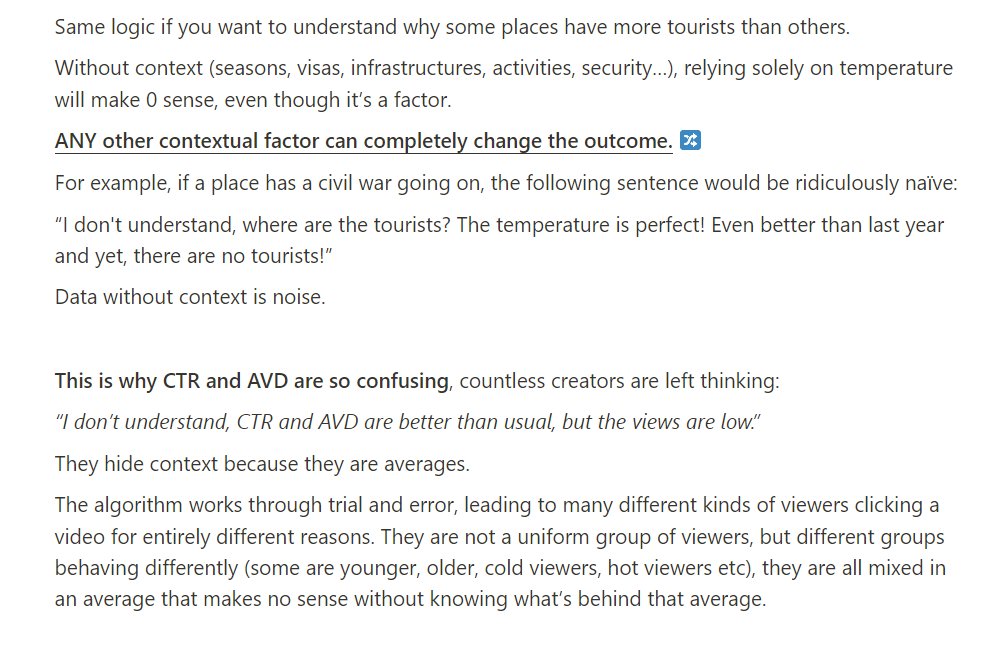
So explain to me: HOW can anyone understand an average without knowing what's behind it? It's impossible at scale. It's like trying to understand a puzzle of 1000 pieces with only 2.
Averages are good if you look for a general tendency or have a rough idea of something. But when you look for precise information, like: → "Why this video performed badly?" it is terrible because it hides what you need to know (signal) behind an average (noise).
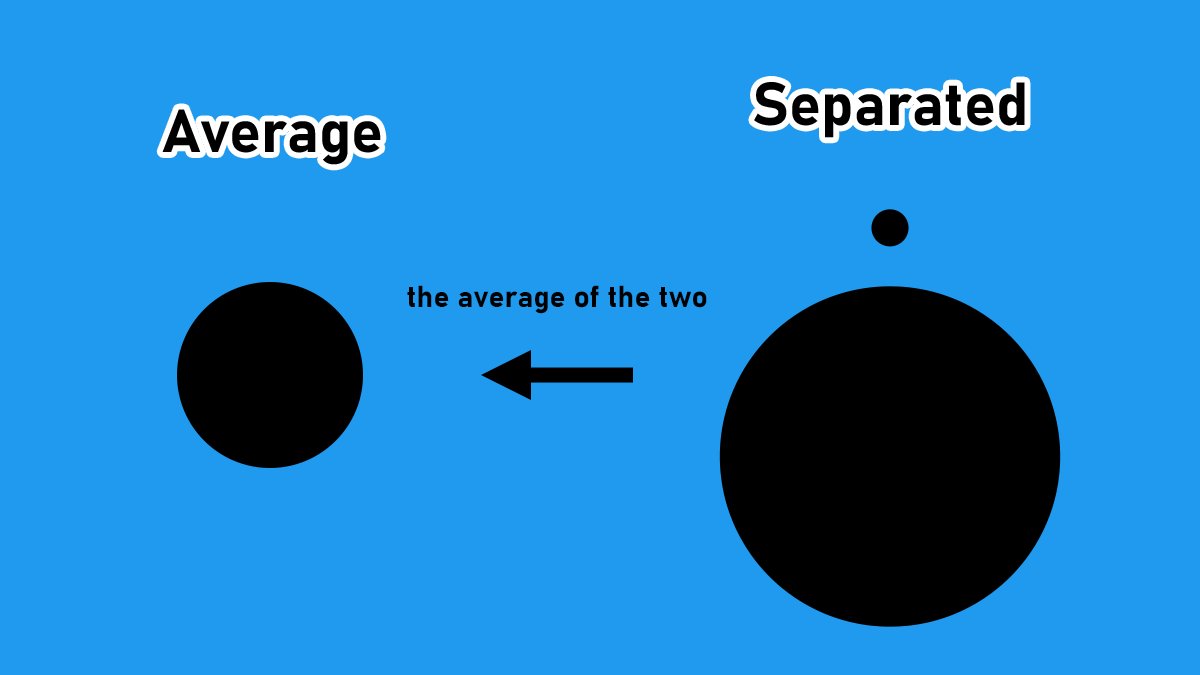
In that case, you want to know exactly what factor caused that. You want to be able to look at CTR and tell: 👉 the problem is my thumbnail or title or 👉 the problem is something else You look for signal, not a rough idea. Here is another example:
Say we want to compare 2 channels: First one: • 10 videos at 1M views Second one: • 9 videos at 1k views • 1 video at 9 991 000 views Both have 1M average views. Are they the same? If you only look at the global average, yes. If you look behind it, no.
Now if you tell me that: CTR is supposed to measure how well your thumbnail and title catch attention. AVD is supposed to measure whether viewers enjoyed/found your video entertaining/interesting or not. Right now they both fail at it, too much context is missing.