
1/ Excited to announce HLP to closed alpha participants. The primary liquidity provider on Hyperliquid is now community owned! HLP = (G+1)LP is the evolution of GLP applied to a performant order book DEX A thread on how this works, why we built it, and where we go from here 🧵
2/ When building Hyperliquid, a big theme was matching CEXs, whether that's UX, speed, or API trading. Since we strongly believe that a fully onchain order book is the only scalable solution without cutting corners on decentralization, we had to push the tech hard to get there.
3/ Matching CEXs in user experience is only table stakes though. To onboard CEX users, we must demonstrate clear advantages to the end user. Most users simply want cool features. We built vaults like HLP to showcase just that: what can be uniquely done on a DEX?
4/ We looked to GMX for inspiration. How did a platform with just a few tokens and opaque execution have such a meteoric rise? The answer was GLP: democratizing the liquidity provision on GMX to the end users, sharing upside that is usually reserved for exchanges and MMs.
5/ This is easy to do with a pool based liquidity solution like GMX, because it is simply a collection of passive assets in a smart contract. On Hyperliquid, the vault primitive allows active strategies to enjoy the same transparent and trustless capital allocation from users.
6/ HLP is a special vault that is entirely community owned. Value accrues directly to depositors with zero intermediaries, fees, etc. The strategy is a CEX MM strategy adapted to Hyperliquid to provide 24/7 liquidity immediately to all listings.
7/ How's it going so far? HLP is a MM strategy honed on adversarial CEX order books. Its per trade expectancy is tuned to be positive on short markouts. For example, 15/15 days have had positive 5 minute markout pnl so far. Cumulative (real) pnl graph so far.
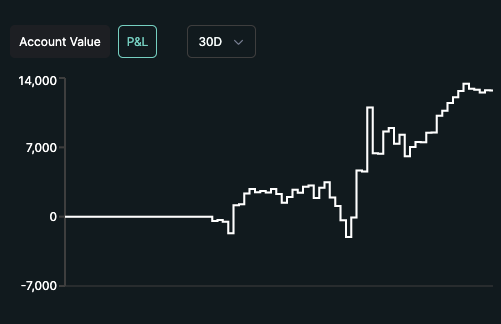
8/ However, right now HLP must hold significant inventory risk so its sharpe is low despite its positive EV. HLP cannot hedge on other venues because it is designed to be trustless and onchain (restricted to Hyperliquid L1). Note that GLP has the exact same positional risk.
9/ Fortunately, the sharpe of HLP will increase over time as: 1) Volumes increase. Sharpe increases naturally as the square root of volume. 2) Other MMs onboard to Hyperliquid. Cross exchange and funding arb is a juicy opportunity for them to take over large positions of HLP.
10/ Other participants coming in to close the arbs will not only smooth out HLP's pnl curve. Hyperliquid's overall liquidity will improve too, and the competition will benefit end users. This dynamic is not possible on GMX where only the liquidity pool can trade against users.
11/ So far, Hyperliquid has reproduced the CEX experience, recently hitting $3M daily non-MM volume and 1.5k users. For the next stage of growth, HLP is a defi solution to the age old liquidity bootstrapping problem, and crucially accrues all protocol upside to the community.
12/ Where do we go from here? The goal is to create the same flywheel effect that GLP had for GMX. More HLP depositors -> better liquidity -> more traders -> more earnings for HLP -> more HLP depositors -> ... Check it out here (not financial advice): https://app.hyperliquid.xyz/va...
@chameleon_jeff Really cool. Curious on who runs the validators and how are you thinking about manipulation at the tx ordering layer Where’s the best place to learn about the microstructure of the DEX?
@niteshnath Right now validators are run by the core contributors because things are changing rapidly and we prioritize rapid iteration. Once the tech is more stable and there is a native L1 token for proof of stake, the validator set will be decentralized. MEV is a concern for any L1. The
@chameleon_jeff Excited to see this in action. Is the strategy run by the HLP open/trustless? I always thought this was the blocker for a community owned order book LP, as the strategy needed to be revealed, making it easier to engineer attacks on. If not open, why can’t HLP steal funds?
@ecdsafu Good question. HLP can't steal funds because it's built into the vault primitive. Users still own the keys to their funds, it's just now tied to the pnl of the vault when deposited. That's why we like to say vaults are more like "copy trading" than some other vault products. The
@chameleon_jeff This is cool. What are the tradeoffs between this model and GMX’s model? Typically no such thing as a free lunch - what pros/cons exist between this model and GLP
@tundra_v1 Thanks! The key tradeoff between Hyperliquid and GMX is that it's much harder to build a custom L1 with an onchain order book. But the benefit is that the exchange itself is more scalable, robust, efficient, etc. (e.g. compare binance and GMX or any other oracle based
@chameleon_jeff Looks awesome, very similar to Binance. Love that every transaction hash is available. Given that all trades have zero fees and vaults are community owned, I am wondering how the exchange is going to sustain itself?
@krullun Good question. There will ultimately be fees that accrue to a native L1 token. No concrete plans yet. For now the core development team has ample runway. The focus is building a killer product and acquiring users.
@chameleon_jeff Cool! Who are the current makers? Any docs on the model and parameters behind HLP? Given the GLP rebal is v centralized, how does this differ?
@0xDavio Current market maker is Chameleon Trading, the crypto MM firm I built and have been leading for more than 3 years. I write a lot about CEX MM on this twitter account, and have some some podcasts too. That's probably the best way to understand the strategy behind HLP. The key
@chameleon_jeff Wen $HLX?
@DeFiAgriculture Haha that sounds like Helix. No timeline at this time, but there will ultimately be a native L1 token to secure the network