
Why is war unpredictable? [THREAD]
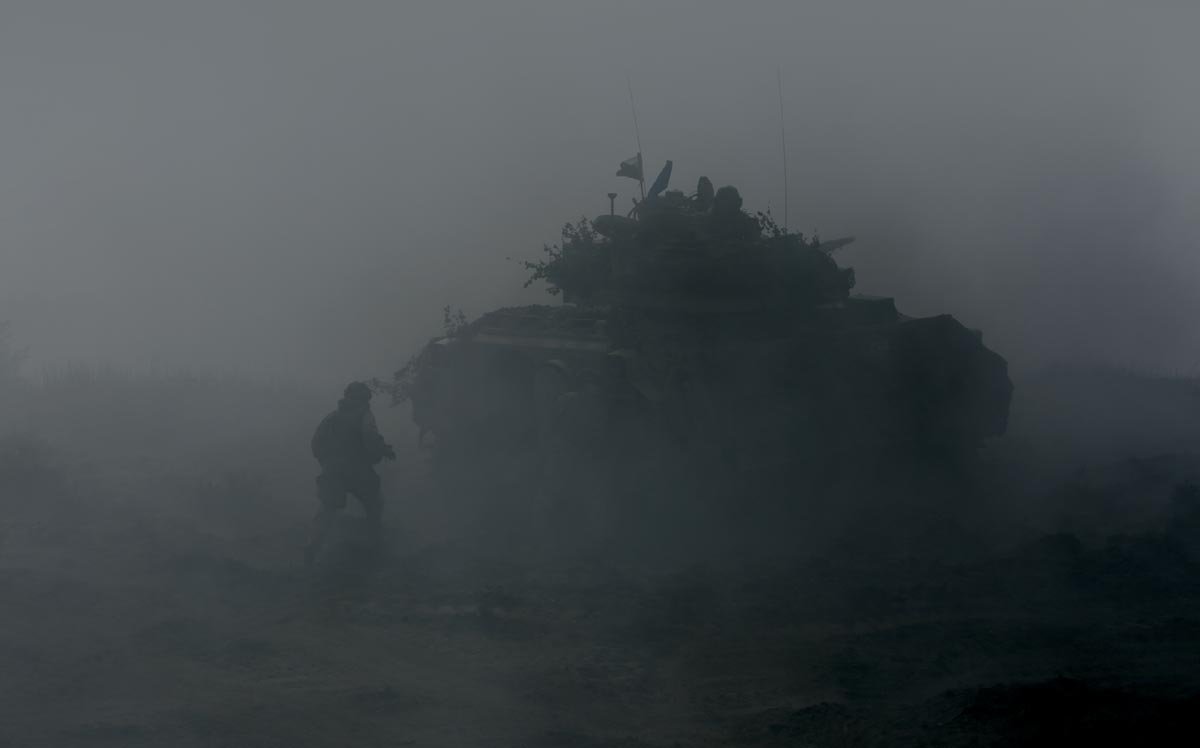
Since Russia's invasion of Ukraine last February, a lot of criticism has been leveled at pre-war assessments of Russian military effectiveness. https://www.theatlantic.com/id...
While those assessments were indeed largely off, the reasons why are complex. https://www.tandfonline.com/do...
As I wrote in my latest @WPReview column, assessments of Russian military capability and effectiveness were off because of war's inherent uncertainty. https://www.worldpoliticsrevie...
In this 🧵, I want to elaborate on what it means for war to be an unpredictable enterprise. War is unpredictable in three core ways.
War onset is uncertain. https://www.cambridge.org/core...
The course of war is uncertain. This is why, as Eisenhower said, "plans are useless, but planning is indispensable"... https://www.amazon.com/Fog-Pea...
War outcomes are uncertain (Reiter's book opens with a quote by Menken, "Love is like war; easy to begin but very hard to stop") https://www.amazon.com/How-War...
Let's focus on the second of these three ways that war is an uncertain enterprise: the nature of war fighting.
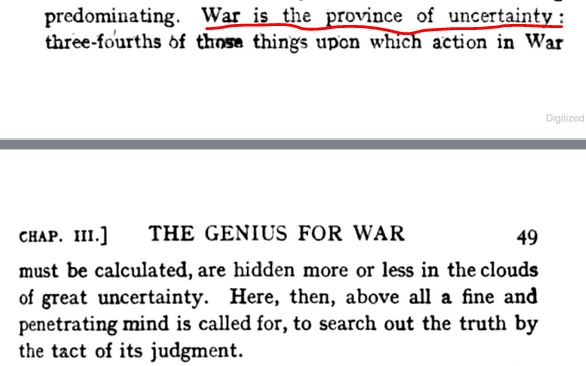
As Clausewitz wrote in "On War"... https://www.amazon.com/War-Ind...
... war "is the province of uncertainty".
Why is actual combat uncertain? There are a host of unknowns heading into any battlefield: - will the weather change? - will the gun break down at the wrong moment? - will it be hard to see? - will the radio/comms stop working? - will it a soldier get confused or tired?
That's just thinking about your side. The other side faces similar issues. This is the "friction" of the "fog and friction" elements of battlefield combat uncertainty https://www.army.mil/article/1...
All of this is further compounded if you are not the only military fighting on your side, i.e. if you are in a coalition. https://www.tandfonline.com/do...
The uncertain nature of actual combat has been explicitly adopted into some of our models of war, such as treating battle outcomes as a "random walk" https://journals.sagepub.com/d...
What this means is that "Adaptability" to the inherent uncertainty of war fighting is absolutely vital to battlefield success. If you can't adapt quickly, you can't succeed. https://warontherocks.com/2020...
This is why the key to "military effectiveness" is not so much WHAT your forces have, but HOW they are deployed. https://www.amazon.com/Creatin...
For instance, having an effective military in battle requires allowing low-level (i.e. unit level or junior officer) initiative. https://www.amazon.com/Militar...
An inability to adapt to changing conditions is a core reason that militaries of dictatorships tend to underperform in war: they are chosen for regime loyalty, not military planning prowess https://www.amazon.com/Dictato...
This is also a key reason to have diverse militaries. It can prevent marginalized groups from becoming unreliability (i.e. suddenly refusing to fight) and can lead to a great range of ideas for adapting. https://www.amazon.com/Divided...
To be clear, having an effective military is not all determinative of war outcomes. As Williamson, Murray, and Watman noted, "Some [but not a complete] relationship exists between military effectiveness and victory" https://www.jstor.org/stable/2...
By the way, their International Security article was a precursor to their outstanding edited volume "Military Effectiveness" https://www.amazon.com/Militar...
In sum, war is an inherently unpredictable activity. This makes pre-war assessments liable to being wrong, sometimes VERY wrong. [END]
@ProfPaulPoast If it was predictable, both sides would not bother with war.
@jgarzik Exactly!
@ProfPaulPoast @threadreaderapp unroll please
@ProfPaulPoast "War is an unpredictable beast. Once unleashed, it runs like a rabid dog, ravening friend or foe alike. It can drag on for years, a slow attrition of nerve and fortitude, or be over in one brilliant flash, an extravagant conflagration of flame and blood and waste." @KateForsyth
@ProfPaulPoast I think you're grossly overcomplicating things. Retired Russian analyst here. When I was in the IC it was impossible to prove that Russian combat effectiveness was terrible because the things that make it terrible are not things that can be proven. How do I prove poor training
@ProfPaulPoast Retired Russian analyst here, who got the Russian invasion right from the start. My take on this topic. @dylan_combellick/intelligence-failures-3216af3a6043?sk=65824b17c528471f66ac4096c9f78f0e class="text-blue-500 hover:underline" target="_blank" rel="noopener noreferrer">https://medium.com/@dylan_comb...
@ProfPaulPoast All wars are bankers wars.
@ProfPaulPoast I show imagery of 10,000 tanks to a four-star, and say "75% of these are beyond repair". The four-star accepts I might be right, but makes plans as though I'm wrong. It's the rational thing to do.
@ProfPaulPoast The only unpredictable thing regarding war is the date of first action. Was the WWI unpredictable? And what about the second one. Russian war on Ukraine was also predictable because of the occupation of Crimea. The point is to see the way paving to war.
@ProfPaulPoast 44zzzy7ytz8zyytrzzzzzz5tzztzyytyztyyzyzyzzyty5tzzyzztzz
@ProfPaulPoast I don’t agree with you. The Russian army in a last 70 years just fought only enemies who are haven’t really have a proper army. The Russian corruption ruined everything in military. When officers only see what they’re can steal, or demand for bribes..
@ProfPaulPoast There's also the incentive Factor. When I was in the IC if I overestimated enemy capabilities I would get lots of attention. If I underestimate enemy capabilities then people will die. Only after retiring am I free from the responsibilities of my assessments.
@ProfPaulPoast @ProfPaulPoast says "yes, I got it completely wrong, but it's not my fault. It is reality that has the problem." I think you have to look far deeper into why your models are giving you disastrously wrong predictions, rather than simply saying "eh, shit happens. As you were."
@ProfPaulPoast Why is war inevitable?