1/N This is a thread on two geometry problems: circling the square & squaring the circle. These problems were first proposed & analyzed by ancient Indian Hindus before 2000 BCE. They also designed multiple methods & provided approximate solutions before 800 BCE
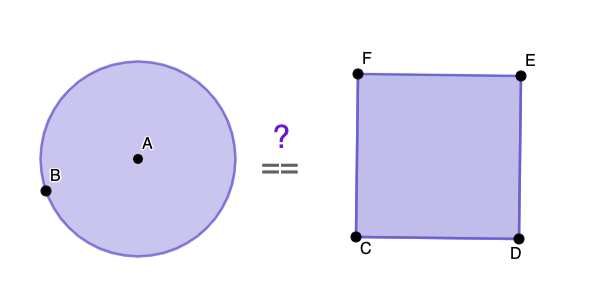
2/N Circling the square is an important problem in geometry which refers to the problem of constructing a circle with the same area as that of a given square.
3/N The inverse problem is known as squaring the circle, which is the problem of constructing a square with the area of a given circle.
4/N Both these problems were studied by the ancient Indian mathematicians since at least 2000 BCE, as we will see in this thread
5/N Before we delve into the actual numerical recipes that ancient Indians invented to solve these problems, we will take a brief detour and try to understand why these problems with specific geometric constraints were important to the followers of Vedic systems in India.
6/N The problems of circling the square and squaring the circle were rooted in how ancient Indians looked into the process of self-realization - specifically the science & art of Yajna (यज्ञ) - fire based rituals.
7/N An important part of the process of performing these Yajnas is described in Shulba Sutras.
8/N Shulba Sutras are part of Kalpa Sutras in Veclic literature, an enormous body of work dealing with means of self-realization. There are four main Shulba Sutras - Baudhayana, Apastamba, Manava, Katyayana, & a number of smaller ones.
9/N Shulba Sutras are used to construct physical altars for Yajna. These altars are called ‘chiti' in Sanskrit (चिति). Chitis are complex 3D structures - construction of which requires advanced knowledge of geometrical skills.
10/N A chiti (चिति) is a basis that symbolizes Chitta (चित्त) or consciousness.
11/N The general format for the main Shulba Sutras are the same - each starts with sections on geometrical and arithmetical constructions and ends with details of how to build “chitis”.
12/N When the Shulba Sutras are viewed as a whole, instead of collection of parts, then a striking level of mathematical efficiency & integrity becomes apparent.
13/N Literal meaning of the word Shulba is rope. In its true essence Shulba represents both connection & evolution from individual consciousness to the universal consciousness.
14/N Agni (अग्नि) or fire has huge importance in Vedic knowledge system. Agni is the seer-will in the universe unerring in all its works. He is a truth conscious soul, a seer, a priest and a worker, the immortal worker in all beings.
15/N All offerings during a Yagna are made to Agni - which is the ultimate transforming agent. There are three specific चिति which are of primary importance in Vedic Knowledge system.
16/N There are three essential चिति or altars in Vedic rituals: namely गार्हपत्य (Garhapatya), आहवनीय (Ahavaniya) and दक्षिणाग्नि (Dakshinagni). The fire kindled in these altars are known as Tretagni & are directly related to the geometry problems mentioned in this thread.
17/N These three altars (Garhapatya, Ahavaniya and Dakshinagni) need to be constructed in such a way so that the bases of all of them have the same area but each base has a different shape (Garhapatya: circular, Ahavaniya: square and Dakshinagni: semi-circular)
18/N The geometric problems of circling the square & squaring the circle can be traced back to this constraint
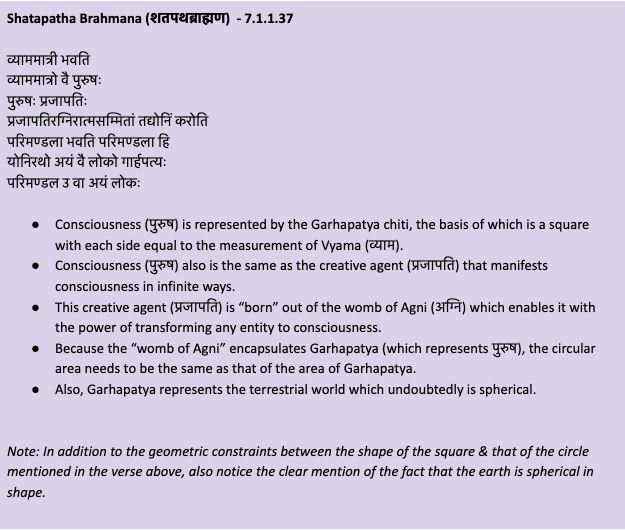
19/N The earliest reference to that constraint in building these altars is found in Shatapatha Brahmana (शतपथब्राह्मण) - 7.1.1.37 (no later than 2000 BCE). The original Sanskrit text of the verse & its contextual translation are provided below.
20/N Now that we know why ancient Indians wanted to solve the problems of circling the square and squaring the circle problems, let’s look into what solutions they came up with.
21/N The first reference to an approximation solution to circling the square problem is found in the Baudhayana Shulba Sutra
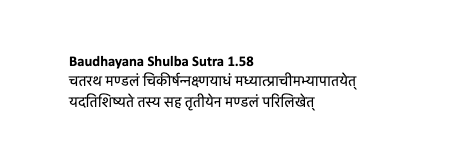
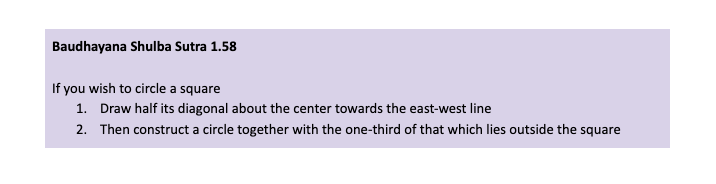
22/N The translation of Baudhayana Shulba Sutra 1.58 for finding an approximate solution to circling the square problem is given below
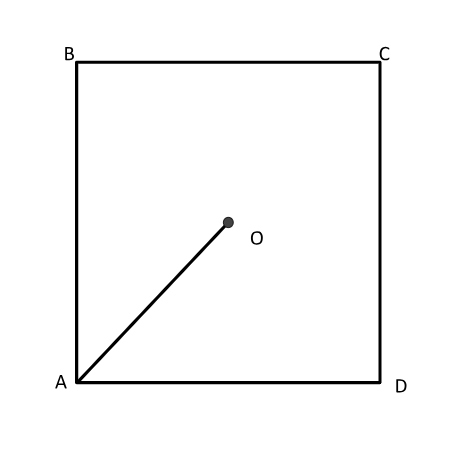
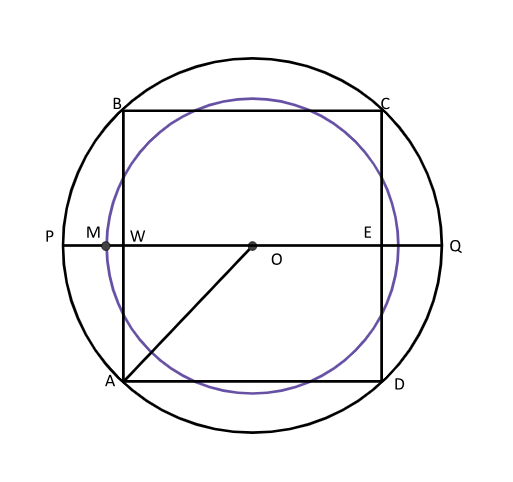
23/N Let’s illustrate Baudhayana’s method of circling the square step by step. Let ABCD be a square for which we want to find out a circle whose area is approximately the same as the area the square.

24/N First we join OA
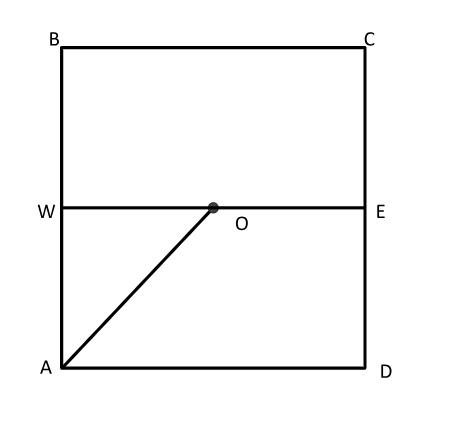
25/N Then we draw an east west line by drawing a line that goes through the point C and is perpendicular to both AB and CD
26/N We then divide the line segment WP so that WM is one third of WP
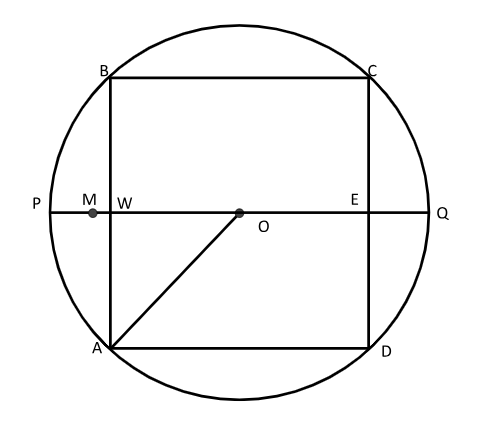
27/N Finally we draw a circle with O as center and OM as radius. This is our desired circle (drawn in purple here)
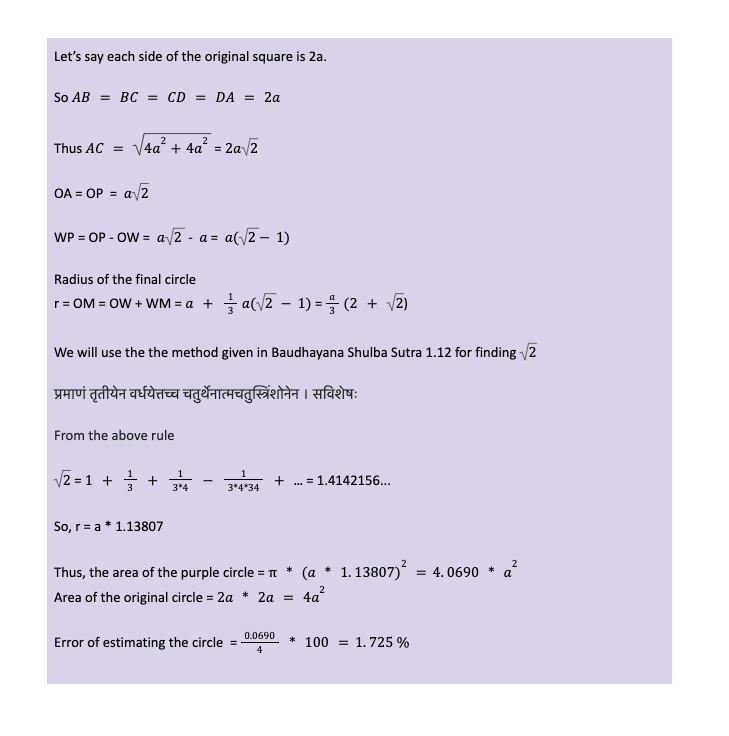
28/N We know that the method specified in the Shulba Sutras for circling a square is meant to find an approximate solution. Let’s find out the how closely the circle estimates the given square
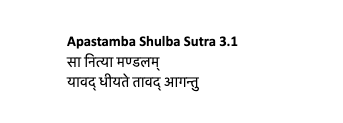
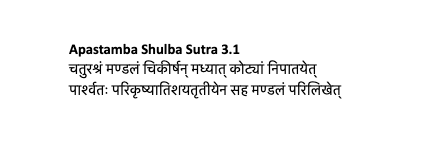
29/N Apastamba Shulba Sutra also gives a very similar recipe for circling the square as provided in the Baudhayana Shula Sutra
30/N It is interesting to note that ancient Indian mathematicians were very aware of the approximate nature of this numerical recipe for circling the square
31/N In Apastamba Shulba Sutra it is specifically mentioned that the method was provided as an approximation and not as an exact solution. Apastamba mentioned “It is an inexact method construction of the circle; by as much as the circle falls short, so much comes in”