
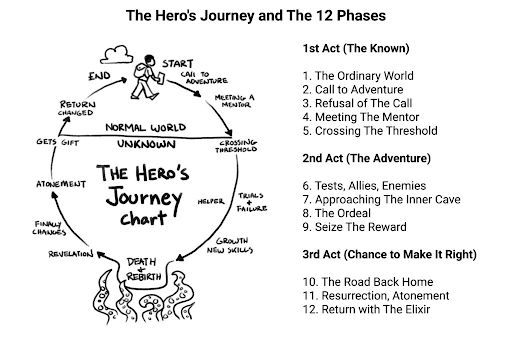
The Hero’s Journey gets painfully oversimplified. It’s not just a simple 12-step process that guarantees a great story. But that’s how it’s often taught. Yet in Hero of a Thousand Faces (and Power of Myth), Joseph Campbell explains the Hero’s Journey from a different, more powerful perspective — one of psychology. • Archetypes • Rites of Passage • Inner vs Outer Conflict Let’s dig into each. Rites of Passage When you look through the steps of The Hero’s Journey, look for points of initiation, transition, and change. The Hero is “Called to an adventure,” “Crosses a threshold,” “Returns with an elixir.” Then think about your life. What Rites of Passage do you go through? Graduations, weddings, births, promotions, 21st birthdays, getting your driver’s license, and many many more. We mark our lives with Rites of Passage. Campbell frames the Hero's Journey as an extended Rite of Passage. The Hero departs from the known world, faces challenges in the unknown, and returns transformed. That’s why we relate so much to stories told in this fashion. From ordinary person to reluctant adventurer to conquering Hero. I was once this, but now I’m this. Over and over. Archetypes Carl Jung, the Swiss psychoanalyst, introduced archetypes as universal, recurring symbols that come from humanity’s shared collective unconscious. Campbell built on Jung’s work by identifying recurring character archetypes, such as: • The Hero: Often an unlikely candidate who rises to the occasion. • The Mentor: A wise figure who guides the hero. • The Shapeshifter: Character whose loyalties or identities are uncertain. • The Shadow: Represents the darker aspects, often the antagonist or the hero's inner conflict. • The Trickster: A mischievous figure that challenges the status quo. There are 1000s of potential character Archetypes you can build on. Inner vs Outer Conflict The Hero isn’t fighting evil the whole time. They’re also dealing with inner demons. The Hero ‘Refuses the call’ – They have a moment of doubt. They don’t believe in themselves. They’re not brave enough. ‘The Ordeal’ involves the Hero facing and overcoming their greatest fear. ‘The Resurrection’ isn’t of the Hero’s physical body but of their mind. When you overcome a fear, how do you feel? Pretty great. So when you see a character do the same, you can’t help but cheer. Outer conflict drives the plot forward, but inner conflicts gives your story and characters depth. Your characters become relatable, human, and multi-dimensional. Their eventual triumph is a testament not to their incredible abilities but to the indomitable human spirit that resonates within each of us. And that’s what makes The Hero’s Journey so powerful. Not blindly following some steps.
I write about storytelling every Saturday morning. If you want to become a better storyteller, I'm sending new readers my 15 favorite storytelling tips I've come across. You can grab that here (and join 80,000+ storytellers): http://www.worldbuilders.ai