
Protein 101 and how much you need for your goals - an educational thread
This post will cover: - What is protein? - The benefits of protein - How much you need for your goals - The best protein sources + Common myths about protein and how to optimize your protein consumption
What is protein? -Protein is the main building block of your cells -It is used in the body to create: • Muscles & tendons • Organs & skin • Enzymes • Hormones • Neurotransmitters • And other important molecules :) Source: https://medlineplus.gov/geneti...
-Proteins are made up of smaller molecules called amino acids -Our body produces some on its own, however we have to obtain “essential amino acids” through the protein in our diet! -“Complete” protein sources have all 9 essential amino acids Source: https://www.ncbi.nlm.nih.gov/p...
-Some examples of complete proteins are: • Quinoa • Hemp • Soy • All animal proteins (eggs, dairy, meat, fish) -Incorporating complete proteins in your diet is one way to optimize the health benefits from a high protein diet!
The benefits of protein: -Increased protein consumption has almost no downsides no matter what your goals are! -Eating more protein can: 1. Aid in weight loss by speeding up your metabolism and increasing satiety (fullness) Source: https://www.healthline.com/nut...
2. Increase muscle growth and strength • A 2018 meta-analysis concluded that a diet high in protein significantly increased muscle strength and size with a strength program • Protein will also prevent “skinny fat” Source: https://www.ncbi.nlm.nih.gov/p... https://www.ncbi.nlm.nih.gov/p...
3. Anti-aging effects • A high protein diet is associated with a lower risk of sarcopenia (muscle + strength loss due to aging) and improved bone health! Source: https://pubmed.ncbi.nlm.nih.go...
But these are just 3 of the hundreds of positive impacts a high protein diet can have on your health. So, how much do you need for your goals?
How much protein you need: -For overall health: • The RDA advises a minimum of .36 grams per pound (.8g per kg) of bodyweight to avoid nutritional deficiencies and adverse health problems -However, this is not sufficient for fat loss, muscle gain, or muscle preservation! ⬇️
-For muscle gain in a caloric surplus (bulking): • .7-1g of protein per lb (1.6-2.2g per kg) of bodyweight is sufficient • Protein intake beyond .7g per lb (1.6g per kg) did NOT further increase muscle gain! Source: https://pubmed.ncbi.nlm.nih.go...
-For preventing muscle loss in a calorie deficit (cut/losing fat): • .8-1.2g of protein per lb (1.8-2.7g per kg) of bodyweight is recommended • If you are leaner + training hard, it is advised to consume the upper range of the recommended protein intake
• If you have a normal/high body fat %, it is perfectly fine to consume the lower end of recommended protein intake Source: https://pubmed.ncbi.nlm.nih.go...
-For those who are doing body recomposition (fat loss + muscle gain at the same time): • .7-1g per lb (1.6-2.2g per kg) of bodyweight is recommended • However, there can be advantages to consuming the upper range of these recommendations! • More info on body recomp here ⬇️
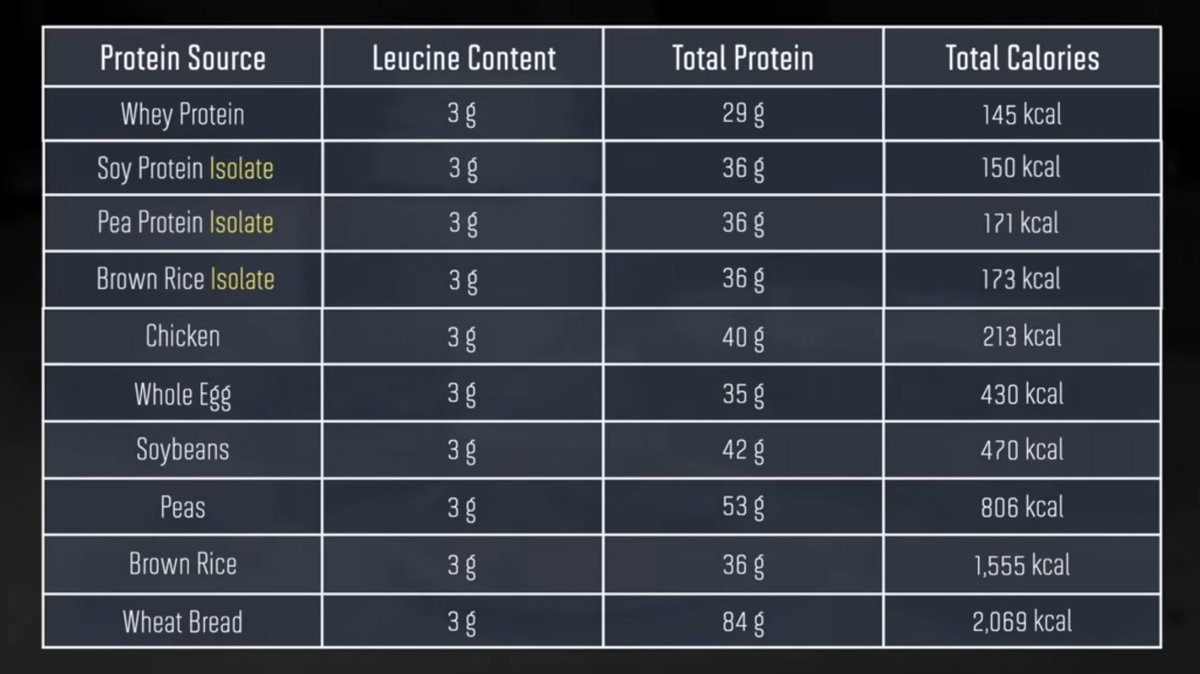
The best protein sources: -There are plenty of high protein foods out there, but I will specifically talk about protein sources high in the amino acid “leucine” -Leucine stimulates mTOR, which triggers muscle growth
-This is a phenomenal graph from Jeff Nippard summarizing the amount of leucine across different plant & animal-based protein sources
Would you like a more in-depth thread on all of the best high protein foods in each category? ex. plant based, animal based, powders, protein bars, whole foods, etc
Common myths about protein & how to optimize protein consumption: -Myth: Your body can only absorb a fixed amount of protein per sitting -Truth: Your body will absorb all of the protein you feed it, however spreading out your protein intake over 3-5 meals can improve digestion
-Myth: You have to eat protein within 30 minutes of exercise to optimize your “anabolic window” to not make training useless -Truth: Eating your pre-workout & post-workout meals within 4-6 hours of each other can maximize your anabolic response to training
-Myth: A high-protein diet alone will increase muscle mass -Truth: Progressive overload resistance training coupled with a high-protein diet will significantly increase muscle mass • Learn more about progressive overload:
Summary: -A high protein diet is great for overall health, weight loss, muscle gain, and strength -Depending on your goals, your protein needs will be unique -Prioritizing “complete” proteins and protein high in leucine can increase the benefits of a protein-rich diet
I hope you liked this post and leave feeling more informed about protein intake! Like, repost, + follow me for more threads on fitness, nutrition, and self-improvement 💪✨