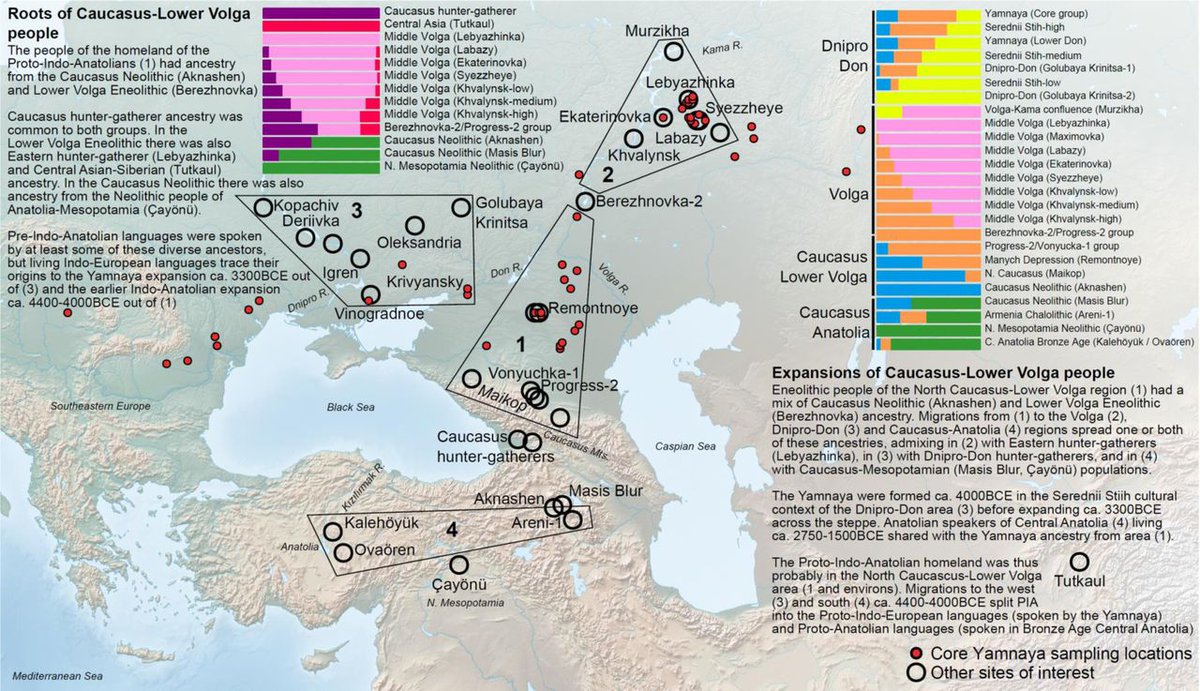
In our new preprint we propose that the likely route connecting Anatolian speakers with the Yamnaya (and thus with the speakers of Indo-European languages) is from the east. This thread summarizes different arguments for this hypothesis, as well as the alternative (from the west)
This hypothesis agrees (partly) with both two hypotheses of the Southern Arc paper. Recall that Hypothesis A is a steppe origin with massive dilution and Hypothesis B is an eastern origin from the broad area denoted by the Proto-Indo-Anatolian circle of that paper.

Agreement with Hypothesis B pertains to the fact that the spread of Anatolian languages is linked to the major demographic transformations affecting Anatolia from the east (the replacement of the local Anatolians by people from the Caucasus-Mesopotamia).
Agreement with Hypothesis A pertains to the discovery of an example of dilution of the steppe ancestry that was postulated in the Southern Arc paper specific to Central Anatolians of the Bronze Age that included likely Anatolian speakers.
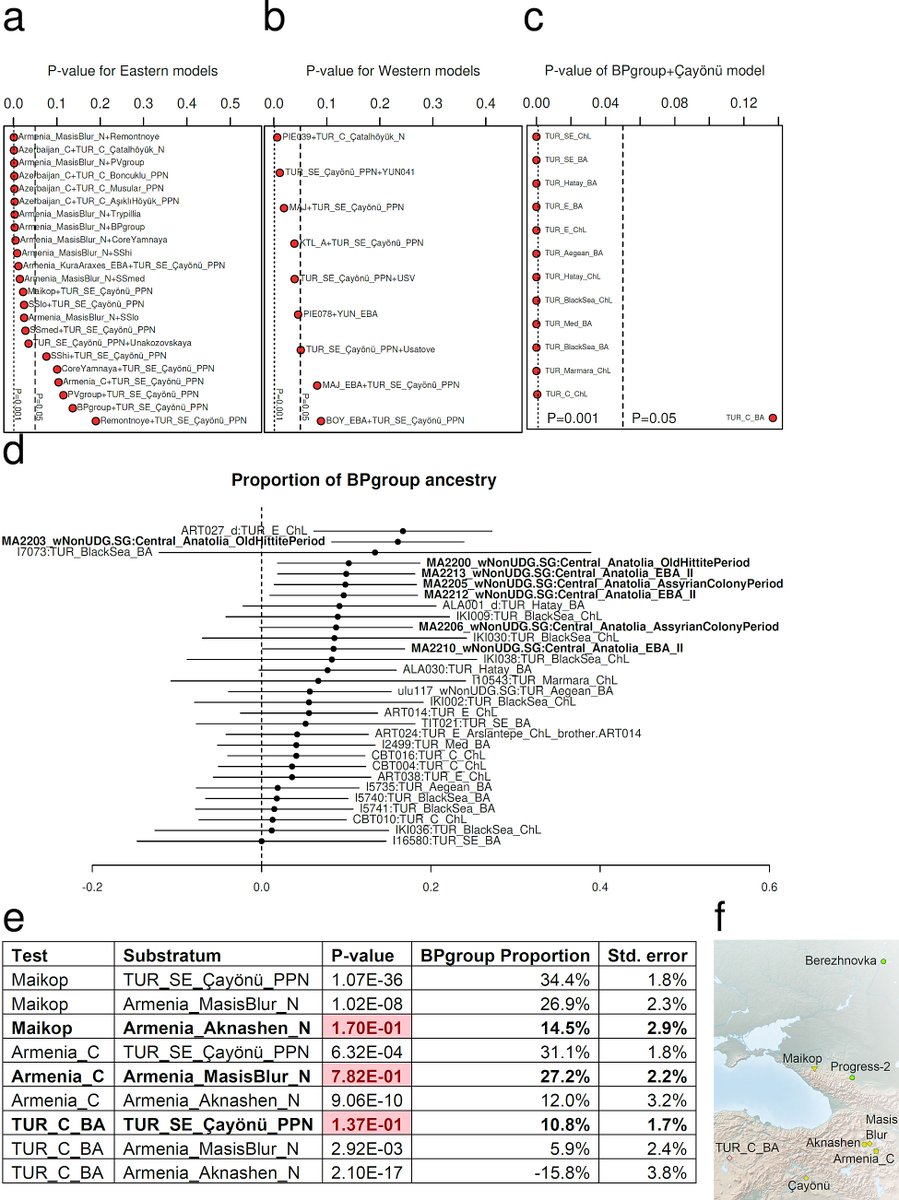
And so the bringers of Pre-Anatolian languages to Central Anatolia did really come from the Caucasus via Mesopotamia but they included among them a small component of Caucasus-Lower Volga ancestry that tied them to steppe populations and to the Yamnaya.
Which among the many deep ancestries of the Caucasus-Lower Volga (CLV) people was the Pre-Indo-Anatolian, genetics cannot say. What we can say is that Anatolians and Yamnaya both had ancestry from them.
This seems to be an elegant model for the primary Anatolian/Indo-European split explained by migrations of CLV people west (=> the Serednii Stih of the North Pontic region, whence the Yamnaya) and south (=>admixing with Caucasus and Mesopotamian people, whence the Anatolians)
The evidence for the Pre-Anatolian movement (in addtion to the qpAdm modeling) is IBD sharing between Vonyuchka-1 and Ovaören and the presence of R-V1636 Y-chromosomes in Armenia and Southeastern Turkey.
The model also has the great advantage that it is the shortest route from the Caucasus-Lower Volga region to Anatolia, covering half the distance of the western model and avoiding the crossing of several water obstacles and ecological transitions.
It is also evidenced in the admixtures of populations along the way: Maikop with Aknashen-related ancestry (the Caucasus Neolithic); Areni-1 with Masis Blur ancestry (Caucasus-Mesopotamia intermediate); Central Anatolia with Mesopotamian ancestry.
All this evidence aside, we cannot be certain that this is the solution, so alternative ideas must continue to be investigated while the details of the CLV->Anatolia route are fleshed out.
Let's consider the alternative (western entry model). In the North Pontic region we detect two waves of ancestry from the CLV region. Wave 1 = CLV+Farmers => Usatove and Wave 2 = CLV+Hunter-gatherers => Serednii Stih => Yamnaya https://www.biorxiv.org/conten...
There are two reasons to associate Pre-Anatolians (in the western model) with Wave 1. First, that Serednii Stih/Yamnaya are associated with Wave 2, and a western model must account for the linguistic split. Associating both Anatolian and IE with Wave 1 defeats that purpose.
Second, that Wave 1 penetrated deeper than Wave 2, into the territory of Trypillians and was not limited to the more eastern North Pontic hunter-gatherers as was Wave 1; if the goal is to link the steppe with Anatolia, Wave 1 is moving more distinctly towards that goal.
And so, let's hypothesize that Wave 1 includes Pre-Anatolians and Wave 2 Pre-Indo-Europeans. And, let us also hypothesize -for the sake of argument- that somehow Pre-Anatolians covered all the Balkans and western Anatolia to reach Central Anatolia.
What kind of ancestry would they have introduced into Central Anatolia? Usatove is a Trypillian+CLV mix and Southeastern/Western Anatolian farmers -if any admixture with them occurred en route- would add more ANF/EEF-related ancestry to the Trypillian one.
We would thus expect an _increase_ of the ANF/EEF-related ancestry in Central Anatolians from that postulated movement when, in fact, we observe a decrease.
To account for the genetic ancestry of Central Anatolians of the Bronze Age we would need to postulate that Central Anatolians were formed by the long-distance migration of CLV people into the NPR, down the Balkans, into Anatolia (from the west) where they would meet...
Caucasus-Mesopotamian people moving in precisely the opposite direction, the two meeting up just in time within Anatolia to form the exact balance of ancestry we observe in the Central Anatolian Bronze Age.
It seems to me that this model involves much longer migrations, synchronicity of (from west) Pre-Anatolians and (from east) Caucasus-Mesopotamians, and massive dilution of (from west) Pre-Anatolians.
The west-south movements of CLV people provide an elegant solution to the Indo-European/Anatolian split; the west-west of Wave 2/1 people keeps them in proximity to each other.
According to the eastern entry model the CLV people (and their languages) hitch a ride on the major genetic transformation occurring in Anatolia during this period (from east-west). According to the western entry model they are a small minority going against the grain.
According to the eastern entry model there is massive demographic displacement in Central Anatolia as Mesopotamians (with a CLV component) arrive; it is not difficult to imagine that such a movement would have a linguistic impact.
According to the western entry model, the Pre-Anatolians from the west somehow transmit their languages even though they are a small minority and have none of the technological advantages of the later Yamnaya migrations.
The strongest argument for the western entry is the western-central Anatolian distribution of Anatolian languages in Bronze Age and later Anatolia.
If Anatolian speakers did really come from the east, how come they left no linguistic descendants in the east? But, this argument can also be applied to the proposed western entry: Anatolians did not leave any linguistic descendants in the Balkans either.
So, the argument carries little force. Whether you get Anatolian speakers into Anatolia from the west or east you must contend with lacunae of their linguistic relatives in either the Balkans or eastern Anatolia/the Caucasus from either direction.
It may be reasonably argued that the traces of the Pre-Anatolians in the Balkans were wiped out by the later Indo-European migrations associated with the Yamnaya dispersals; in any case, the Balkans are not well known linguistically except for the Aegean where Greek was written.
On the other hand, there were clearly events along the eastern route that may have wiped out traces of the Pre-Anatolians as well, namely the Kura Araxes phenomenon that totally wiped out steppe ancestry in Armenia between the Chalcolithic and EBA. https://www.science.org/doi/10...
And there may also be linguistic hints for traces in Mesopotamia of the migrating Proto-Anatolians along their eastern path into central Anatolia suggested by @KroonenGuus et al. https://zenodo.org/records/124...
@KroonenGuus To wrap up this thread: we think that the model we propose (eastern entry of Caucasus-Lower Volga people who admix with Mesopotamian-related people and then head westwards into Anatolia) is the best current solution to early Indo-Anatolian history.
@iosif_lazaridis Hello @iosif_lazaridis a problem with individual I23654, one of three brothers from Vesely Kurgan 1, burial 26, who is noted MtDNA H2a1 in suppl file xls while in supplementary info the three brothers are U5a2, please confirm MtDNA U5a2 or H2a1 thank you :)
@MarcOlivieRondu There are two brothers, I23654 is their 2d relative; so there is no conflict with their mtDNA haplogroup. See entry in Online Data: Rostov Oblast, Veselyy Family A (3 members) (brothers: I23568-I23655 | 2d: I23568-I23654, I23655-I23654)
@iosif_lazaridis These are all meaningless academic exercises to understand the "East", and " West" of the ancient world or "Asia" and "Africa" of the ancient tribes. We have ancient world maps. What led you not to refer to these maps?