
On Nordic recidivism and rehabilitation It is widely believed that (a) the Nordic countries have very low recidivism rates, and (b) this is the result of a focus on rehabilitation rather than retribution. In this thread, I will argue that this is probably largely a myth.
It is common to see comparisons between the United States and the Nordic countries. For example, US NEWS reports that Norway has a recidivism rate of only 20%, compared to 76.6% in the United States.
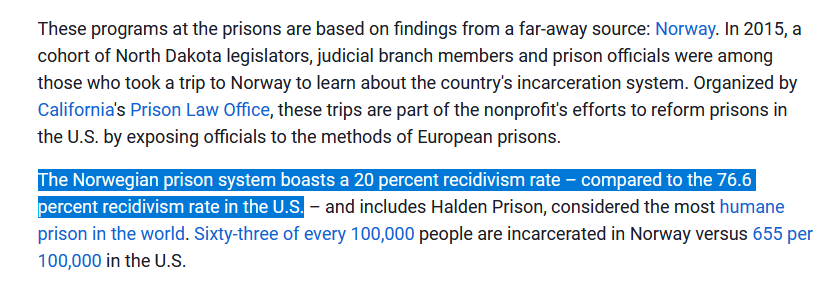
But such comparisons are often misleading, as they are not measuring the same thing. It is especially egregious in this case, as the Norwegian figure is *resentence* within *2 years*, and the American is *rearrest* within *5 years*. They cannot be compared.
When we use equivalent definitions for each country–the percentage who are reconvicted within 2 years of release–the recidivism rates are far more similar. The US recidivism rate is only slightly higher than Denmark, Finland and Sweden; though Norway remains meaningfully lower.

So this data shows that the differences in recidivism rates are far smaller than they are often portrayed. At least for the comparison between the United States and Denmark, Finland and Sweden. I will address Norway in specific later.
Yet another issue is the common assumption that the lower recidivism rates must reflect better rehabilitation practices in prisons. This is a fallacy, because recidivism rates are hugely confounded by other factors in society.
For example, the base rate of crime in a society matters. In a review of global recidivism rates, Yukhnenko et al (2023) find “the more criminogenic a society is, the higher the recidivism rates (given other factors are held constant).”
Because the United States has a higher base rate of crime and incarceration, we should *expect* them to also have a higher recidivism rate, even if their prisons were as good at rehabilitating as the Nordic countries.
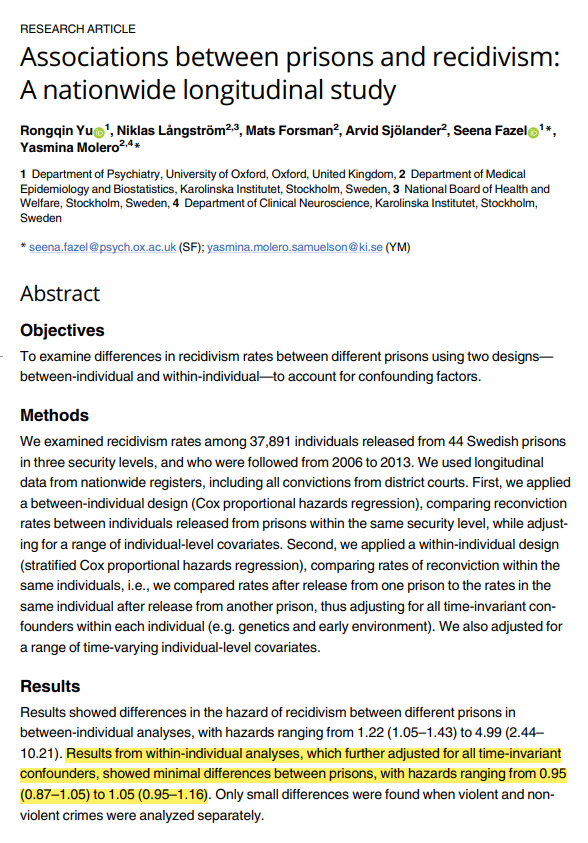
Moreover, we have good reason to believe that recidivism rates have far more to do with things that are external to prisons themselves. One study used within-individual design, comparing the same person being released from different prisons, to assess prison differences.
They found that prison differences had little causal impact on the rate of recidivism. In other words, the large differences in recidivism rates observed between prisons must reflect other things--e.g., prisoner composition--rather than rehabilitation effectiveness.
Let's return to Norway again, who did have meaningfully lower recidivism rate. A commonly told story is that, Norway used to have very high recidivism rates, but then -- following rehabilitation reforms of the early 90s -- their recidivism rates dramatically fell.
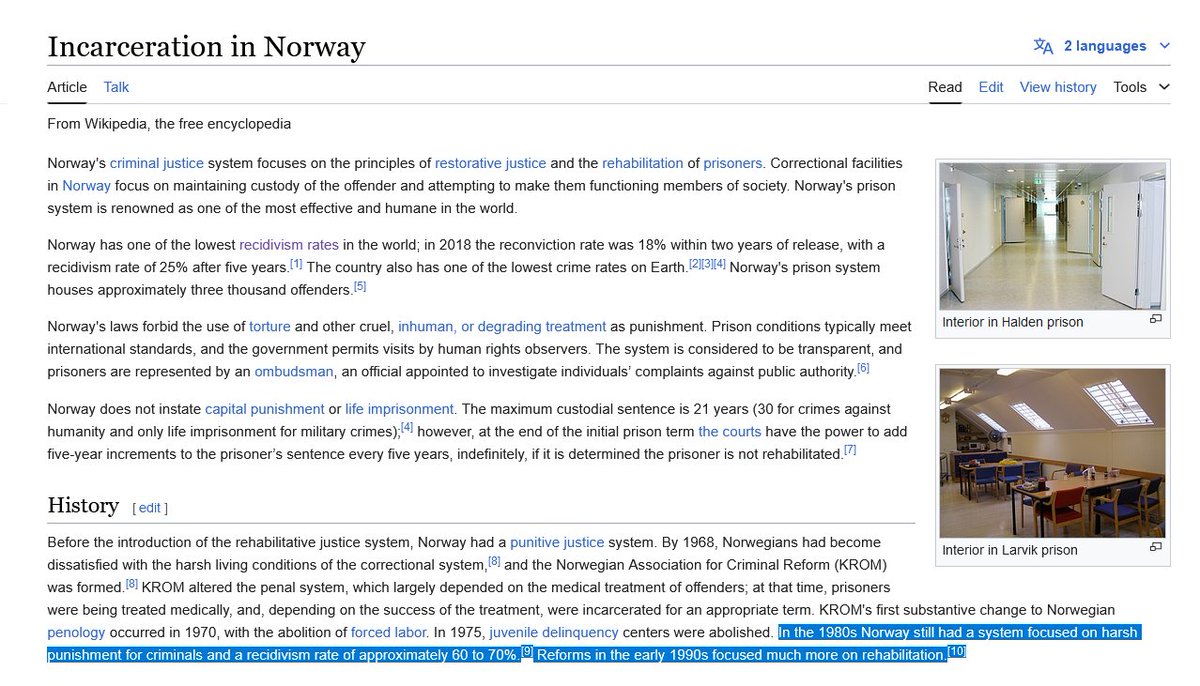
This story is unfortunately false. I collected Norwegian recidivism data from the 50s to present. What I found is that the recidivism rate was at its lowest *prior* to any of these rehabilitation reforms. This puts a huge dent into the widely held narrative.
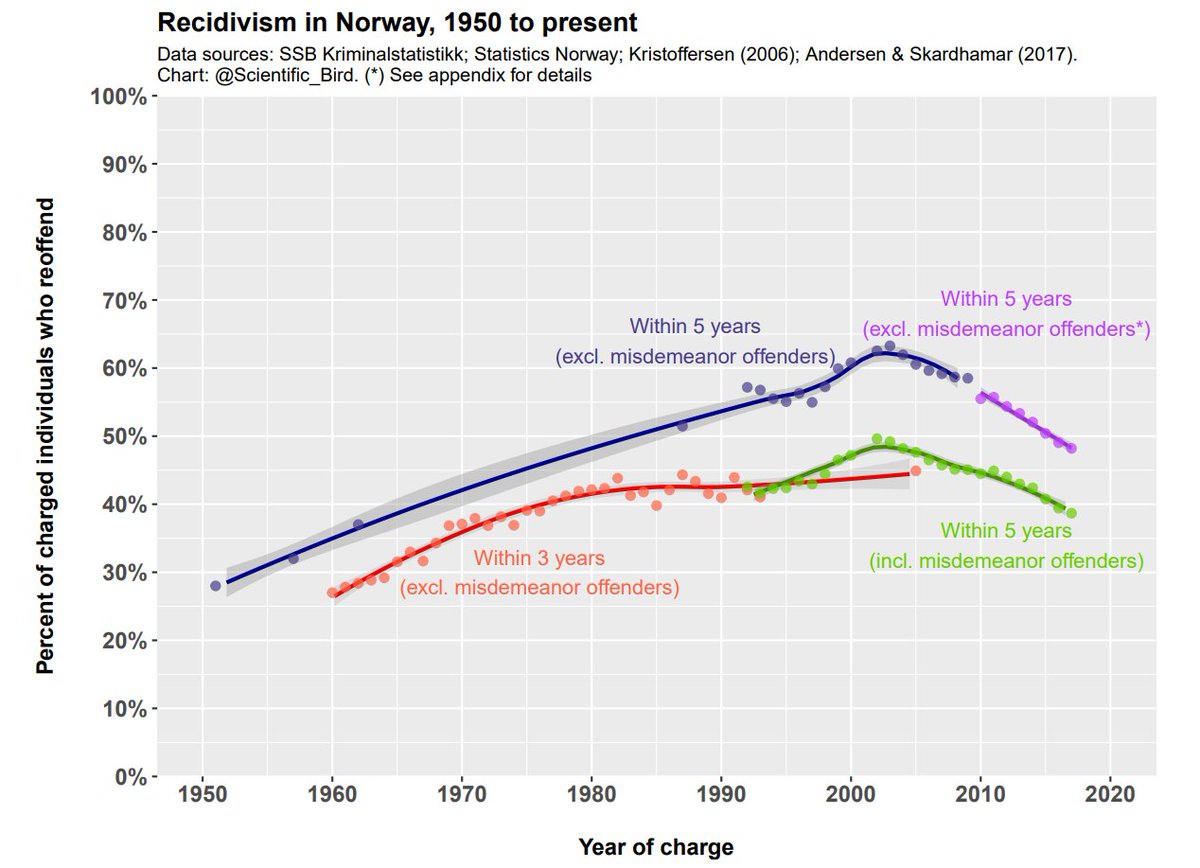
I argue that trends in Norwegian recidivism rates better fit the trends in overall levels of crime, rather than any rehabilitation reforms. In any case, low recidivism rates precede rehabilitation reforms, so a different explanation is needed.
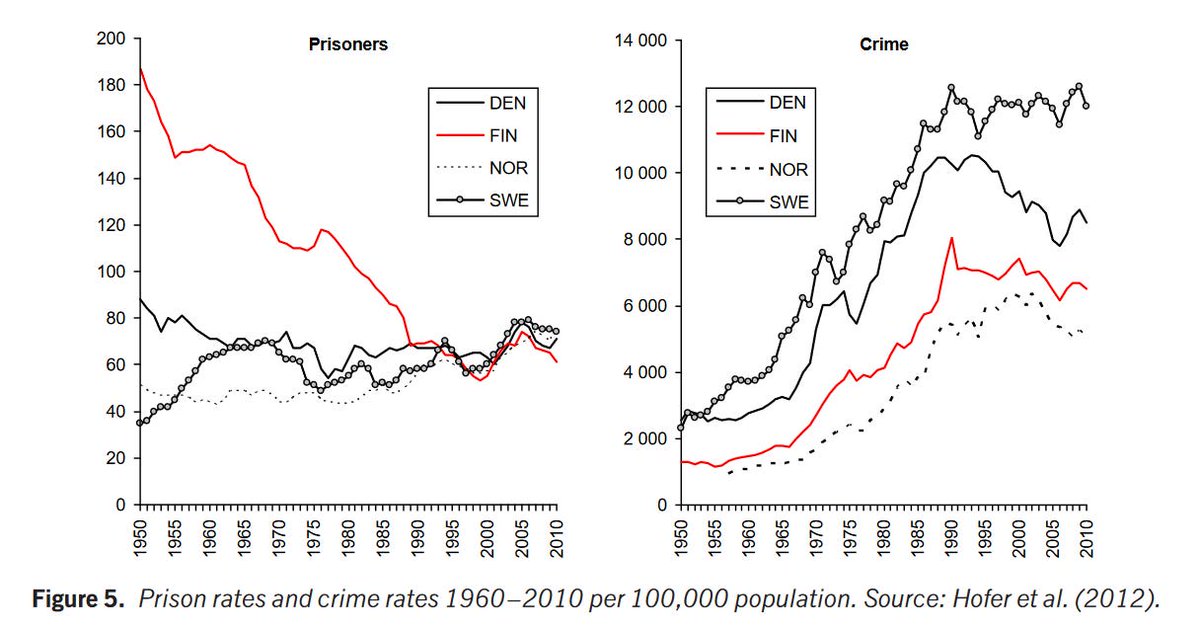
So what is going on? If it's not their superior rehabilitation practices, why *do* they have lower recidivism rates in Norway? It's difficult to provide a complete explanation. But a few key factors are relevant. First, of course, is the low base rate of crime in Norway.
Another factor is the Norwegian practice of imprisoning low-risk offenders, in particular traffic offenders. These have far lower rate of recidivism. The recidivism rate can thus be artificially lowered through compositional effects, e.g., by including low-risk offenders.

Another possible contributor could be the deportation of foreign criminals. When people are deported, they cannot reoffend within the country (unless they illegally reenter the country). However, it's difficult to estimate the impact of this on recidivism rates.

In conclusion, I have argued that the differences in recidivism rates between the Nordic countries and the United States are smaller than generally thought. Further, recidivism rate differences are mostly due to things external to prison rehabilitation practices.
This thread was a summary of two previous articles I wrote. If you're more interested in this topic, you're welcome to read those. There I go into more detail. The first article discusses the topic of international recidivism rates more broadly: https://inquisitivebird.xyz/p/...
The second article I wrote focused specifically on Norway, and the trends in Norwegian recidivism rates: https://inquisitivebird.xyz/p/...
@Scientific_Bird Honest question: why not try to get this published?
@Scientific_Bird The nordic countries were extremely homogeneous with a relatively high average IQ. They all shared a common history and compassionate culture -> low crime Now this is all ruined because of massive migration from Africa and the middle east. There you go, all statistics follows.
@Scientific_Bird A comprehensive argument. Thanks!