
Dear Evolutionists: The (fictional) story of whale evolution is built entirely on speculation and lies. Could whales really have evolved from some form of land mammal, as the evolutionists claim?
Evolutionists claim that fossils have been found that might have been transitional between fully terrestrial mammals and fully aquatic cetaceans. Three key fossils in the whale story are Pakicetus, Ambulocetus and Rodhocetus, which are claimed to link land animals with whales.
In the book, “Why Evolution Is True,” author & evolutionary biologist Jerry Coyne wrote: “Whales happen to have an excellent fossil record, courtesy of their aquatic habits and robust, easily fossilized bones. This is one of our best examples of an evolutionary transition.”
But what are the problems with this supposed fossil record? Well for one - they’re all out of order. The alleged first ancestor of all the organisms that eventually led to whales - Indohyus - is actually dated YOUNGER than many of its supposed descendents.
How can Indohyus be considered the first in a line of transitional fossils if it didn’t exist until AFTER its supposed descendants?
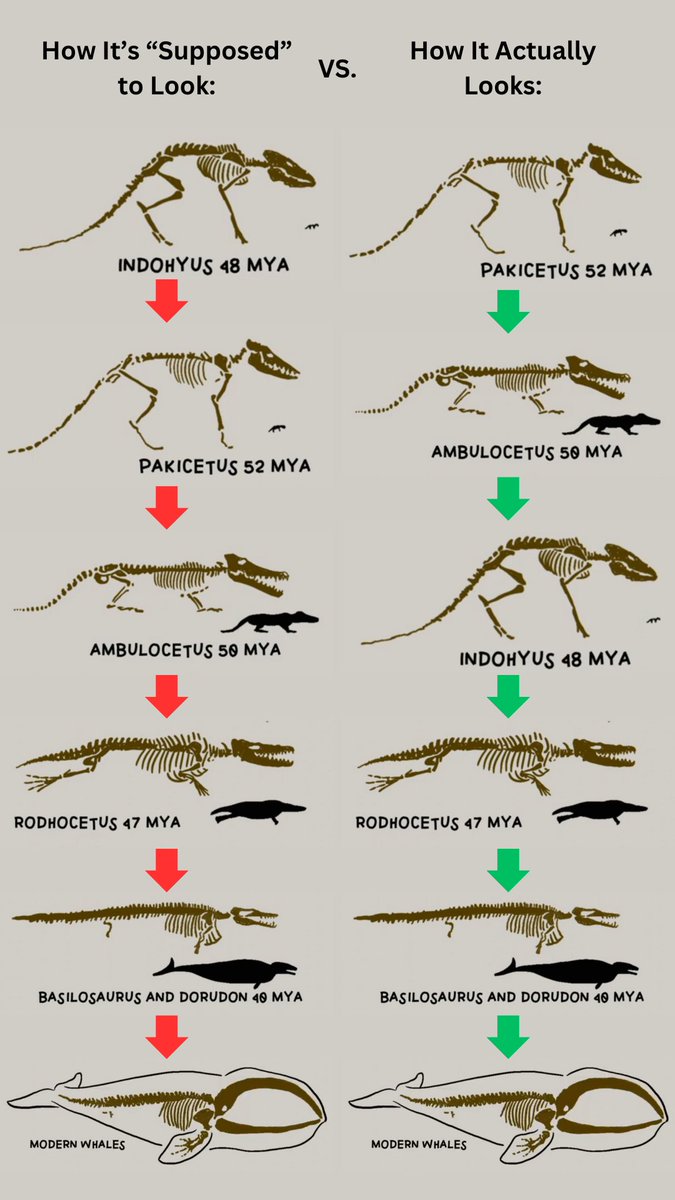
And then there’s the ancient whale jawbone found in Antarctica in 2010, said to be ~49 million years old. Which means it’s older than Indohyus, leaving less than 5 million years for evolution to take place. Not happenin'! The fossil record does not support whale evolution.
Problem 2: Basilosaurus & Durodon are not even considered to be transitional forms between land-dwelling mammals and modern whales. Instead, they represent distinct evolutionary branches within the Archaeocete lineage.
Some evolutionists claim that they are not ancestrally intermediate, but are instead what they deem as “morphologically intermediate,” which means that the organism has features similar to both its alleged ancestor and descendants.
With this broad of a definition, literally any fossil could be deemed as “intermediate” or “transitional,” as long as it contains a few “ideal” characteristics. I dunno about you, but that seems like circular reasoning to me!
In other words - the evolutionists presuppose evolution is true, so when they find similar characteristics in different organisms, they ASSUME some sort of “intermediate” or “transitional” relationship between them.
The ancestral relationship is PURE ASSUMPTION & speculation. Doesn’t sound very scientific to me.
Problem 3: The waiting time problem. Supposedly, land-dwelling mammals evolved into fully aquatic whales in only about 8-10 million years (or less than 5 million if you take into account the jawbone mentioned previously!).
But according to the evolutionist’s own research in population genetics, it would take roughly 43 million years for these creatures to develop just TWO beneficial mutations.

So - how many beneficial mutations needed to change a Pakicetus into a whale? Low-end estimates say ~5,000 total mutations are needed to turn land-dwelling Pakicetus into fully aquatic whales. That means evolution would need around 215 BILLION years. Seem plausible to you?
There simply isn’t enough time, as evidenced by the fossil record itself, for all this to have been accomplished by unguided, unintelligent, uncoordinated, accident-based natural processes.
Problem 4: Coordinated Mutations Now let’s think about the types of changes that must take place to transform land dwelling mammals into fully aquatic whales, and why those changes are so implausible to happen by accident.
We can break it down into 3 necessary changes: breathing, swimming, and reproducing. Land mammals and whales both breathe air, but their lungs operate completely differently.
A whale’s “nostrils” are its blowholes, which contain specialized muscular systems that keep it closed until the whale wants to open it - quite the opposite of land mammals.
These specialized nostrils also contain specialized connective tissues and nervous system pathways, allowing them to easily dispel water & replace the air in their lungs - all of which must evolve simultaneously while staying functional.
Whales also have specialized lungs that can collapse upon deep dives under pressure, and inflate quickly as they come up closer to the surface - requiring more coordinated mutations.
And of course, whales have the ability to hold air in their lungs for vastly longer periods of time than land mammals. Their circulatory system must transport Oxygen & Nitrogen throughout the body in a more efficient manner under high pressure.
All of these changes require multitudes of coordinated mutations, not just at the organ level, but at the molecular level - in their DNA, RNA, & proteins - all while staying functional in transition…which is highly, highly, highly, highly, highly, HIGHLY unlikely to take place.
For swimming, whales possess an entirely novel muscular system compared to land mammals, allowing them to control their fins and swim efficiently in the water. A land mammal’s entire muscular system would have to be virtually replaced. More impossible coordinated mutations.
And reproduction. The entire reproductive system of whales would have had to be “remade” through the evolutionary process - again while maintaining functionality all the way through each stage.
In most mammals (even sea lions) the testicles are outside the body, because sperm production normally requires a temperature several degrees below normal body temperature.
In cetaceans, testicles are cooled below body temperature by countercurrent heat exchangers. Veins carry cool blood from the dorsal fin and flukes to the testicles, where it flows through a network of veins that pass between arteries carrying warm blood in the opposite direction.
The arterial blood is thereby cooled before it reaches the testicles. Internalization of the testicle could not have preceded the countercurrent heat exchange system, or the male cetacean would have been sterile.
Yet there is no adaptive advantage to having a countercurrent heat exchange system around the testicle unless it is inside the body. Even MORE impossible coordinated mutations.
How could any of this happen by random, purposeless, blind natural processes? The odds are too small to even fathom. Whales could not, and did not, evolve from land mammals as the evolutionists believe. The evidence is overwhelmingly clear that it could not have happened.
Here’s another one the evolutionists love to bring up: What about the “vestigial” leg bones in the whale?
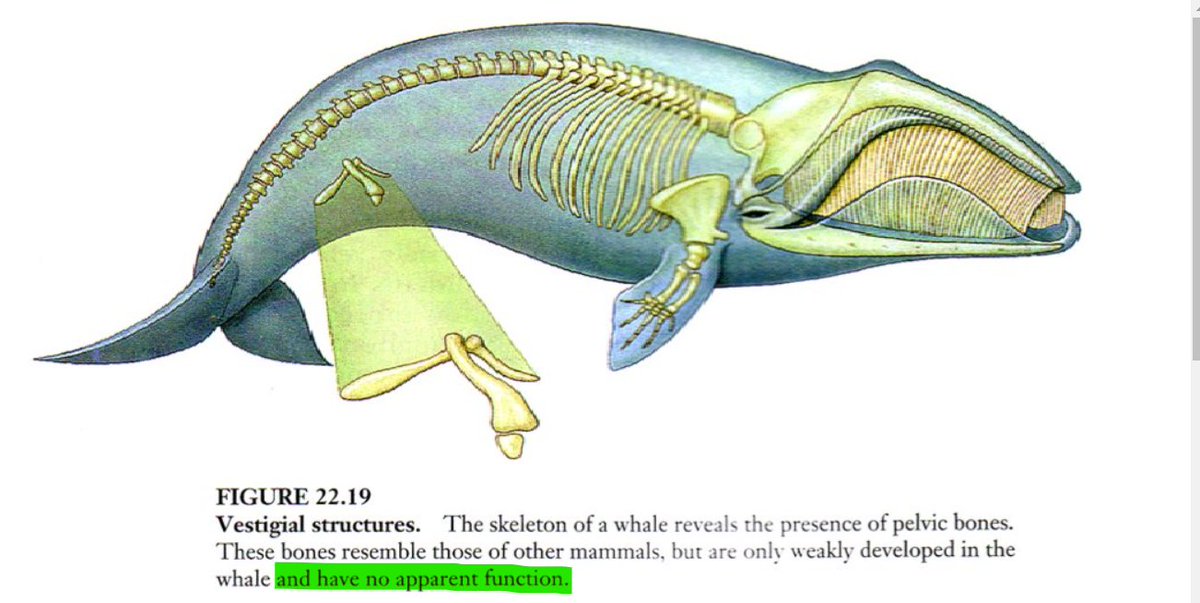
To make a complicated matter simple: these are not “vestigial” leg bones. These bones are necessary for the male whale’s reproductive system. Without these bones, he could not reproduce.
That can just as easily be described by design.