
Here’s what happened in Wisconsin. And a note of gratitude. 🧵
On Election Day, I thought we were winning the presidential race. We came up short. Losing was a gut punch. Enormous peril lies ahead. As we prepare for what’s next, we also have to find space for curiosity about what just happened.
We’re beginning to see the outlines: a red wave. A nationwide shift toward Trump of 6%. But in Wisconsin, we nearly defeated that wave. The shift here was just one quarter the size: 1.5%. Not because Trump was weaker here than elsewhere, but because we were stronger.
Thanks to tens of thousands of heroes—our candidates, the campaign, party infrastructure, allies, and volunteers—we persuaded and turned out even more voters for Harris than we did for Biden in 2020. We lost Wisconsin by just 0.9%—the smallest margin of any state in America.
2024 was a high turnout year, second only to 2020 nationwide. But in most states, turnout went down slightly. In Wisconsin, overall turnout went up—by 1.3%, the most in the country.
All of your work had a critical impact. You helped @TammyBaldwin win re-election. You flipped four state Senate and ten state Assembly seats on our new fair maps, setting the stage for majorities in 2026.
The reality of our wins in WI doesn’t lessen the blow of knowing what Trump is poised to inflict on the country. But it fills me with profound gratitude for your work. To everyone involved in this fight, thank you.
Here’s my first-pass analysis of what just happened, and a note of appreciation. In 2024, voters nationwide—across, from what we can tell, geography, gender, generation, race, & ethnicity—shifted towards Trump. This wasn’t any one group’s “fault.” Don’t fall for that trap.
We’re just at the beginning of figuring out what happened. Be wary of anyone who tells you that X, Y, or Z thing would have changed the outcome.
Two things are very clear from the big picture. The first key thing is that the post-COVID inflation era has marked a global wave against incumbent parties. https://x.com/robfordmancs/sta...
In 2024, for the 1st year on record (w/120 yrs of data), every wealthy-country ruling party has lost ground, regardless of whether it was L or R of center. Across Belgium, France, Japan, Austria, Portugal, the US, and the UK, the average swing was 20 pts. https://www.ft.com/content/e8a...
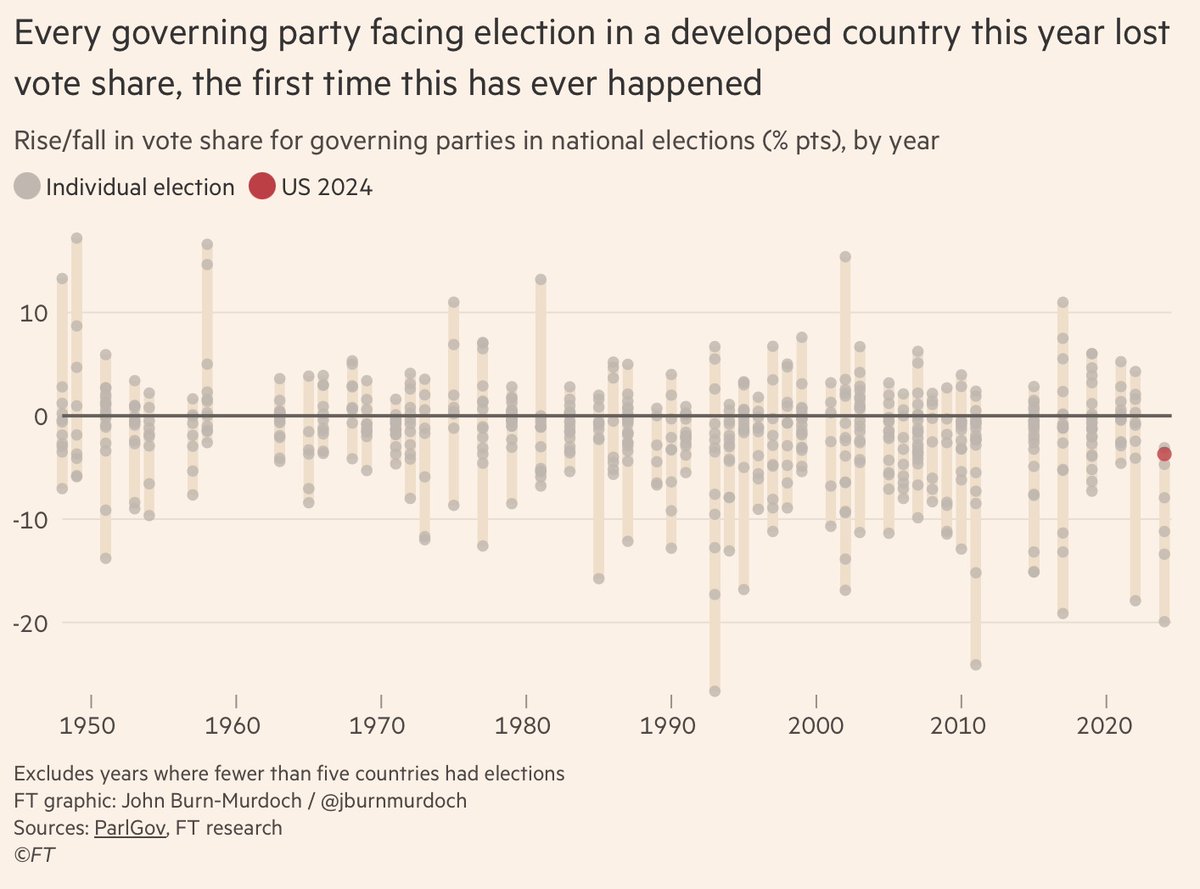
Worldwide, political scientists are arguing, this is a reaction to high prices. Inflation leads voters to punish whoever’s in power, even if they didn’t have control over it.
The fact that US voters swung less hard against Dems may be due to the greater success in the US, relative to other countries, in bringing inflation down. https://x.com/johnmsides/statu...
This tracks with what we’ve heard consistently for the last 2 years—in polls, in exit polls, and on doors. Many voters have been furious about high prices.
The question was whether we could win the presidential race despite that headwind, given everything else (and yes, there was so much else). Like other parties worldwide, we didn’t. https://x.com/lucas_chancel/st...
The second thing that jumps out is that, in the states where Harris and Trump campaigned the hardest, Harris overperformed. And she overperformed in Wisconsin most of all.
Trump and his allies poured hundreds of millions of dollars into vicious attack ads in the seven battleground states. They did all they could to drive up their vote share, knowing that these states would determine the Electoral College.
Harris and her allies—including all of us—poured our hearts and souls into the battle here too. If Trump’s campaign had been more effective than Harris’, he would have swung the vote in the battleground states by more than the nationwide shift.
Instead, it was the exact opposite. Harris’s campaign had a bigger effect than Trump’s. As Dave Wasserman of @CookPolitical, one of the nation’s most clear-eyed analysts, puts it: https://x.com/Redistrict/statu...
You can see the same thing in turnout numbers. Nationally, based on numbers tallied by the Univ. of FL Election Lab, turnout in 2024 is ~62.3% of eligible voters. That’s higher than any election in the last half-century—except 2020, when it hit 66.4%. https://election.lab.ufl.edu/2...
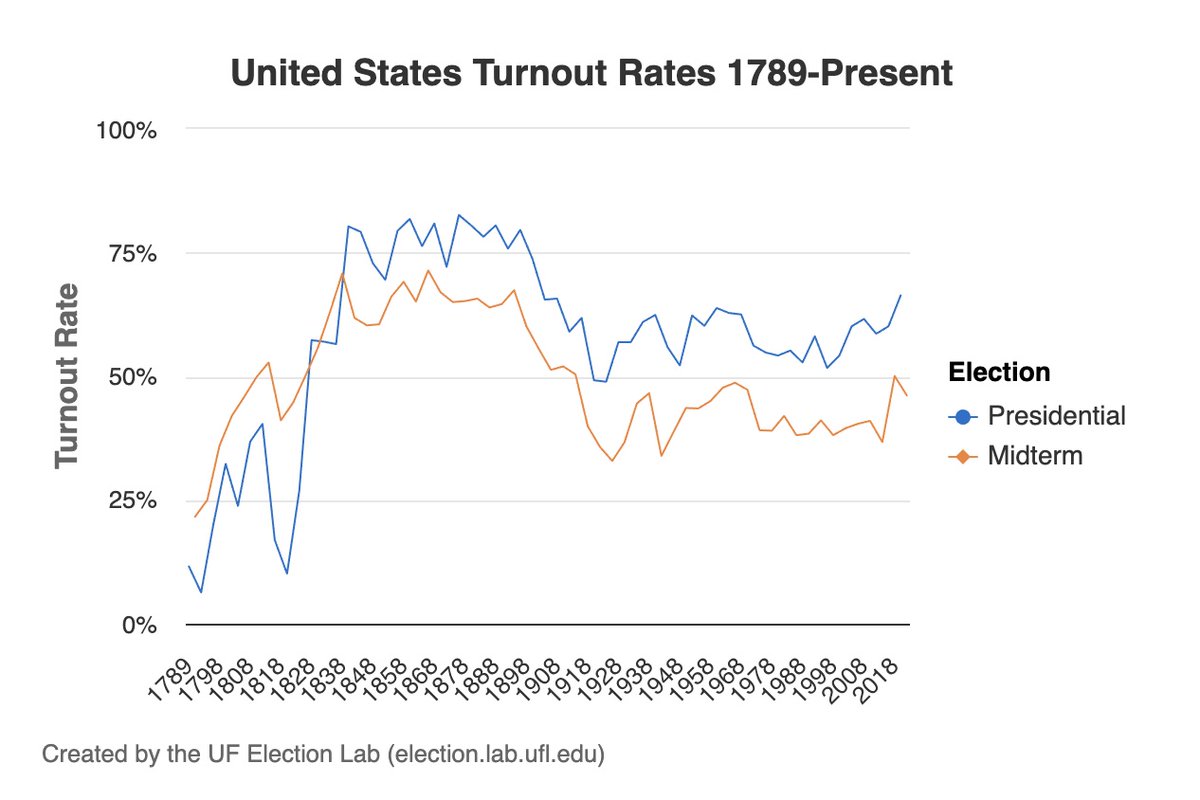
But, as with the swing in margins, this is a tale of two elections—because while turnout dropped slightly in non-battleground states, it actually went UP, very slightly, in the seven battlegrounds. And it rose most of all in WI: turnout here rose 1.3%, the highest in the US.
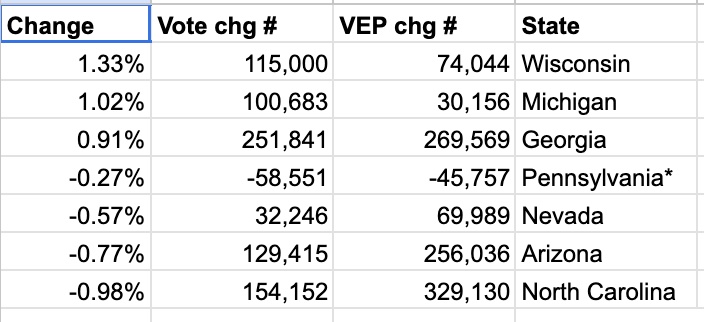
In other words, that feeling so many of us had—that energy on the ground was explosive, that the campaign was soaring, that we were finding new Harris voters all over the state—that was real.
Harris earned more than 30,000 more raw votes than Biden. She earned more votes than Obama in 2012, and almost as many as Obama in 2008—when he won a 14-point landslide victory.
She added votes in 46 of Wisconsin’s 72 counties—rural, urban, suburban, and small-town alike. It’s just that there was an even larger group of voters, a quieter group, that turned out and voted for Trump.
The Washington Post analyzed county by county results to look at what happened in different types of geographies nationally and in the swing states. This year, unlike past years, was not a situation where the blue got bluer and the red got redder. https://www.washingtonpost.com...
Everywhere got redder, and once-blue cities and suburbs swung more towards Trump than rural areas:
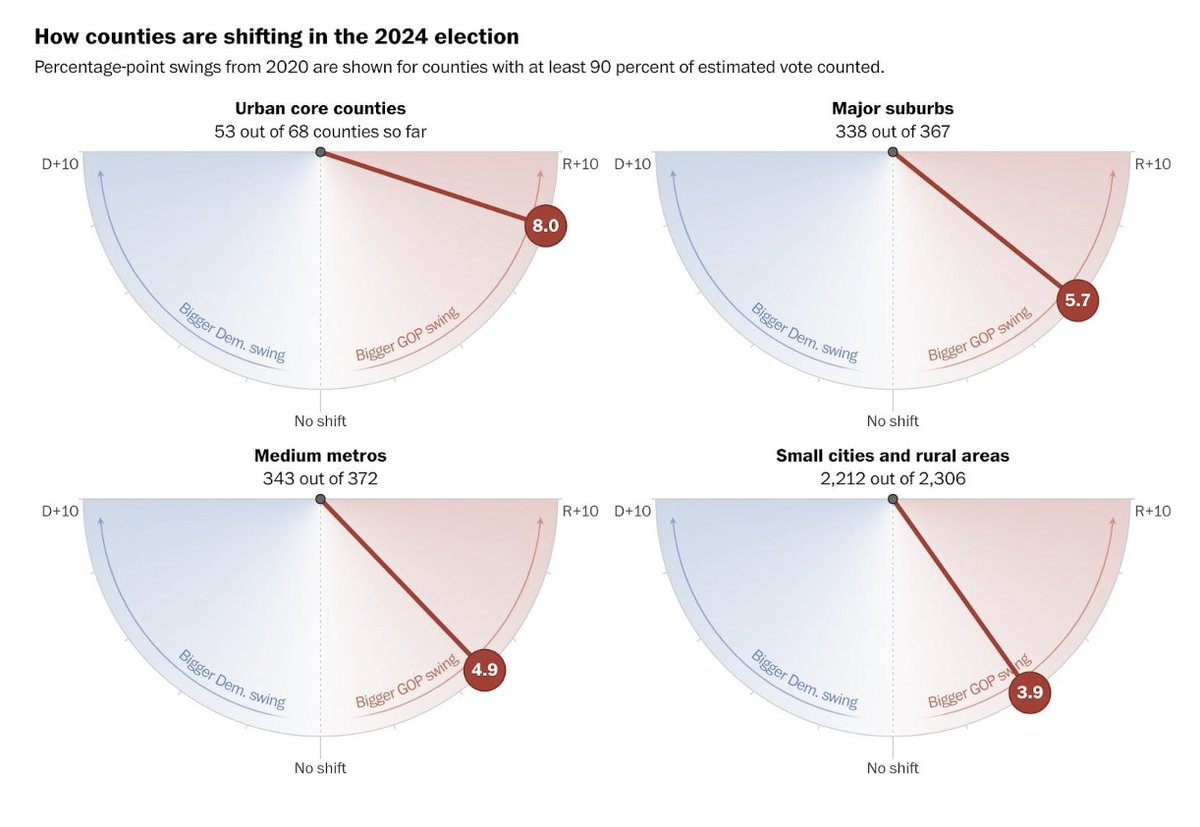
But in Wisconsin, the shift was far smaller than the national picture—across types of geographies:

“Urban core” counties moved 8% towards Trump nationally—but Milwaukee only moved 1%. Milwaukee County actually delivered more net votes (Dem votes minus Republican votes) for Harris than it did for Obama in 2008 or 2012.
“Major suburbs” moved 5.7% towards Trump nationally—but in Wisconsin, they moved 0.1% to Harris. Her margin grew, slightly, in each of the WOW counties.
“Medium metros”—counties with mid-sized cities—moved 4.9% towards Trump nationally, but in Wisconsin, just shifted 1% towards Trump. Dane County, the fastest-growing in the state, for the first time delivered the most net votes for Harris of any Wisconsin county.
And “Rural counties and small cities” nationally moved towards Trump by 4%. In WI, these 57 counties accounted for 36% of the overall vote, and 29% of the vote for Harris.