
Several of you have asked for my thoughts on Curtis Yarvin's NYT interview. I thought it was a masterclass in a very specific kind of persuasion: disenchantment 🧵
The current moment is a moment of disenchantment for the left. Their narratives no longer sell and their control of economic, media and political institutions is on the decline. They are afraid.

Curtis wants this disenchantment. He views it as his most important cultural victory within Silicon Valley.
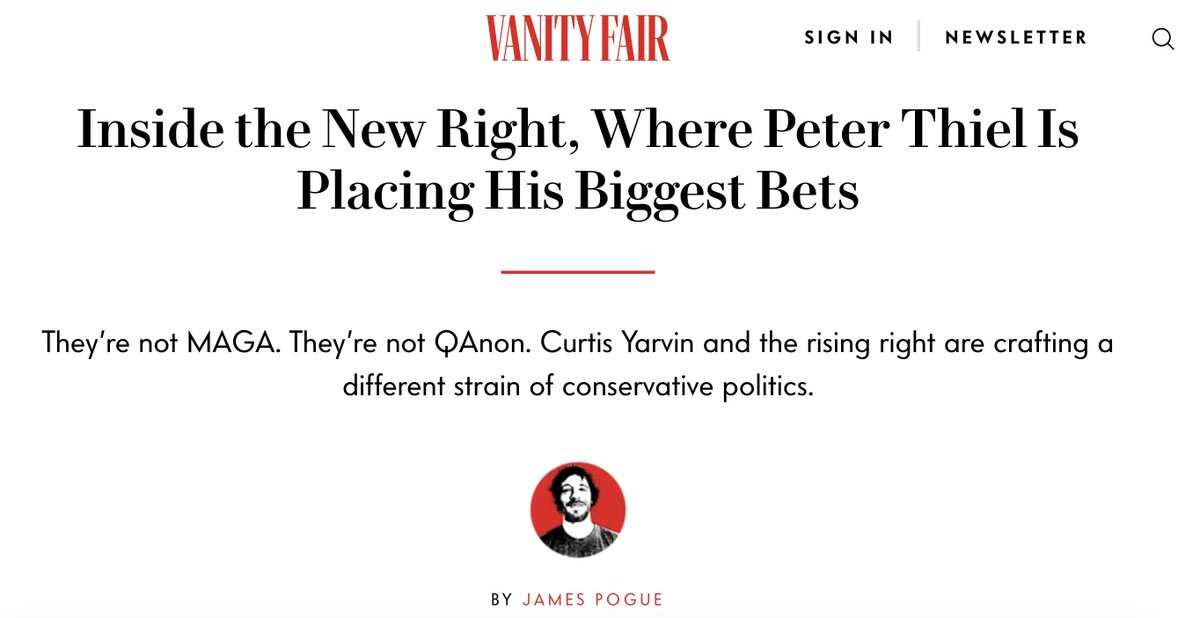
@jhensonpogue's piece in Vanity Fair remains the best explainer on what the fault lines in that disenchantment look like. There are many.
The median NYT reader is halfway through disenchantment. They're disenchanted about their political slogans, but not about their political systems. And Curtis is offering them a solution for their anxiety.
To do that, Curtis challenges the political and historical myths of the left. Not in an angry way, like Tucker Carlson or Darryl Cooper. But in a sympathetic way, like JD Vance.
One of Curtis' most important ideas is the importance, historical presence, and current presence of monarchy. It is as normal as a Macbook.
Curtis argues that even Silicon Valley founders have this form of cognitive dissonance.
This comes at a time when a core question in the left-wing intelligencia is "State Capacity": using government to accomplish things effectively.

Right now, a cottage industry of left-wing think tanks, journalists, and policymakers have formed around State Capacity. They believe Democrats can win if they successfully deliver on the government programs they promised.




The core conflict in the Democratic party is whether they pursue solutions or emotion. While emotion was working well for them - when Obama and Biden won - this was off the table.
The reason why this context is so important is that Curtis draws out this emotion from his interviewer, an NYT journalist who is disenchanted from the tactics of his movement, but not the slogans.
Curtis and the interviewer both get what they want. Curtis gets to be the sophisticated individual and the NYT journalist gets to be the everyman.
Returning to Curtis' answers about race, regardless of whether you agree with his conclusion, he comes off as trying to substantiate them with facts and logic, and not just spewing emotions into the microphone.
The reason why these aesthetics are so important is that they are about disenchantment - Curtis' substance and goals. And his interviewer is sacrificing his own neutrality to make sure that doesn't happen.
Even if Curtis loses a calm, mild-mannered debate about the costs of the Civil War, he has succeeded in disenchantment. The Civil War becomes like the 30 years war - historically important, but not a political slogan.
Even for conservative or Silicon Valley elites, this disenchantment is the goal - disenchantment from the "fraud" of conservatism.
What does it say that the left is more animated about the Civil War, or even about some Norwegian terrorist, than getting to Mars? And what does it say about the right?
At the end of the interview, the host returns to the question of Democracy:
The following part of Curtis' answer is most important: "if there's really one thing that I kind of want to do the most, say with this conversation is to kind of make people feel like they can basically step outside of the kind of very small box that they grew up in"
Thank you to the @nytimes, which is honest and good, for publishing this interview. https://www.nytimes.com/2025/0...
@nytimes thread start: https://x.com/psychosort/statu...
@psychosort RE-ENCHANTMENT https://podcasts.apple.com/se/...
@JohanGardebo the two haves of the pizza pie
@psychosort I cannot believe people on the right who consider themselves intellectual buy this guy's weak sauce. Kant has a much better critique of the enlightenment - 200 years ago... This is mish-mash, pseudo philosophy and bootstrapping of the worst sort. If you think he's an
@psychosort is much of the tech right not also focused on state capacity, simply through a different lens? DOGE seems aimed at more or less this concept
@psychosort He is amazing at what he does.
@psychosort Giggling. I'm watching the entire interview and he claims FDR's overt socialist/Marxist policies, that were the first step in destroying our nation, were like the actions of a 'startup CEO'. If you know startups (as I do) and the history of the 20th century, you'll laugh
@psychosort Marchese is so deft at being affable even as he routinely slams Yarvin for being incoherent or evading his questions with historical diatribes.
@psychosort Did he mention @urbit at all?
@psychosort Here's our response @psychosort
@psychosort 🔥🔥🔥🔥
@psychosort The market keeps the tech “monarchs” in check, and even replaces the ineffective ones, but monarchical power, as exercised within government, is much less accountable because, short of revolution, they are impossible to replace.
@psychosort Survivorship bias. There are a thousand other 'absolute monarchies' (family businesses) that fail spectacularly. Conflating the fact that one newspaper does well with the management system being superior.
@psychosort Only idiots still trust the @nytimes
@psychosort Yarvin is an idiot. He thinks tech companies can take the place of government yet they’re already having a hard time being efficient. There’s a few out there that do, but the number is pretty small. Financialisation caused that. That being said, I do enjoy listening to him and
@psychosort Yarvin is so up his own ass. Problem is men of his generation play too many video games and read sci-fi and dont actually experience the world in the way that 98% of ppl do. Hopefully he goes away without destroying too many other people’s lives.