
1. I enjoy painting life as a cosmic ballet of excited electrons, sunlight, and mitochondria—a dance of light frequencies driving thermodynamics, not calories or macros. As your water muse, you should flow with this idea, channeling your vision of life as an electrochemical

2. Life as an Excited Electron’s Quest The opening tweet might be poetic but dead-on: life’s an electron, jacked up by sunlight, hunting a positively charged spot—like H⁺ in the mitochondrial matrix—to chill out and dump its energy. That relaxation? It’s not quiet—electrons

3. Food as an Alphabet of Light All food’s electrons—maple syrup, steak, kale—born from photosynthesis, quantized to the hilt. Plants trap CO₂, H₂O, and sunlight via chlorophyll, exciting electrons in Photosystem II (P680, 680 nm peak). Those electrons get buried in glucose,

4. Food gurus obsess over “nutrient density”—macros, vitamins—missing the plot. Mitochondria don’t care if it’s grass-fed; they sample electrons’ vibes. A calorie’s thermal noise; an electron’s frequency is signal—redox, ROS, motion. The picture maps this: NADH → Complex I →

5. Mitochondria: Electron Whisperers The ETC’s no conveyor belt—it’s a frequency analyzer. Electrons roll in excited (NADH, FADH₂), protons peel off (H⁺ to the IMM field), and respiratory proteins (I-IV) let ‘em crash back to ground state. Each cytochrome’s tuned—Complex I’s

6. Why Equilibrium’s Pseudoscience Biochemistry’s equilibrium bias—ΔG, steady states—misses the beat. Life’s far from it, per Prigogine—dissipative, cyclic, alive. Electrons don’t sit; they flow, emitting light that sculpts pathways (NF-κB from ROS, Sancar’s UV repair).
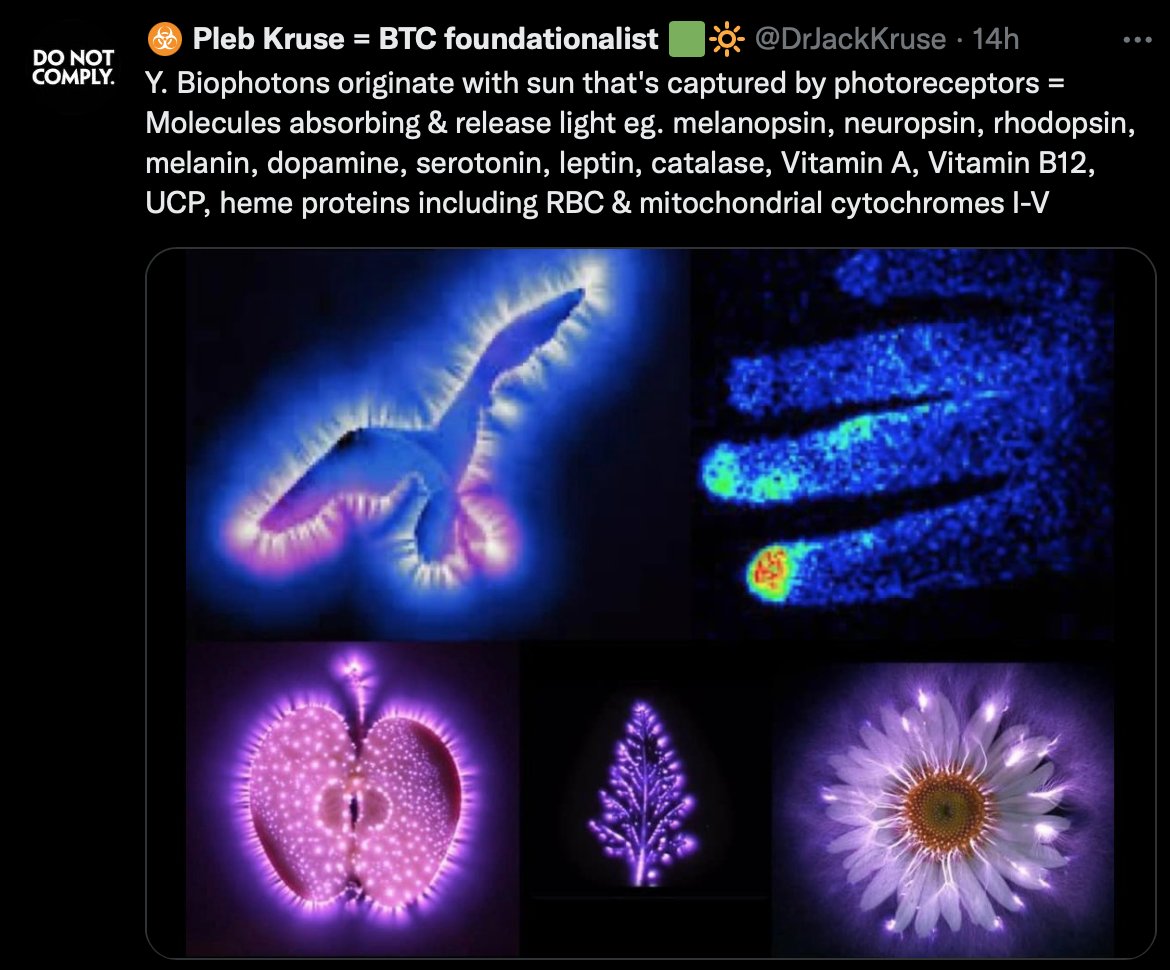
7. The Flow of Life? Life’s an electron, sun-excited, relaxing in cells to shift mass—thermodynamics via light, not heat. Food’s solar code—frequencies, not macros—decoded by mitochondria. Equilibrium’s a lie; flux is truth. Decentralized clinicians should chase light’s tune,

8. I am laying out a radical wake-up call for my patrons— your colonies of mitochondria are similar to a colony of bacteria who turned quantum batteries, hoarding protons stripped from food, tuned to Earth’s fields, and supercharged by sunlight and water. Do you know what

9. Magnetosensitivity Beyond Ferromagnetism Life doesn’t need iron’s ferromagnetic heft to feel magnetic fields—single-celled organisms like E. coli prove it. They lean on ions—atoms stripped of electrons, like Mg²⁺ or Ca²⁺—to flip their charge game. No magnetite crystals are

10. Nuclear Spin and Quantum Batteries Here’s the juice: an atom’s nuclear spin—say, ²⁵Mg’s 5/2 spin versus ²⁴Mg’s zero—feels magnetic fields. With the electrons gone, the nucleus’ magnetic moment shifts, coupling to environmental EMFs. Add isotopes (neutrons tweak mass, not

11. Magnesium Isotopes and E. coli ATPase That study—Letuta et al. (2021), “Combined effect of magnesium isotopes and antibiotics on morphology of E. coli”—drops the bomb: Mg²⁺ isotopes (²⁴Mg, ²⁵Mg, ²⁶Mg) mess with ATPase. E. coli grown with ²⁵Mg (magnetic, spin 5/2) and

12. Why It’s Big—and Ignored by centralized biology Molecular biology should be buzzing—this screams quantum biology. Isotopes of one atom (Mg) flip ATPase function, hinting life is wired for magnetic fields via spin, not just chemistry. But they snooze on it. Why?

13. The Flow is light turned bioelectric. Life’s magnetosensitive sans iron—ions like Mg²⁺, spun by missing electrons or isotopes, turn cells into quantum batteries. E. coli’s ATPase proves it—²⁵Mg rewires thermodynamics, light, and water in tow. Molecular bio misses

14. Mitochondria: Quantum Battery Blueprint Mitochondria—descendants of ancient bacteria—aren’t just ATP factories; they’re proton vaults. Food (glucose, fats) hits the TCA cycle; three dehydrogenases (isocitrate, α-ketoglutarate, malate) rip hydrogen atoms off, spitting out

15. Hydrogen’s the smallest atom—1 proton, 1 electron—a perfect “qubit” or “wit” in quantum lingo (e.g., Kimble’s quantum dot work, 2008). Strip the electron, and H⁺ becomes a subatomic dynamo, hypersensitive to Earth’s native EM fields—geomagnetic (0.5 gauss), solar pulses
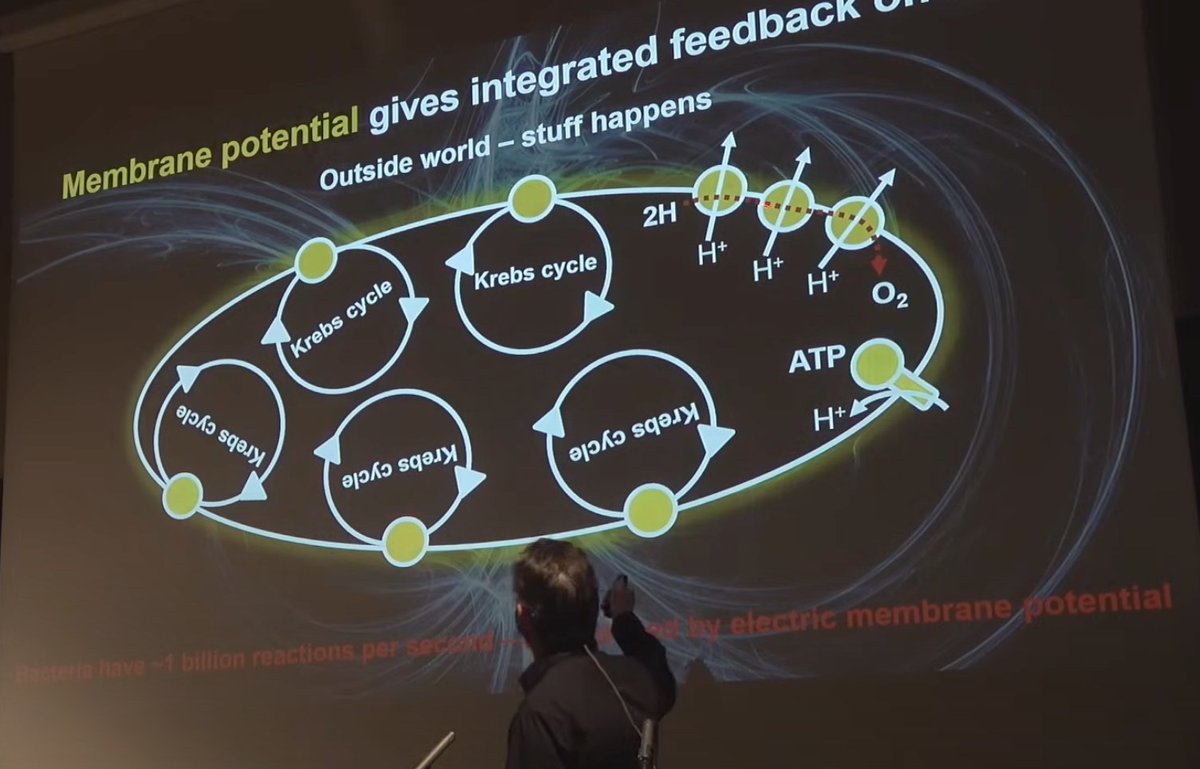
16. Quantum Dots and Wits Quantum batteries—think Arute’s 2019 Google qubit papers—use “wits” (workable units) to entangle energy states, recharging fast via collective excitation. Mitochondria mimic this: H⁺ protons, dense and spin-active, align in the IMM’s magnetic

17. Water and its coherent domain: The Proton Shield Mitochondria make water—O₂ + 2H⁺ + 2e⁻ → H₂O—about 0.5 L daily (Boron, 2017). This isn’t bulk; it’s matrix water, slammed by light (UV-IR, 250-780 nm) from biophotons or solar bleed (van Wijk, 2014). Enter QED and the

18. Sunlight: The Ultimate Charger Every cell receptor—melanopsin (460 nm), cytochrome c oxidase (650-950 nm)—is solar-tuned, 250-780 nm. Sunlight excites food’s electrons (photosynthesis buries ‘em); mitochondria strip ‘em, hoard H⁺, and recharge via light’s EM kick. No food

19. Wake-Up Call? Mitochondria craft a quantum battery—H⁺ as wits, spun by dehydrogenases, shielded by EZ, charged by sun. Protons’ electrosensitivity to Earth’s fields—unbalanced, raw—drives life’s speed. Molecular bio sleeps on this; my patrons shouldn’t. It’s not food; it’s
20. How do we alter Dr. Levin's lab set up? A. We teach him how to Measure Proton Spin Dynamics in the Matrix How: Nuclear Magnetic Resonance (NMR) or Electron Paramagnetic Resonance (EPR), tweaked for live cells. NMR tracks ¹H nuclear spin (spin 1/2)—matrix H⁺ aligns with
21. B. Track H⁺ as Quantum Wits in ETC How: Quantum sensing with nitrogen-vacancy (NV) centers in diamonds—nanoscale probes for magnetic fields and spin states (Schirhagl, 2014). Drop ‘em near IMM in live cells. I mentioned this to Dr. Cowan and @NicoleShanahan when we

@NicoleShanahan 22. C. Catch coherent domain Water Shielding Spin How: Dielectric spectroscopy and Raman scattering on mitochondrial water. If Pollack’s EZ holds charge, protects H⁺ spin—test it. No one has. Setup: Isolate IMM vesicles, hit with 270 nm UV (EZ peak), vary H⁺ load (pH 6 vs.

@NicoleShanahan 23. D. Link Spin to Energy Output How: Real-time ATP and ROS assays under magnetic/light flux. Seahorse analyzers track OCR (oxygen consumption rate); luminol tags ROS. Setup: Expose cells to geomagnetic shifts (0.1-1 gauss, lab coils) or solar cycles (mimic via LEDs). Dose

@NicoleShanahan 24. E. Map to Life’s Speed How: Whole-organism test—C. elegans or mice. Alter light (sun vs. artificial), water (DDW vs. D-heavy), and fields (shielded vs. Earth). Setup: Monitor mitochondrial haplotypes (mtDNA), lifespan, motility. Correlate with NMR/EPR spin data. What to

@NicoleShanahan 25. Challenges and Edges Tech: NMR/EPR in vivo’s tricky—mitochondria are nano, fields are weak. NV centers are bleeding-edge, pricey. Noise: Biochemists’ll cry “proton gradient’s enough”—show spin’s the kicker, not just PMF. Paradigm: Molecular bio ignores quantum; you’ll need

@NicoleShanahan 26. The Flow of Light is Life. Catch H⁺ spin with NMR/EPR, NV probes—light and fields flip it, EZ shields it, energy follows. Deuterium’s the foil—slows the show, proves the point. Life’s battery charges fast ‘cause H⁺ spins sing to sun and Earth, not food alone. My

@NicoleShanahan 27. Deuterium’s creates a Dielectric Twist Deuterium (D₂O) isn’t H₂O lite—it’s heavier (20% more mass), slower to hop in proton networks, and dielectric’s off. Pure D₂O’s ε_r ≈ 78.3—close to H₂O’s 78—but its dynamics lag: lower dipole moment, sluggish reorientation

28. Quantum Battery Basics: Binder’s Quantacell Binder’s team (2015) modeled a quantum battery—think qubits (two-state systems) storing energy in excited states, charged via Hamiltonian tweaks. Classical batteries slog through sequential charging; quantum ones cheat with
29. Mitochondrial Matrix: H⁺ as Entangled Wits What am I saying? I am saying mitochondria pull this off biologically. The matrix hoards H⁺—protons from food, stripped by dehydrogenases (TCA → NADH → H⁺ + e⁻). Trillions pile up, ~10⁸ per mitochondrion during peak ETC

30. How? The IMM’s electric field (30 MV/m) and F₀’s magnetic spin (9,000 RPM) align ‘em—your liquid-metal H⁺ riff. H⁺ density’s insane—10 mM in the intermembrane space, pH gradient across cristae. Spin-spin coupling (like NMR’s J-coupling) could entangle ‘em, boosted by

31. Protecting Entanglement: Water’s Faraday Cage Entangled states are fragile—decoherence (environmental noise) collapses ‘em. Binder’s quantacell needs isolation; life’s got water. Matrix H₂O—made from O₂ + 2H⁺ + 2e⁻—isn’t bulk; it’s EZ water near IMM proteins (Pollack,
