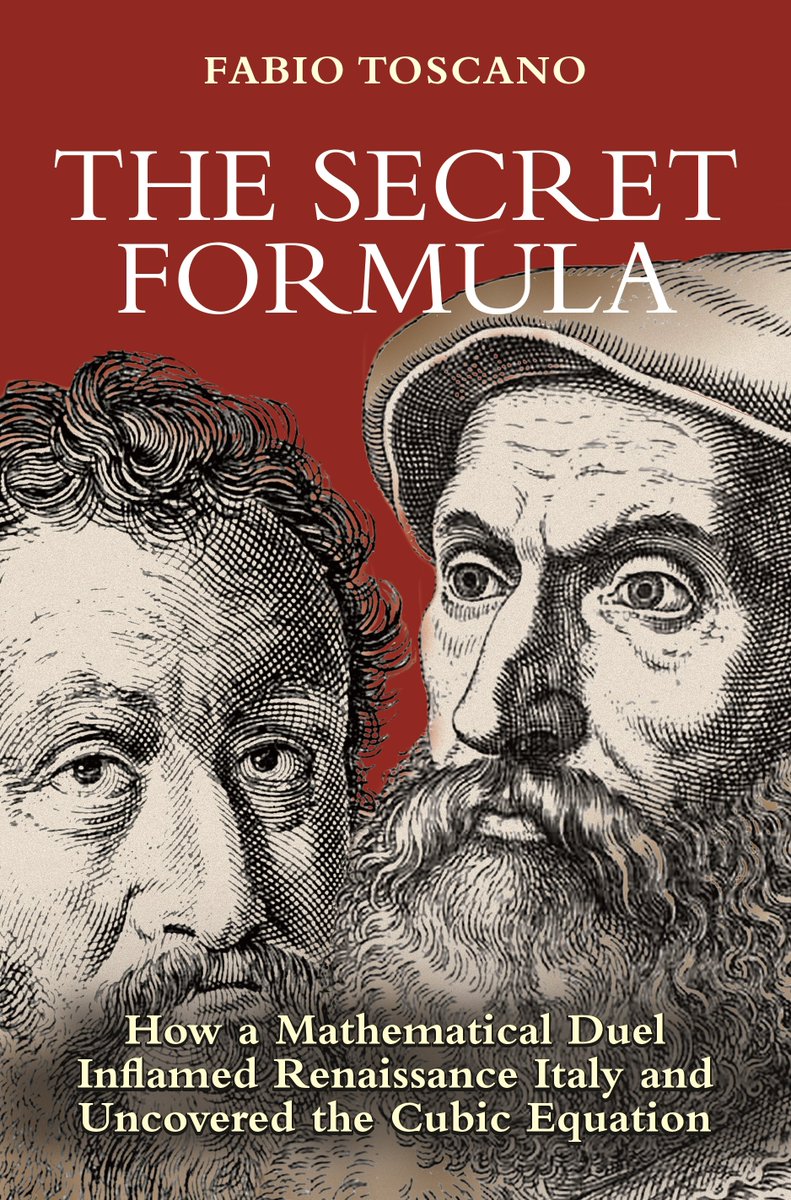
Mathematicians in Renaissance Europe partook in academic duels to win one another's respect, students, assets, and academic positions. A duel like this is how the cubic equation became known—the first real algebraic discovery since the Babylonians. Let's talk angry Italians🧵
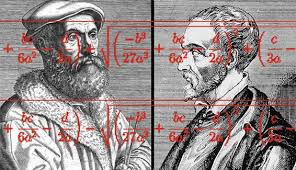
The cubic equation was sought after by numerous ancient civilizations, from India to Greece, and despite attempts, a solution was never found You're probably familiar with these equations, but they're of the form x^3 + cx = d Without a squared term, we have a "depressed cubic"
The mathematician Scipione del Ferro, a professor at the University of Bologna, found a way to solve these cubic equations around 1510. And then he kept the method a complete secret until his death bed.
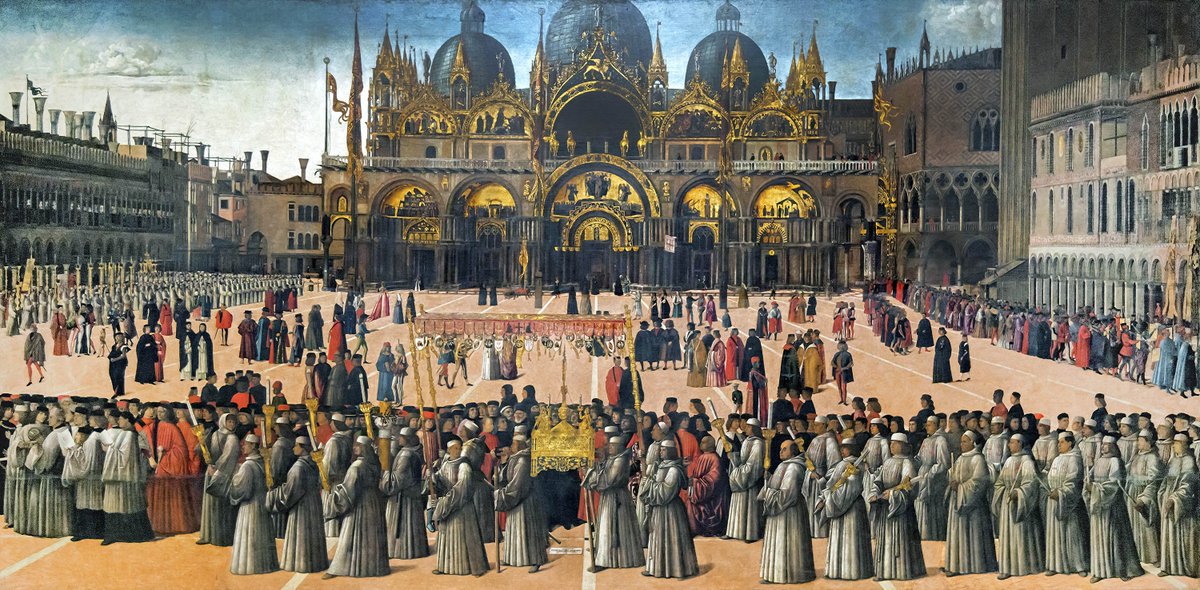
In Renaissance Italy, the life of a mathematician was one that was always beset by trouble precisely because mathematical duels existed. At any moment, a talented upstart could come and issue you a series of mathematical problems to initiate a duel.
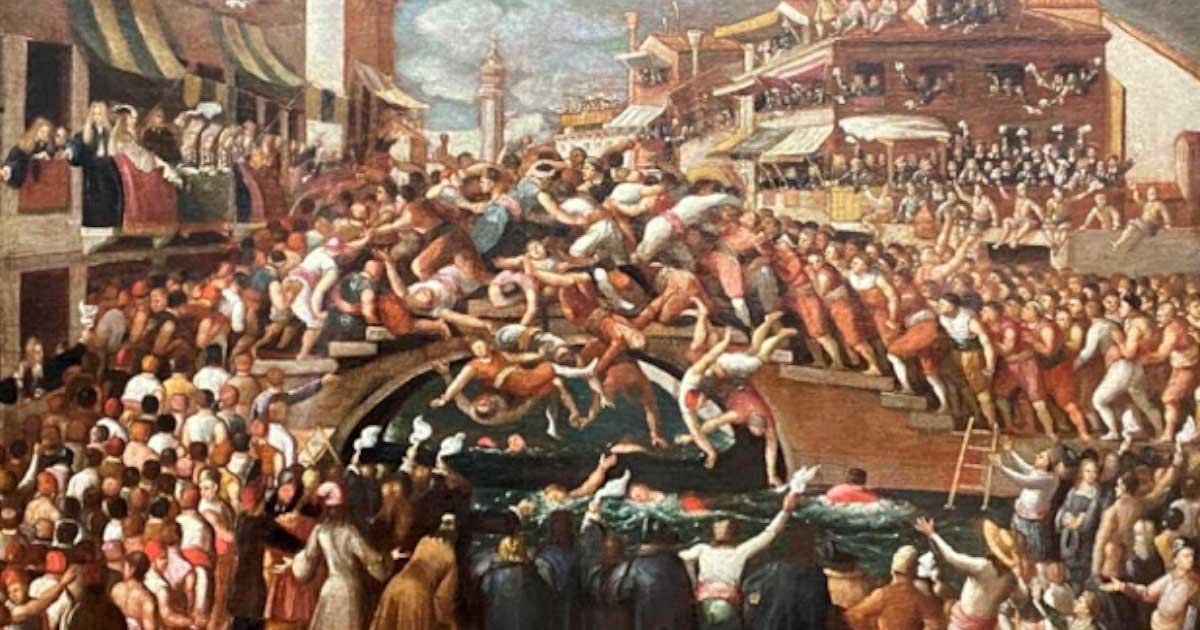
If you failed to solve the problems, you could lose prestige, you could lose money, you could lose students, and you could even lose your teaching position. For that reason, del Ferro kept his method a secret so he could quash any upstarts seeking to take his job.
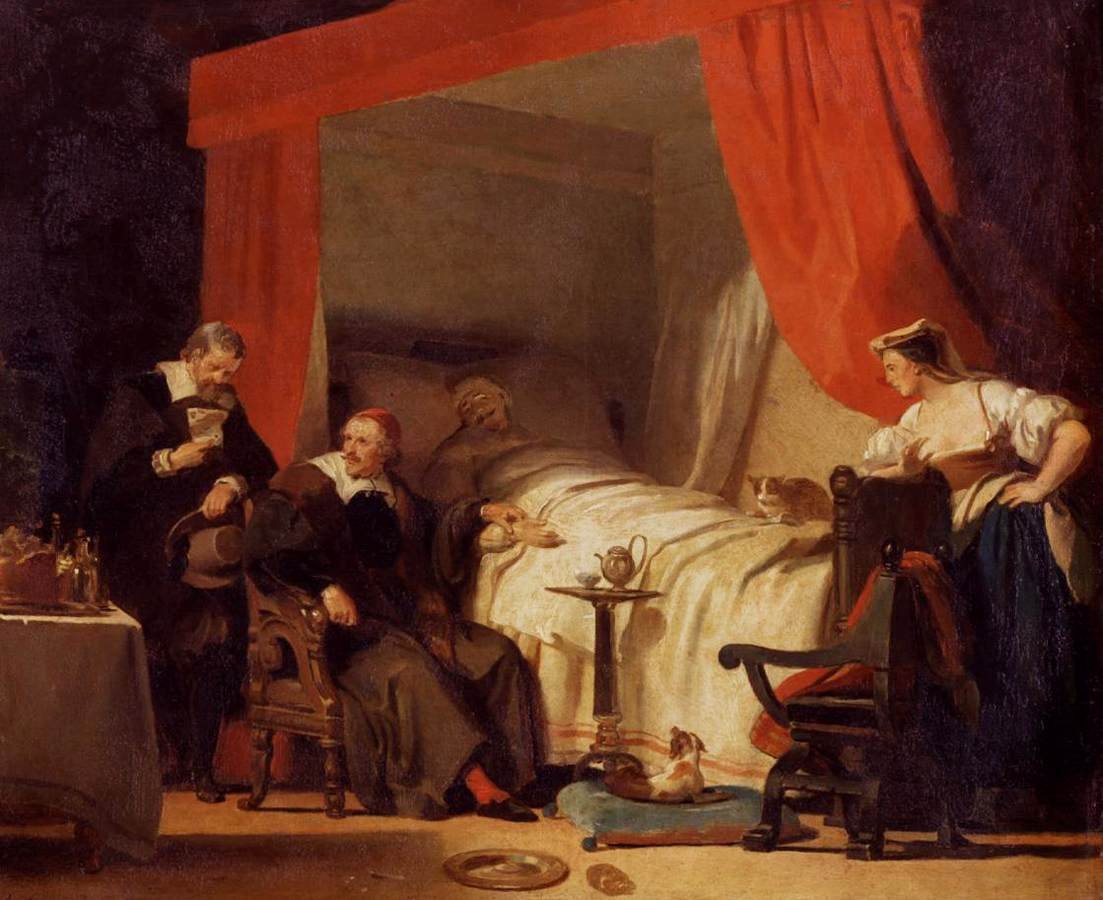
At least until he was on his death bed almost 20 years later. From his death bed, he taught his student Antonio Fior how to solve the depressed cubic. Fior, who was a bit of a gambler and a loser, started bragging and sought to prove his mathematical mettle by using it in duels
Fior issued a series of thirty different problems to a new mathematician in town, one Niccoló Tartaglia. Tartaglia responded with his own thirty questions, and they both agreed to the duel and had the notary Iacomo Zambelli certify what would happen to the loser.
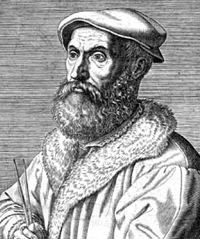
The terms of this duel were not very extreme. The loser would concede his inferiority and provide the other one a lavish dinner per unsolved question.

Tartaglia solved Fior's questions in two hours In the whole 40-50 day period of time he was allotted, Fior failed to solve a single one of Tartaglia's questions Everyone in Venice thought this was exciting and embarrassing for Fior, and news even spread to Tartaglia's hometown
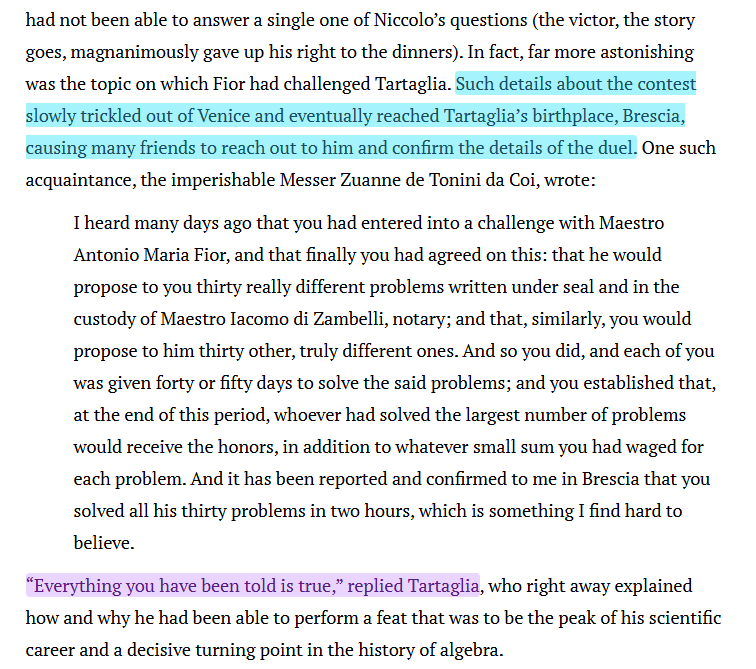
Tartaglia was an overnight celebrity Tartaglia had figured out an important formula some time before the duel, and Fior wasn't bright enough to even use it From here on, Tartaglia's life was made! People came from far and wide to be his students, and everyone wanted his secret
One particularly persistent fellow who nipped at Tartaglia's heels was Giralomo Cardano. Cardano sent Tartaglia letter after letter asking for his secret, but the famous mathematician would not budge. He wouldn't even provide him with a question from the duel.
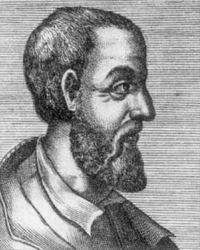
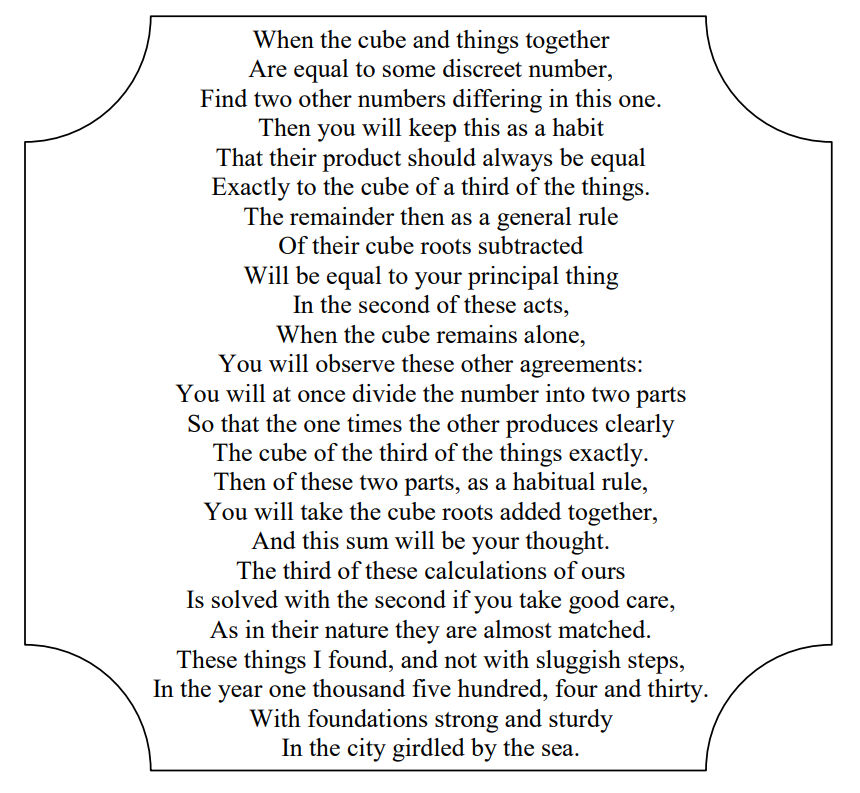
Until one day, after being bribed with an introduction, Tartaglia agreed that Cardano he could have his formula on the condition of never revealing it to a soul. Now, bear with me. Notation was, in those days, less standardized. Tartaglia's equation came in the form of a poem:
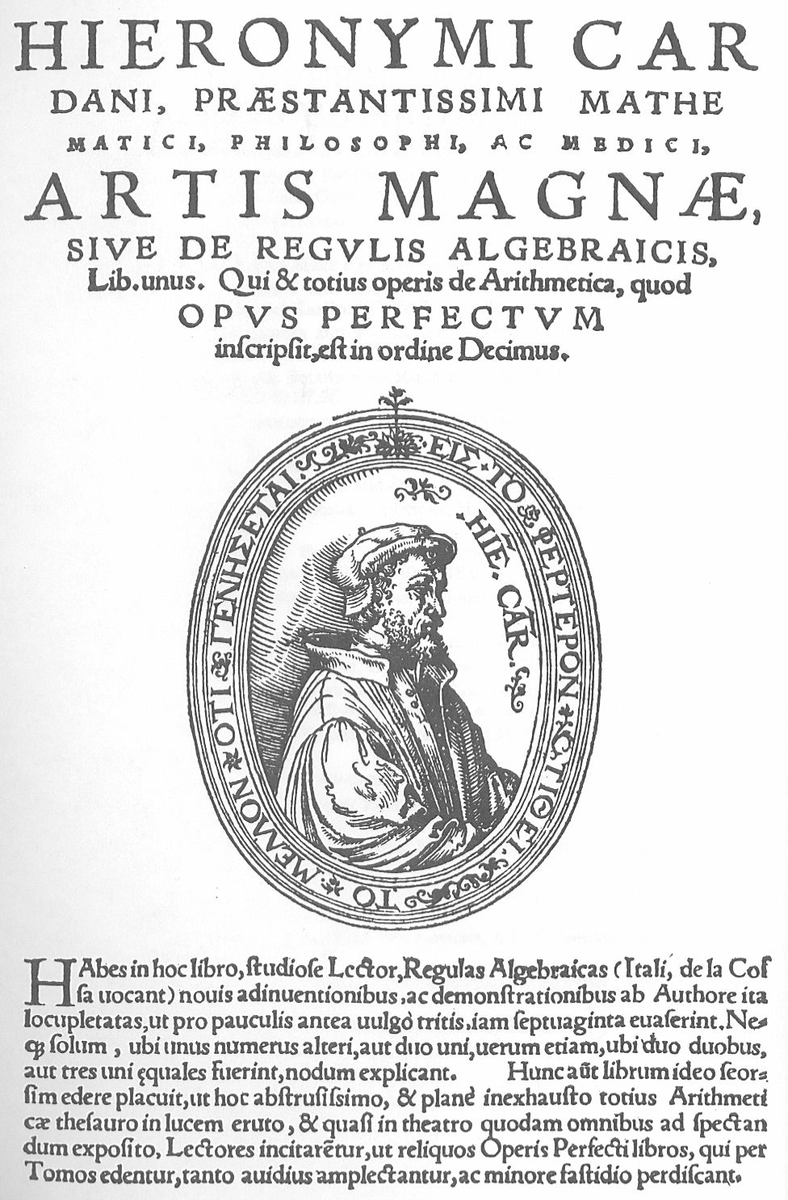
But, some years later, Cardano acquired Scipione del Ferro's notes on the formula and thought "Well, it wouldn't violate my oath if I published this, since it wasn't from Tartaglia." Both men arrived at the same formula, so what's the harm? Enter Cardano's Ars Magna:
Tartaglia was furious about Cardano's book and sought to make Cardano pay him by taking him to court. But the courts didn't care. After all, why should knowledge remain private? They didn't see a good reason why.
After failing to sue him in court, Tartaglia challenged Cardano to a mathematical duel But Cardano could refuse Tartaglia, since he wasn't a mathematician, he was a medical doctor and public polymath He had no academic position to defend, so he supported sharing all knowledge
Tartaglia was, of course, still upset. But Cardano's student (whom Cardano had elevated into a teaching post he didn't personally want) saw this as a great opportunity to grow his own fame. So, on his master's part, Lodovico Ferrari accepted the duel.
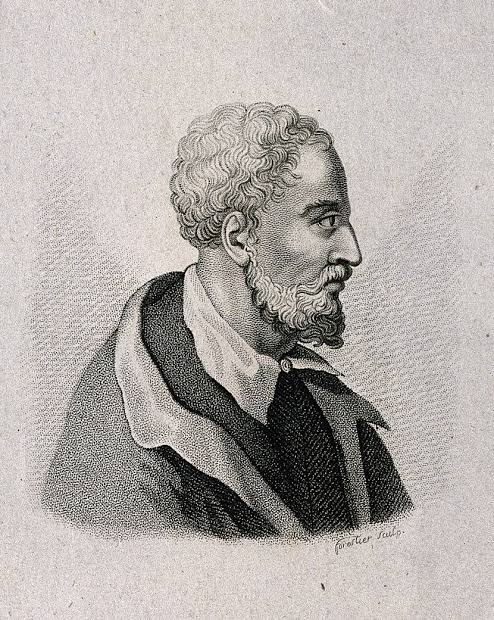
The men met in a square in Milan and publicly debated equations. But Ferrari was his better. In fact, Ferrari was equal to the genius Cardano, and he had solved quartic equations—the last step before reaching the indeterminacy of quintic equations.
Embarrassed by losing after desperately begging for a duel to prove his honor, Tartaglia fled Milan and his reputation was ruined. He lost his job and he went bankrupt. Meanwhile, Ferrari was feted for the rest of his days and the job offers and requests for teaching flooded in.
At the end of the day, the European system of dueling with words, formulas, and findings to acquire academic positions, titles, and merits had its up- and downsides. For one, the secrecy it engendered was probably harmful. People hid results to best would-be opponents.
In a very real sense, this system of dueling made it so science advances one death at a time, because people only gave up their secrets on their death beds! But in another, it did encourage excellence, and it did provide room to celebrate non-academic geniuses like Cardano.
Do I wish we had a system for academic duels today? Yes: absolutely, unequivocally, and completely. I actually think it should go further. I think that if you prove someone's a fraud, you should be able to take their doctorate from them. Oh to dream.
The source for this information is Fabio Toscano's The Secret Formula, a book that's well worth reading. It's dry, but the subject is so fascinating on a deeper level that I can still highly recommend it.