
this is a huge misconception that needs to be addressed properly. let me explain why. i know most people don’t read my posts, but trust me, this one is both educational and interesting. so stick with me. 🧵
let’s assume the price of ETH drops to a ridiculously low value, $1 per ETH with the current supply. now, let’s break down how much an attacker would need to spend to compromise the security of the Ethereum blockchain.
current total supply of ETH: ~120 million ETH total staked ETH (as of now): ~27 million ETH (rough estimate)
ethereum’s PoS security threshold to compromise Ethereum via a 51% attack, you need control of at least 51% of the actively staked ETH. that means: 51% of 27 million ETH = 13.77 million ETH at $1 per ETH: cost of attack = $13.77 million sounds cheap right? not exactly…
1. liquidity matters. you’d need to buy most of the staked supply, which is likely held by long-term validators, not for sale. aquiring that much ETH would drive the price back up, or you’d need to buy OTC at a premium.
2. validators are distributed you’d need to run ~430,000 validators (32 ETH each) that’s a massive infrastructure operation, not just a wallet full of coins.
3. slashing and retaliation risk if caught attacking, Ethereum clients could coordinate a fork that slashes or invalidates your stake. you’d lose your ETH and potentially achieve nothing if the network reorganizes.
4. social consensus kicks in in a low-price scenario like $1, Ethereum might be seen as already “dead”, but ironically, this increases the community’s willingness to fork out malicious actors. it’s easier to coordinate defense if value is low and ideology is high.
but what about BTC at $1: the current block reward is 3.125 BTC ($3.125) that’s not enough to cover electricity, even on the cheapest energy. possible scenario: 1. miners shut down. hashrate collapses. 2. anyone with access to even modest mining power could dominate the network.
cost of attack: renting hashpower or deploying old asics might cost under $1M to overtake the chain. conclusion: bitcoin becomes trivially insecure at $1 the economics of PoW completely break.

bitcoin’s PoW relies on economic incentive to justify energy use. if price drops too low, miners abandon the network, and security dies. Ethereum’s PoS is more resilient in low-price environments, because it doesn’t depend on external energy costs, just stake and coordination.
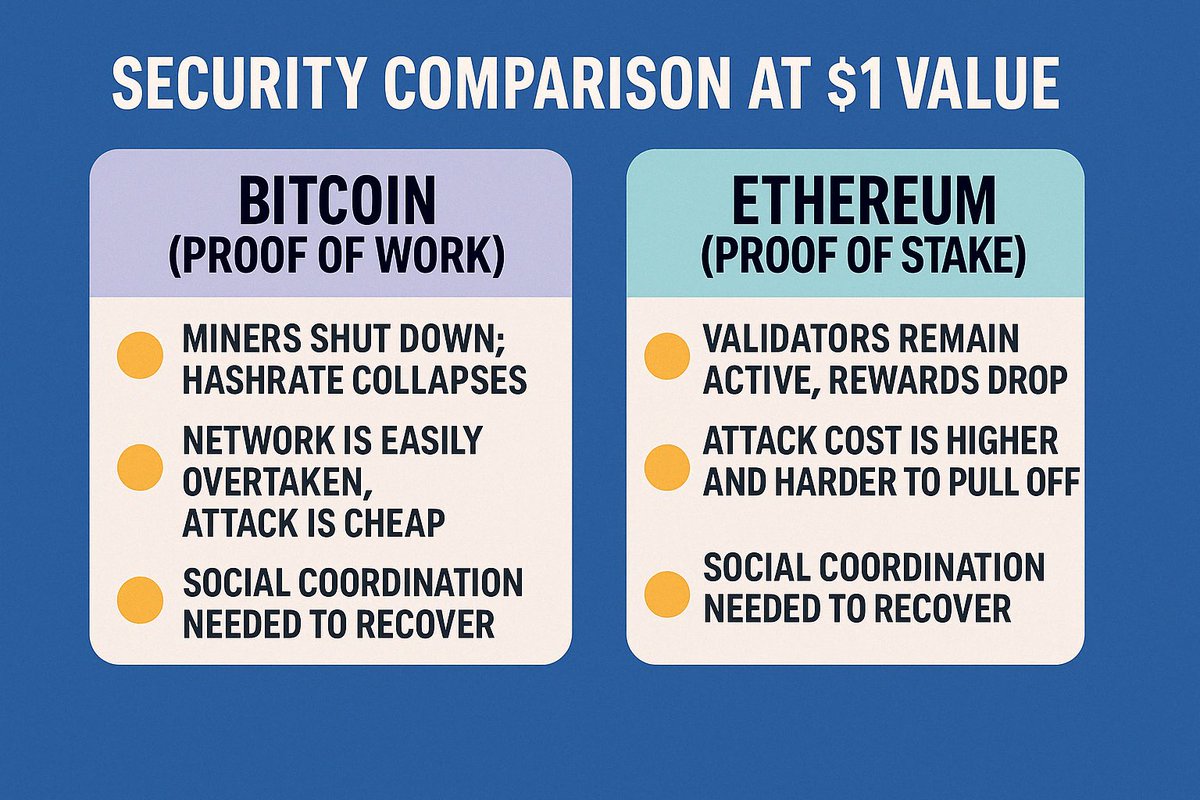
Ethereum is arguably more secure by design, thanks to slashing, stake-based consensus, and easier social recovery. bitcoin’s PoW is harder to kill outright, but has less built-in recovery tools. at current BTC prices, ETH > $145 makes Ethereum more secure than Bitcoin.
IMO at the end of the day, PoW is expensive and outdated. Ethereum secures itself through capital, coordination and code. just stake ETH. @tkstanczak @VivekVentures @materkel @ec265 @AdrianoFeria @digitalartchick @VitalikButerin @torok_tomi