
Mini thread on Tié, the long sought Njimi Capital of the Kanem empire


The Kanem site of Tié, the long sought capital of Njimi is located northeast of lake Chad and thanks to recent excavations taken by magnavita’s team. We are now more certain Tié was the medieval capital of Njimi. Due to the constructions dating back from the 11-13th C.
Tié is now understood to be much larger than previously thought, thanks to recent excavations. Where only 16 sites were known in the region, that number has increased to 90.
The majority of the fired brick sites are concentrated in a defined area east of Mao, spanning the territories of the Kanem and Bahr el Gazel regions. This area, along with most of the fired brick sites within it, likely represents the political core of the Kanem empire.

The sites include a relatively large fired brick residential enclosure (Tié) within this enclosure archaeologists uncovered a substantial multi-roomed palace built of fired brick. Featuring lime plastered interior walls and measuring 16.8 by 23.4 meters.
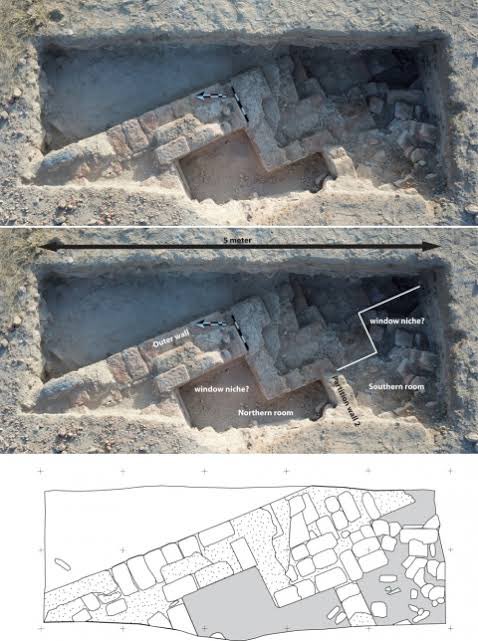


Two smaller enclosures Tié Kalatè S1 and Tié Dardanga S1, just located 2.5 km away from Tié, also contain a series of interior structures. These smaller sites were likely established in the 11th century or earlier.
To help confirm that the ten fired brick sites near Tié were built during the Kanem empires dominance, archaeologists test excavated and sampled five of them: Tié Babanga S1, Tié Koulkou 2, Tié Kalaté S3, Tié Dardanga S5, and Tié Kalaté S2. These sites are located 3.9km from Tie.
Tié Babanga S1 is a small residential enclosure, and Tié Koulkou 2 is very similar. Tié Kakaté S3 is another enclosure but may be apart of a larger settlement of scattered houses to the east.
Tié Dardanga 5 is a single isolated house with no visible surrounding structures. Tié Kakaté 2, unlike the others, is not a dwelling but a cluster of discarded bricks in a Wadi- suggesting it was a site for clay extraction and brick production. Tié Kakaté S2 was a industrial site
Here is the link to the very recent study on Tié that was published at the beginning of this year, in which excavations in Kanem is an ongoing project in which we will get more studies or discoveries in the future: https://link.springer.com/arti...
@milad_leo I like this map of the kanem-bornu
@Tril892754 Yeah, a friend of mine made the map. It covers up where most maps on Kanem fail.
@milad_leo A question that bothers me is, why did they leave?
@aliberiansalafi Due to a period of civil war which forced the ruling class (Sayfawa) to switch their court to Borno in the 15th century. Even after Kanem was reconquered, Kanem was less fertile than Borno, which is why Borno became the new political center of the sayfawa.
@milad_leo Al Kanemi was a colonizer just like Usman Danfodio too creating the Bornu and Sokoto caliphate 🤔