
I've written a detailed thread to teach you everything you need to know about Timeboost, @arbitrum's latest upgrade. This efficiency upgrade introduces a new transaction ordering policy to reduce spam, and offer faster inclusion for your transactions. Here's how it works 🧵 👇
Prior to the launch of Timeboost, Arbitrum One and Nova sequencers operated using a First-Come First-Serve (FCFS) inclusion mechanism. This mechanism is useful, because it protects users from harmful types of MEV, such as sandwich attacks - though, it did introduce a tradeoff.
Unfortunately, in most scenarios, nearly all of the MEV was being extracted by searchers who would spend heavily on resources like hardware and spamming in order to win latency races.
The problem was that none of the MEV extracted was benefiting the ecosystem in any way. In fact, these latency games between searchers would often lead to unnecessary stress placed upon the network, which ultimately lead to unwanted congestion, and suboptimal UX for users.
Thankfully, we have a stacked team of researchers and developers who have spent more than a year ironing out a solution to this problem. The solution is Timeboost - an ordering mechanism that retains all of the benefits of FCFS, but with a viable solution to our MEV problem.
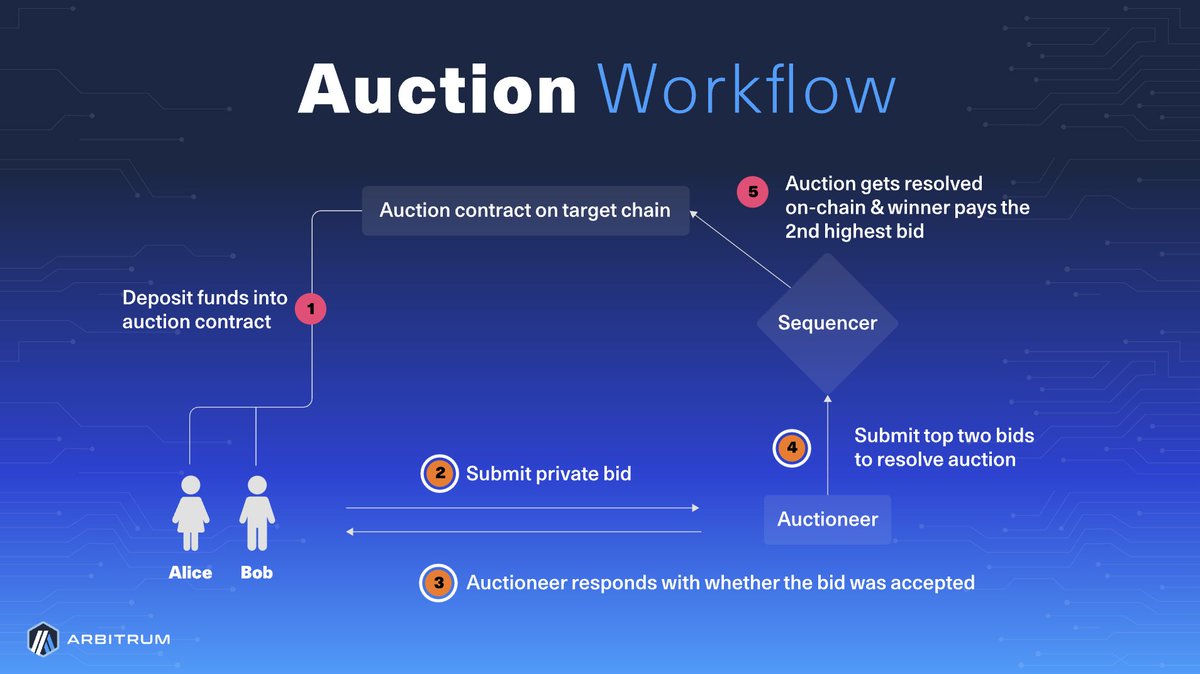
Timeboost is broken down into three key components: 1) An "Express Lane" 2) An offchain auction (to decide the temporary leader of Express Lane) 3) An auction contract (canonical source of truth for results and handling)

The "Express Lane" is a form of priority access that allows valid transactions to be sequenced immediately after the sequencer receives them. In order for this to work, a per-round auction is held every 60 seconds to determine the temporary controller of the Express Lane.
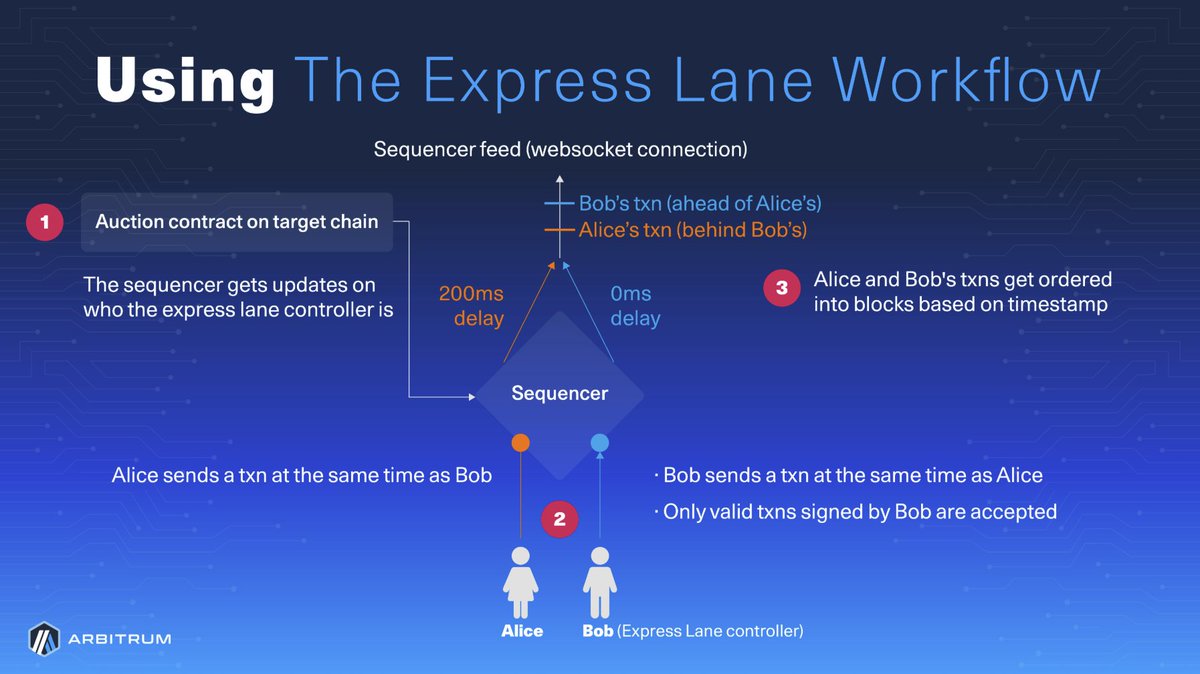
Even though the highest bidder (Express Lane controller) of any given round will have their transactions included first, the average user who is not using the express lane will only incur a very minor 200ms delay - the benefit is that we end up with less congestion for everyone.
Okay, but why do we need Timeboost? Well, for one, this new ordering policy allows the owner of any customizable Arbitrum chain to capture a larger share of MEV, and distribute it how they please - such as to their app layer, or user base.
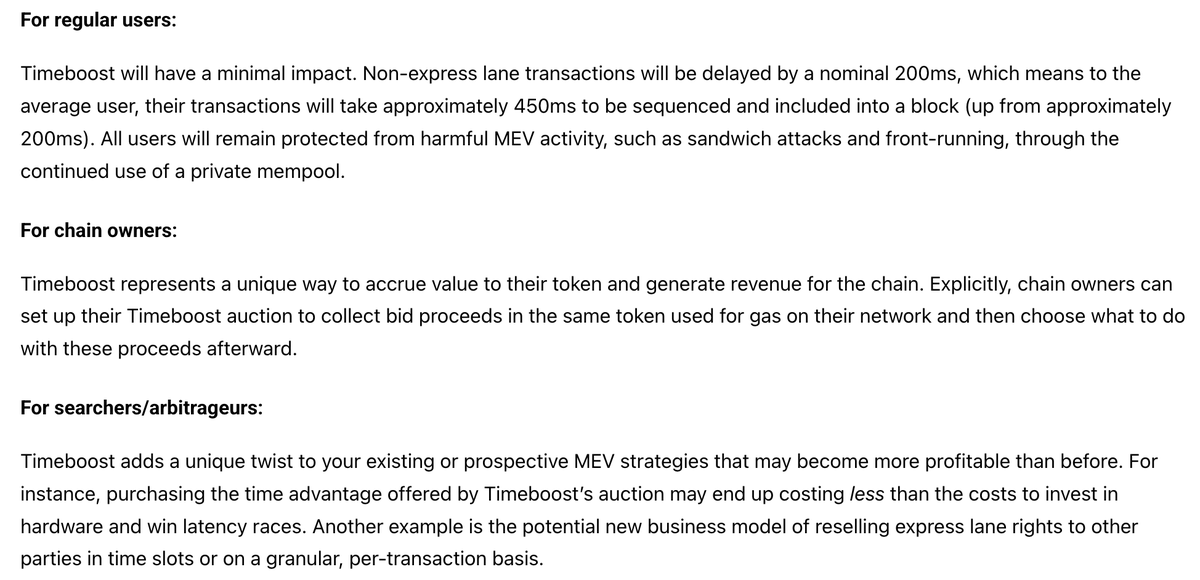
As an added bonus, chain owners can use Timeboost to introduce more efficient methods of value accrual to their own token, such as enabling the use of a custom gas token, etc.
All in all, Timeboost is a massive UX improvement for Arbitrum chains and their users. MEV is a difficult problem to solve, but I'm glad that Arbitrum is on the forefront of trying out new ways to make MEV less extractive, and instead, more empowering for the Ethereum community.