
Whenever I see people debating what we should take away from experiments where AI demonstrates troubling behavior, I am reminded of the true story of William “Billy” Mitchell vs. the battleship Ostfriesland. 🧵
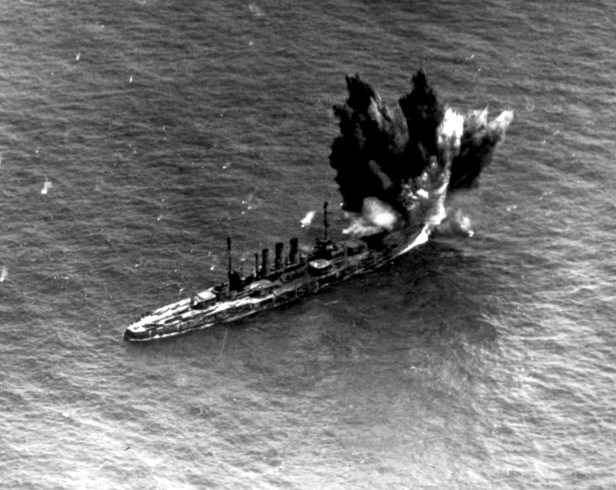
Background: Mitchell believed he had seen the future of war over the skies of France, where he had commanded more than 1,500 allied aircraft in the final months of WWI. He came home frustrated that the U.S. had not formed a separate military branch for its air service. (2/49)
One could argue that Mitchell was merely hoping to rise higher personally by raising the stature of airpower at the expense of land and sea forces. Indeed, this is a story of how a great many reasonable things can always be argued by those with motive to do so. (3/49)
Losing the top post in the Army Air Service to someone who had never been in an airplane must have been especially irritating to Mitchell. This didn’t stop him from publicly challenging top-level doctrine, to the annoyance of top brass. (4/49)
Stating that “changes in military systems come about only through the pressure of public opinion or disaster in war”, he set about arranging a demonstration of air power that the public could understand, even if the establishment preferred not to. (5/49)
Mitchell argued that the Air Service could defend America’s coastlines better and more cost-effectively than the Navy, and that the U.S. should get some aircraft carriers. So the public demonstration he needed was obvious: Mitchell needed to sink a battleship. (6/49)
This is 1919-1921. It’s easy to forget that battleships were the nukes of the early 20th century. As undisputed masters of the seas, they were the focus of an arms race so ruinously expensive that key players would sign a treaty in 1922 to limit their construction. (7/49)
It’s also easy to forget how slow and flimsy the era’s aircraft were, being primarily biplanes of wood and fabric construction. You probably drive a car that can go faster than the cruising speed of the bombers in this story. (Below: The Martin MB-2) (8/49)
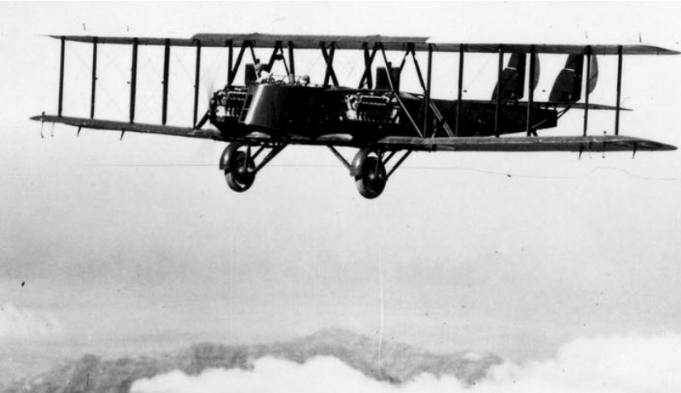
“The Navy doesn’t need airplanes. Aviation is just a lot of noise.” —Admiral William S. Benson, Chief of Naval Operations, 1919 (9/49)
As Mitchell’s WWI exploits had earned him a good deal of fame and congressional support, the Navy felt they had to rebut his testimony that the Air Service could “destroy or sink any ship in existence today”. Which they did, by sinking their own battleship. (10/49)
That would be the decommissioned Indiana. In late 1920, The Navy pelted her with dummy bombs and set off explosive charges at the corresponding locations. It’s not clear if they intended to sink her, but they regardless claimed the tests refuted Mitchell’s boasts. (11/49)
Captain William D. Leahy, in his report on the Indiana experiments: “The entire experiment pointed to the improbability of a modern battleship being either destroyed or completely put out of action by aerial bombs.” (12/49)
Unconvinced, in December of 1920, Congress took up two resolutions urging the Navy to provide ships for Mitchell to bomb. Before these could come to a vote, the Navy agreed to carry on a series of bombing experiments with the cooperation of the Army Air Service. (13/49)
The former German battleship Ostfriesland, would be the main target. Ceded to the victors after WWI, she was about as unsinkable as the technology of the era permitted. She had survived 18 shell hits at the Battle of Jutland, and a mine hit on the way home. (14/49)
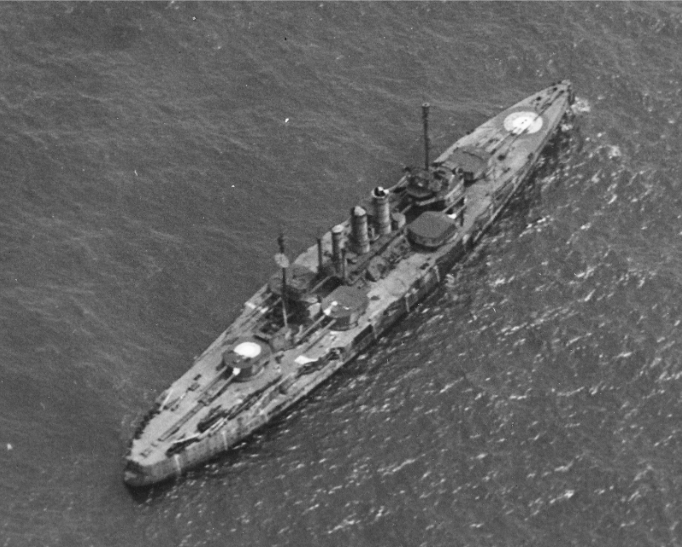
Regardless of how the tests went, there would be plenty of room to dismiss them. They would hardly reflect battlefield conditions. Mitchell’s 2,000-pound bombs had to be specially produced; the largest available bomb in service was only 1,100 pounds. (15/49)
Mitchell would also get multiple attempts over two days, starting with smaller bombs on day 1. (As expected, these would do minimal damage.) And most unrealistically, the Ostfriesland would be anchored, uncrewed, and undefended. (16/49)
“I would be glad to stand bareheaded on the deck or at the wheel of any battleship while Mitchell tried to take a crack at me… he will be blown to atoms long before he gets close enough to drop salt on the tail of the Navy.” —Josephus Daniels, Secretary of the Navy, 1921 (17/49)
But the test would also be unrealistic in other ways. Most glaringly, torpedoes were forbidden. (Probably because the Navy already had plenty of data about battleships vs. torpedoes; this test had been justified by the lack of similar data on aerial bombs.) (18/49)
And on the day for the bigger bombs, Mitchell’s bombers were allowed only three of their largest munitions, and were to stop after two direct hits. Mitchell ignored the last-minute payload limit; his flight of eight bombers each carried a single 2,000-pound bomb. (19/49)
And the final restriction suited Mitchell fine; he ordered his formation to avoid direct hits and instead aim for near misses to cause “water hammer” shock damage below the waterline. (20/49)
July 21, 1921. 12:18 pm: Bombing commences. 12:40 pm: The Ostfriesland sinks. Mitchell only needed six bombs. (21/49)
The public was impressed. Mitchell testified to Congress that in his opinion, “the Navy actually tried to prevent our sinking the Ostfriesland.” Navy leadership, on the other hand, insisted that Mitchell had broken the rules and ruined their data. (22/49)
“The battleship is still the backbone of the fleet and the bulwark of the nation’s sea defense, and will so remain so long as the safe navigation of the sea for purposes of trade or transportation is vital to success in war,” —Joint Army and Navy Board post-test report (23/49)
After Mitchell’s very different report leaked to the press (“Had the Army Air Service been permitted to attack as desired, none of the seacraft attacked would have lasted 10 minutes…”) the Director of the Air Service pushed, unsuccessfully, for Mitchell’s removal. (24/49)
The next four years would play out as follows: 1922: The Navy commissions its first aircraft carrier. This shift to carriers has less to do with Mitchell than with the limits on battleships in the new Washington Treaty for the Limitation of Naval Armaments. (25/49)
1923: Mitchell and the Air Service go on to sink a second surplus battleship and severely damage a third. The Army Chief of Staff, showing solidarity with the Navy, publishes a dismissive op-ed in the New York Times. (26/49)
“These tests against obsolete battleships will not, I hope, be considered as conclusive evidence that similar bombs would sink modern types of battleships.” —Army Chief of Staff John J. Pershing, 1923 (27/49)
1924: In a report following a Far East inspection tour, Mitchell predicts, in great detail, that the Japanese, as part of their expansionist plans, will one day bomb U.S. assets on the Hawaiian island of Oahu in a surprise Sunday-morning attack. (28/49)
1925: Tired of his criticism and insubordination (he had recently accused senior Army and Navy leaders of incompetence leading to the loss of the airship Shenandoah), the War Department, at the President’s request, successfully court-martials Mitchell. He resigns. (29/49)
William “Billy” Mitchell died in February of 1936. The Navy’s strong disagreement with his demonstrations did not. (30/49)
“It is significant that despite the claims of air enthusiasts no battleship has yet been sunk by bombs.” —caption to photo of the USS Arizona, Army-Navy football game program, November 29, 1941 (31/49)
