Tesla Energy - Growth & Profit Contributor In Q1 2025 Tesla Energy generated revenue of $2.73 billion, up 67% from the same quarter one year ago. More importantly, gross profit of $785 million rose 95% from the same quarter one year ago - to a new quarterly record. Tesla Energy is now Tesla's most profitable line of business, with gross margins of 28.8% in Q1 2025. What's amazing is that Tesla has achieved this profitability in spite of rapidly declining energy ASPs (average selling prices per KWh deployed). The chart below shows how ASPs (measured by the trailing 12-months revenue divided by the trailing 12-month deployments - to smooth out some of the lumpiness) have declined over time from over $2,500/KWh in 2017 to under $300/KWh today. Most recently, over just the last 12 months, ASPs declined from $412/KWh to $296/KWh - that's a 28% decline - and Tesla's gross profit margins still rose from 24.6% to 28.8%! What might explain the increase in gross margins? I can think of a few reasons: 1) Scale - as Tesla scales up the business, the cost of production (the orange line in the chart) can be spread out over a higher unit volume. With a new Megapack factory in China and another one being built-out in Texas (near Houston), Tesla should continue to benefit from scaling this business. 2) Product Mix Shift - The gross margin increase could partly stem from a shift in Tesla Energy’s product mix. If higher-margin products like Megapacks (used for utility-scale projects) are making up a larger share of revenue compared to Powerwalls (for residential use), this could boost overall margins. Megapacks, being larger and tailored for high-value grid applications, likely carry better margins than smaller-scale products. 3) Learning Curve Effects - As Tesla produces and deploys more energy storage units, it benefits from the learning curve - accumulated expertise in design, production, and installation. This can lead to incremental cost savings through process refinements, waste reduction, or faster production cycles, all of which enhance margins. 4) Tax Credits: In some markets, Tesla Energy benefits from tax credits. These could enhance profitability without directly affecting ASPs or production costs. 5) Autobidder - Tesla’s Autobidder, an AI-powered software platform, optimizes the operation of energy storage systems like Megapacks by autonomously managing energy trading in electricity markets. The marginal cost of deploying Autobidder to new installations is minimal, making it a high-margin product. If Tesla charges licensing fees, subscriptions, or a share of the revenue generated by Autobidder-managed systems, this adds a lucrative revenue stream that boosts overall gross margins for Tesla Energy. continued...


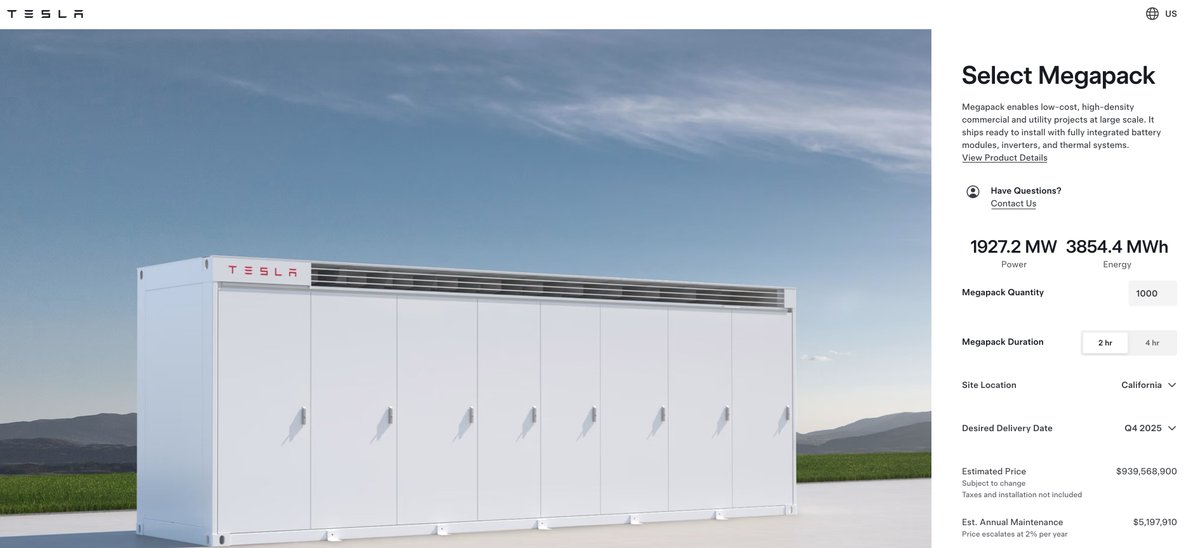
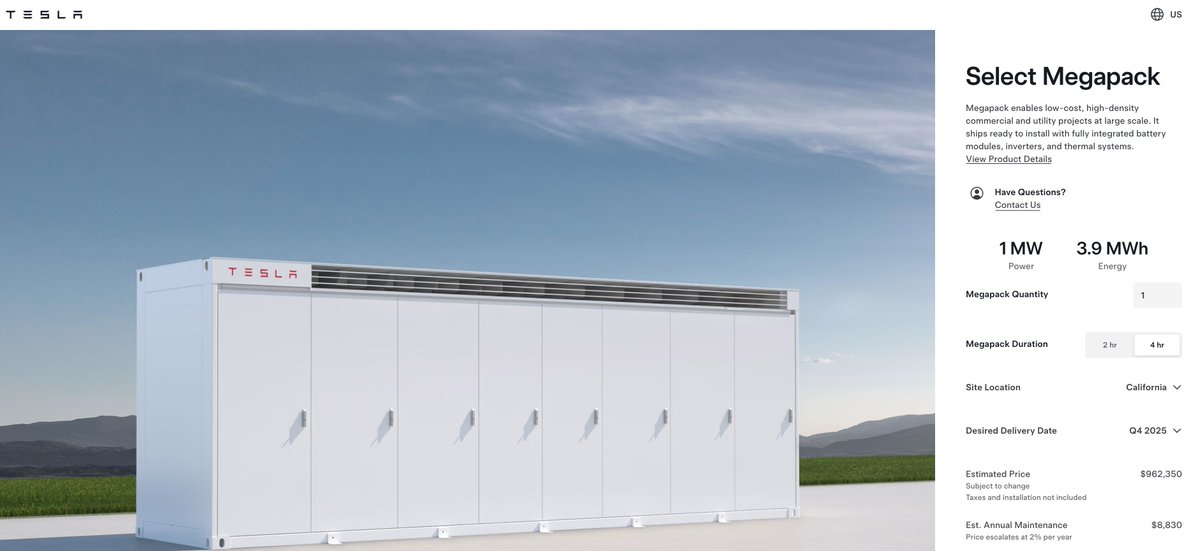
What are Megapack ASPs today? Here are four examples... 1) If you purchased one Megapack (2hr duration) and ship it to California, it will cost $1,028,580 - that's $263/KWh. 2) If you purchased 1,000 Megapacks (2hr duration) and ship it to California, it will cost $939,569 each - that's $241/KWh. 3) If you purchased one Megapack (4hr duration) and ship it to California, it will cost $962,350 - that's $247/KWh. 4) If you purchased 1,000 Megapacks (4hr duration) and ship it to California, it will cost $877,603 each - that's $225/KWh. Just taking a simple average of all four gives us a rough average ASP of $244. Note: This is just the pricing for shipping to California, which probably gives us the lowest possible shipping costs (since the manufacturing plant is in Lathrop, CA) - so it also gives us the best indication of the underlying $/KWh. That said, now that the new Megapack factory is up and running in China, ASPs could be somewhat lower in that market (it's a more competitive market). But this also means that material costs and labor costs are lower - so the profitability of a Megapack made in China might be higher than one made in the US -- only time will tell!