INDIA'S VENGEANCE IS BEST SERVED COLD The single biggest mistake of the century was America's response to Pakistan-backed fundamentalist terrorism. And it happened in three acts. (1) First came Bush, the anti-terror president, who overreacted to terrorism by starting a giant series of wars. (2) This led to Obama, the antiwar president[1], who overreacted to war by starting a giant surge in woke[2]. (3) This in turn led to Trump, the anti-woke president, who is now reacting to woke by ending[3] a giant empire. And this whole series of events was due in large part to Pakistan. Because Osama bin Laden was based in Pakistan, just down the street from the Pakistan Military Academy! Remember, America had everything going for it on September 10, 2001. It was the world's dominant hyperpower. But Osama bin Laden and Pakistan successfully baited the US into wasting its blood and treasure on war, distracting America from the rise of China[4], and thereby kicking off the series of events that brought us to the present day. So: India should learn from America's mistakes. It should not take the bait of Pakistani terrorism. It should instead play its own game, and coldly neutralize Pakistan by aligning the world against it. Here's what that could look like. WHAT INDIA CAN DO First, what should Bush have done? In retrospect, he should have stopped fundamentalist immigration into all NATO countries, avoided war in favor of surgical counterterrorism, and targeted Wahhabism at the root by backing domestic anti-fundamentalists like Mohammed bin Salman[5]. That would have neutralized the terrorist threat without waging a giant war. And that is what India can do in response to Pakistan's bait. IN THE SHORT RUN Let's divide India's possible strategy into short run, medium run, and long run actions. In the short run, India should: (a) Stop the immediate threat. 99% of security is border security. So the smart first step for India is to do what they've just done[6]: namely, temporarily suspending issuance of visas to Pakistani nationals, asking those still within India to leave, and securing the border. While this policy will regrettably impact the many Pakistani nationals who aren't fundamentalists, it is essentially nonviolent. And it addresses the immediate situation by making it hard for Pakistan to execute followup attacks within India. (b) Begin surgical counterterrorism. The next step is to hunt down the gunmen within Kashmir and then begin surgical counterterrorism. No doubt this is already happening, but the basic point is that invisible special operations are the appropriate mirror to deniable terrorist attacks. That is: retaliation should look more like pagers[7] than bombers. IN THE MEDIUM RUN With the border secured and counterterrorism initiated, India's next step should be to isolate the Pakistan regime economically and diplomatically by cutting off its support from the US and EU/UK. (a) Incentivize the US to stop arming Pakistan. Somehow America is still sending money to Pakistan[8], as a relic of Cold War-era policy. The latest episode involved the release of $397M (!) for some sort of bizarre program to monitor the use of Pakistani F-16s for counterterrorism. Obviously: F-16s aren't useful for counterterrorism, Pakistan shouldn't have F-16s, Pakistan intends to use those F-16s against India, the $397M sent to Pakistan will be stolen, and the program as a whole just helps prop up the prestige of the Pakistani army. Instead, India should ask the US to just shut down all funding for Pakistan, the country that harbored bin Laden. That saves the US money, it's in America's national interest, and India is a better customer anyway. (b) Incentivize the EU/UK to stop trading with Pakistan. India has a long history with the UK and billions in trade with the EU. All parties want a trade deal given current circumstances. So India can ask the EU/UK to freeze out Pakistan[9] in return for more market access. If it really needs to sweeten the pot, India does have some influence over Russia[10] — so India can offer to help bring peace to Ukraine in return for EU/UK sanctions on Pakistan. IN THE LONG RUN Now for the hard part. India's strategic goal with Pakistan should actually be regime change, with the goal of deniably installing a non-fundamentalist leader like Ataturk/MBS/MBZ/Reza Shah Pahlavi/Zahir Shah[11-15] who can keep the lid on. But this can't be done through a Bush-style invasion, both because that'll wreck India's economy and because Pakistan has ~250M people and nuclear weapons. Fortunately, there are other mechanisms for regime change. And in Pakistan's case, the key lever may be Chinese money and Gulf oil rather than the Indian military. NO WAR, JUST OIL As background, China is Pakistan's number one backer[16], in part because China and India are rivals in many ways. But China needs oil more than it opposes India. And that could be the key to flipping China on Pakistan. You see, China is trying to build a pipeline[17] through Pakistan to pump oil from the gulf: But fundamentalist psychos in Pakistan keep launching attacks on that very corridor, including one in October[18] that killed multiple Chinese nationals: Moreover, China and India have a shared interest in stopping fundamentalism in Central/South Asia, because it's been a huge issue for China too since at least the 2014 Kunming[19] stabbings. So: India could make the case to China (and the Gulf states!) that they should cooperate to nonviolently support anti-fundamentalist factions in Pakistan. Then China gets all the oil they need, the Gulf gets all the money they want, and India gets all the peace they deserve. How would this work? Well, Turkey had Ataturk[10], and Saudi had MBS[11], and the UAE had MBZ[12], and neighboring Iran had Reza Shah Pahlavi[13], and neighboring Afghanistan had Zahir Shah[14]. Moreover, India is friendly[20] with the Gulf states, which it trades with quite a bit. So it's not completely crazy to imagine that by combining China's economic influence, the Gulf's cultural influence, and India's political intelligence that they could eventually back a Pakistani faction willing to just crush the fundamentalists, pump the oil, and stop the infiltrations. Yes, Pakistan's Army is the ultimate king-maker, but they are resource-constrained. In particular, if India can get the US to stop sending military aid to Pakistan, and the EU/UK to stop trading with Pakistan, it starts to seriously reduce the amount of money the Pakistani regime has without Chinese/Gulf support. And that may open up room for alternative factions within the Pakistani regime — factions that like money more than they like terrorism. IN SUMMARY To be clear, I'm not saying this specific strategy to get China to flip on Pakistan is guaranteed to work, though I think it's worth trying. I am however saying that the general concept of going upstream to cut off US/UK/EU/Chinese/Gulf support for the Pakistani regime is the right line of attack — as opposed to taking the bait like America did after 9/11. Remember: like America in 2001, today's India has everything going for it. It has the fastest growing large economy in the world. It has UPI, Jio, dozens of tech unicorns, and a young, rising population that's optimistic about the future. It is even landing probes on the dark side of the moon! Meanwhile, Pakistan has nothing going for it. It is a fundamentalist basketcase wracked by coups. In its envy and malevolence, it seeks to drag India down to its own level and pull it into endless war, followed by internal division and distraction. Just like bin Laden did to America. But India can learn from America's mistakes. It can surgically respond in the short run with secure borders and deniable special operations, rather than all-out war. It can economically respond in the medium run by cooperating with the US and EU/UK to cut off Pakistan. And it can strategically respond in the long run by aligning China and the Gulf to install a stable, secular faction within Pakistan who will just crush fundamentalism and pump gas. That's what strategic victory looks like. And that's how India can avoid taking Pakistan's bait in favor of calmly neutralizing Pakistan as a threat. This vengeance is best served cold.


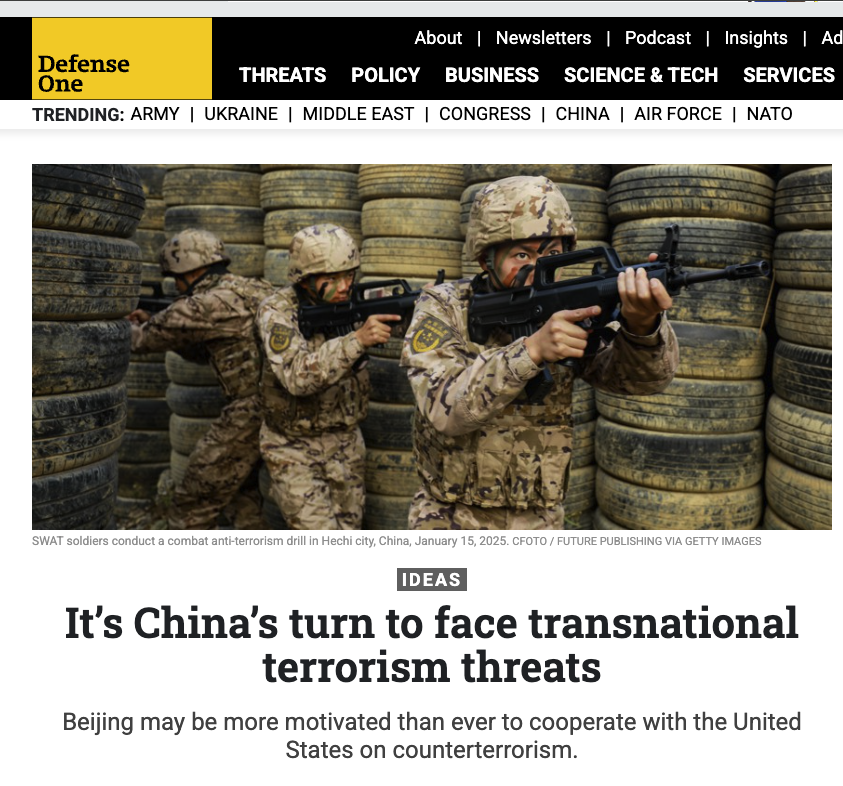
One more remark, and then citations below. It's important to note that the US actually does cooperate with China in a limited way on counterterrorism, and has done so for decades. For example, see this Defense One piece on how Chinese citizens keep getting attacked by fundamentalists in places like Pakistan: https://www.defenseone.com/ide... So: if India can similarly get China to understand that Pakistani fundamentalism is a danger to China's interests, then perhaps China will stop backing Pakistan in quite the same way. There will still of course be competition between India and China on other axes, but China need not indirectly fund terrorists. CITATIONS [1]: We forget this now after Syria/etc, but in the runup to 2008 Obama billed himself as the antiwar candidate. "As Candidate, Obama Carves Antiwar Stance" https://archive.is/kksid [2]: The rise in wokeness got underway in 2013, in part because in 2012 Obama couldn't run on economics in a still-soft economy. So he increasingly stressed race (eg Ferguson) and especially gender (the "War on Women" was a key feature of his campaign). See: https://www.forbes.com/sites/c... [3] Many conservatives are persuaded by the Buchanan concept of a "republic, not an empire". I've written about how the end of American Empire may not go as they expect; so has Niall Ferguson: https://niallferguson.substack... [4]: "9/11 offered what Beijing defined as a 'window of strategic opportunity' to develop its strength while the United States was acutely distracted." https://interactives.lowyinsti... [5]: Saudi Arabia has radically changed under MBS. He's purged the fundamentalists and is much more of a technocrat. This is now being more widely acknowledged, even in the West. See eg: https://archive.is/cB9BS [6]: https://www.mea.gov.in/press-r... [7]: War is an ugly business, but if you absolutely must fight it's best to be as targeted as possible. [8]: https://foreignpolicy.com/2025... [9]: The EU is one of Pakistan's largest trading partners: https://archive.is/wip/gx58m [10]: There's a Rube Goldberg machine running right now where Europe buys oil from India, who in turn buys oil from Russia, so that Europe doesn't buy it directly from Russia: https://www.nzz.ch/english/dat... India certainly can't stop Putin's war by itself, but it does have some influence with Russia, and perhaps it could lean in on the Ukraine peace deal if the EU genuinely cuts off Pakistan. [11]: Ataturk famously built a secular Turkey, even if that's arguably being reversed today: https://www.ieg-ego.eu/en/thre... [12]: MBS pulled Saudi away from fundamentalism: https://archive.is/cB9BS [13]: MBZ ensured the UAE was technocratic rather than fundamentalist. See for example this clip by UAE Foreign Minister bin Zayed: https://x.com/ABZayed/status/1... [14]: Jimmy Carter undercut the Shah, leading to the Islamic Revolution. But before 1979, this is what Iran looked like: https://archive.is/WOEG6 [15]: Under Zahir Shah, Afghanistan had schools and colleges for girls. But then Afghanistan turned communist and eventually fundamentalist. A dark regression: https://www.outlookindia.com/i... [16]: China is in many ways Pakistan's number one patron. For example, 82% of Pakistani arms come from China: https://www.mei.edu/publicatio... [17]: There is a whole website and everything for the CPEC (China Pakistan Economic Corridor), including the proposed pipeline from Gwadar to Kashgar: https://cpec.gov.pk/index See also this SCMP article: https://multimedia.scmp.com/ne... [18]: Chinese nationals keep getting blown up by fundamentalists within Pakistan, which is of course completely irrational from the Chinese perspective given that they are paying Pakistan: https://www.mfa.gov.cn/eng/xw/... India may be able to press this point to get China to stop funding Pakistan in the same way. They probably won't flip China entirely, but getting China to simply back a Pakistan faction that doesn't support terrorism is in both India and China's interests — as well as the Gulf states that want to pump oil, as well as the interests of most of the people in Pakistan. [19]: https://www.bbc.com/news/world... [20]: India and the Gulf states do a lot of business together nowaday, particularly India and the UAE, where there's a large Indian diaspora and even now a large Hindu temple. These are broadly speaking increasingly pragmatic, technocratic countries that oppose fundamentalism: https://www.iiss.org/online-an...