
THE CREATION OF THE USSR & MEMBERS Thread 1/. This Post thread is to clarify mass MISINFORMATION in X MEDIA about the original members of the USSR & their ethnic background ! Here we go > In 1917, the Bolsheviks, led by Vladimir Lenin, were in the process of seizing power during the October Revolution, which marked the beginning of Soviet governance. At this time, the Russian Soviet Federative Socialist Republic (RSFSR) was being established, and the Union of Soviet Socialist Republics (USSR) itself was not formally created until December 1922. Therefore, the governmental and party structures in 1917 were those of the Bolshevik Party and the early Soviet organs, primarily the Russian Communist Party (Bolsheviks). The Politburo & Central Committee were key bodies within the Bolshevik Party, not yet the formal government of the USSR, but they effectively directed the revolutionary government after the October Revolution. Below is a detailed list of the members of the Politburo & Central Committee of the Bolshevik Party in 1917, their roles around the time of the October Revolution (October/November 1917), along with their ethnic backgrounds. The Politburo was a temporary body created specifically to lead the October uprising & ceased to function immediately after, with the Central Committee taking over leadership. The ethnicities are based on historical records and self-identification & reflect the complex multi-ethnic nature of the Russian Empire and early Soviet leadership. Politburo of the Bolshevik Party (October 1917) The Politburo (Political Bureau) was established on October 10 [23], 1917, by the Central Committee to provide political leadership for the planned "military uprising" (the October Revolution). It consisted of seven members &] was meant to direct the revolution but, according to Leon Trotsky, never held a formal meeting &) ceased to function after the Bolshevik coup on October 24 [November 6], 1917. The members were: Vladimir Ilyich Lenin (Ulyanov) Role: Leader of the Bolshevik Party, chairman of the Council of People's Commissars (Sovnarkom) after the revolution. Ethnicity: Russian, with mixed ancestry (Russian, Kalmyk, Jewish, German, Swedish). paternal grandfather was of Kalmyk descent, & maternal grandfather was Jewish. Identified as Russian. Leon Trotsky (Lev Davidovich Bronstein) Role: Key organizer of the October Revolution, later People's Commissar for Foreign Affairs. Ethnicity: Jewish (Secular Jewish family in Ukraine). Notes: Trotsky led the Petrograd Soviet’s Military Revolutionary Committee, which executed the seizure of power. Grigory Yevseyevich Zinoviev (Ovsei-Gershon Aronovich Radomyslsky) Role: Senior Bolshevik leader, member of the Petrograd Soviet. Ethnicity: Jewish (Jewish family in Ukraine). Notes: Initially opposed the armed uprising alongside Kamenev but later supported the revolution. Lev Borisovich Kamenev (Rosenfeld) Role: Senior Bolshevik leader, deputy chairman of Sovnarkom after the revolution. Ethnicity: Jewish-Russian ( Jewish father & Russian Orthodox mother, identified as Russian). Notes: Initially opposed the October uprising, fearing it premature. Joseph Vissarionovich Stalin (Dzhugashvili) Role: Editor of Pravda, later People's Commissar for Nationalities. Ethnicity: Georgian. Notes: Stalin played a supporting role in 1917, focusing on party organization & propaganda. Grigori Yakovlevich Sokolnikov (Girsh Yankelevich Brilliant) Role: Member of the Bolshevik Central Committee, later involved in financial and diplomatic roles. Ethnicity: Jewish (Jewish family in Ukraine). Notes: Supported the uprising and was active in Bolshevik journalism. Andrei Sergeyevich Bubnov Role: Organizer of Bolshevik military efforts, later People's Commissar for Education. Ethnicity: Russian. Notes: Played a role in coordinating revolutionary activities in Moscow. >>>>>
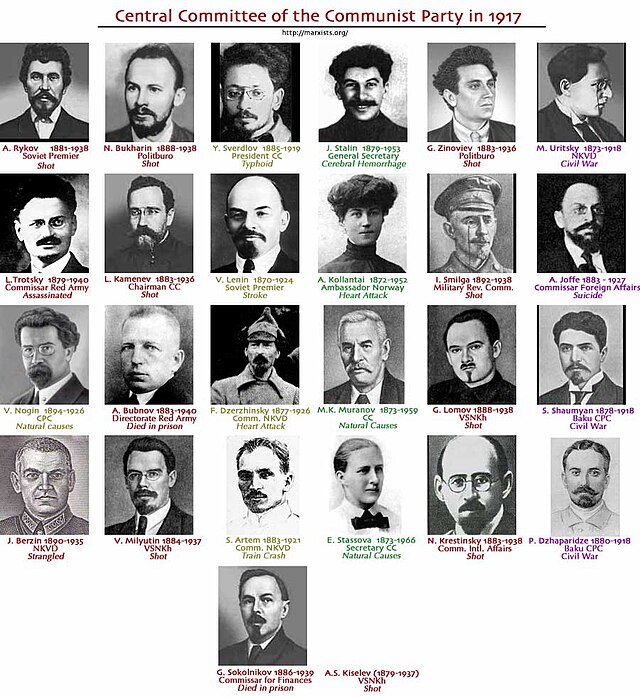
2. Central Committee of the Bolshevik Party (1917) The Central Committee was the main governing body of the Bolshevik Party between party congresses and was responsible for electing the Politburo. In 1917, the Central Committee was elected at the Sixth Party Congress (July–August 1917) and consisted of 21 full members and 10 candidate (non-voting) members. Below is the list of full members, with their ethnicities, based on historical records. Candidate members are included afterward, though less detail is available for some due to their lesser prominence. Full Members of the Central Committee (Elected August 1917) Vladimir Lenin Ethnicity: Russian (mixed ancestry, as noted above). Role: Party leader. Leon Trotsky Ethnicity: Jewish. Role: Revolutionary organizer. Grigory Zinoviev Ethnicity: Jewish. Role: Petrograd Soviet leader. Lev Kamenev Ethnicity: Jewish-Russian. Role: Senior leader, opposed uprising initially. Joseph Stalin Ethnicity: Georgian. Role: Party organizer, Pravda editor. Grigori Sokolnikov Ethnicity: Jewish. Role: Journalist, revolutionary. Andrei Bubnov Ethnicity: Russian. L Role: Military organizer. Yakov Mikhailovich Sverdlov Ethnicity: Jewish (born to a Jewish family in Nizhny Novgorod). Role: Party secretary, later chairman of the All-Russian Central Executive Committee (VTsIK). Notes: Organized party operations and was a key figure in consolidating Soviet power. Nikolai Ivanovich Bukharin Ethnicity: Russian. Role: Theorist, editor of Pravda. Notes: Supported the revolution but was less involved in its execution. Felix Edmundovich Dzerzhinsky Ethnicity: Polish (born to a Polish noble family in Belarus). Role: Founder of the Cheka (Bolshevik secret police). Notes: Played a critical role in suppressing counter-revolutionary forces. Adolph Abramovich Joffe Ethnicity: Jewish (born to a Karaite Jewish family in Crimea). Role: Diplomat, revolutionary. Notes: Active in Petrograd during the revolution. Viktor Pavlovich Nogin Ethnicity: Russian. Role: People’s Commissar for Trade and Industry post-revolution. Notes: Briefly opposed Bolshevik one-party rule after October. Moisei Solomonovich Uritsky Ethnicity: Jewish (born to a Jewish family in Ukraine). Role: Head of Petrograd Cheka. Notes: Key figure in revolutionary security operations. Elena Dmitrievna Stasova Ethnicity: Russian. Role: Party secretary, one of the few women in leadership. Notes: Managed party correspondence and logistics. Alexei Ivanovich Rykov Ethnicity: Russian. Role: People’s Commissar for Internal Affairs post-revolution. Notes: Active in Moscow during the revolution. Vladimir Pavlovich Milyutin Ethnicity: Russian. Role: People’s Commissar for Agriculture post-revolution. Notes: Focused on economic policy. Matvei Konstantinovich Muranov Ethnicity: Ukrainian. Role: Duma deputy, revolutionary organizer. Notes: Represented Bolsheviks in pre-revolutionary Duma. Ivan Teodorovich Smilga Ethnicity: Latvian. Role: Military revolutionary, active in Petrograd. Notes: Supported Trotsky in organizing the uprising. Georgy Ivanovich Oppokov (Lomov) Ethnicity: Russian. Role: People’s Commissar for Justice post-revolution. Notes: Involved in legal reforms. Sergei Georgiyevich Shaumyan Ethnicity: Armenian. Role: Leader of Bolsheviks in the Caucasus. Notes: Operated in Baku, less involved in Petrograd. Stepan Grigoryevich Shaumyan Ethnicity: Armenian (sometimes confused with Sergei Shaumyan, but a distinct figure). Role: Revolutionary in the Caucasus. Notes: Limited role in central leadership in 1917. Candidate Members of the Central Committee (Elected August 1917) Candidate members had no voting rights but participated in Central Committee activities. Less information is available for some due to their lower prominence. Mikhail Mikhailovich Lashevich Ethnicity: Russian. Role: Military organizer. >>>

3. Georgy Vasilyevich Chicherin Ethnicity: Russian. Role: Later People’s Commissar for Foreign Affairs. Notes: Not heavily involved in 1917 revolution. Nikolai Alexandrovich Skrypnik Ethnicity: Ukrainian. Role: Revolutionary in Ukraine. Artem (Fyodor Andreyevich Sergeyev) Ethnicity: Russian. Role: Trade union organizer. Nikolai Glebovich Krestinsky Ethnicity: Russian. Role: Party administrator, later diplomat. Alexander Gavrilovich Shlyapnikov Ethnicity: Russian. Role: Labor organizer, leader of the Workers’ Opposition. Sergei Ivanovich Gusev Ethnicity: Russian. Role: Military revolutionary. Emanuel Kviring Ethnicity: German (Volga German). Role: Revolutionary in Ukraine. Valerian Vladimirovich Kuibyshev Ethnicity: Russian. Role: Revolutionary organizer. Jan Ernestovich Rudzutak Ethnicity: Latvian. Role: Trade unionist, later senior official. Notes on the Government Structure in 1917 Context: In 1917, the Bolsheviks did not yet govern the USSR (formed in 1922) but controlled the Russian Soviet Federative Socialist Republic (RSFSR) after overthrowing the Provisional Government. The Council of People’s Commissars (Sovnarkom), established on October 26 [November 8], 1917, acted as the executive government, with many Central Committee members appointed as People’s Commissars. The Politburo’s brief existence in 1917 was solely for the revolution, and the Central Committee was the primary decision-making body. Ethnic Composition: The Bolshevik leadership in 1917 was ethnically diverse, reflecting the multi-ethnic Russian Empire. Ethnic Russians were prominent but not dominant in the top echelons. Jewish revolutionaries were overrepresented relative to their population share, often due to their urban, intellectual backgrounds and opposition to Tsarist anti-Semitism. Georgians, Armenians, Latvians, Poles, and Ukrainians also featured significantly, aligning with the Bolsheviks’ appeal to oppressed nationalities. However, as the Soviet state developed, ethnic Russians became increasingly dominant in leadership roles. Challenges in Identifying Ethnicity: Ethnicity in the Russian Empire was fluid, often based on self-identification, language, or religion. Some figures (e.g., Lenin, Kamenev) had mixed backgrounds, and Soviet policies later downplayed ethnic distinctions in favor of "Soviet" identity. Records from 1917 are incomplete, and some lesser-known figures’ ethnicities are inferred from biographical data. Sources: The list is compiled from historical records, including the Bolshevik Party’s Sixth Congress proceedings, Politburo records, and secondary sources like Wikipedia’s lists of Politburo members and Soviet history archives. Primary sources, such as Lenin’s writings and party documents, confirm memberships. Summary of Ethnic Breakdown Politburo (7 members): Jewish: 3 (Trotsky, Zinoviev, Sokolnikov) Russian: 2 (Lenin, Bubnov) Georgian: 1 (Stalin) Jewish-Russian: 1 (Kamenev) Central Committee Full Members (21 members): Russian: 7 (Lenin, Bubnov, Bukharin, Nogin, Rykov, Milyutin, Oppokov) Jewish: 5 (Trotsky, Zinoviev, Sokolnikov, Sverdlov, Uritsky) Armenian: 2 (S.G. Shaumyan, S. Shaumyan) Georgian: 1 (Stalin) Jewish-Russian: 1 (Kamenev) Polish: 1 (Dzerzhinsky) Ukrainian: 1 (Muranov) Latvian: 1 (Smilga) Jewish (Karaite): 1 (Joffe) Central Committee Candidate Members (10 members): Russian: 7 (Lashevich, Chicherin, Artem, Krestinsky, Shlyapnikov, Gusev, Kuibyshev) Ukrainian: 1 (Skrypnik) Latvian: 1 (Rudzutak) German: 1 (Kviring) This diversity reflects the Bolsheviks’ appeal to marginalized groups within the Russian Empire, though the small sample size and urban, intellectual bias of the leadership skewed representation. By the 1920s, under Stalin, the leadership became more Russified, and many non-Russian Bolsheviks from 1917 were purged. Education is free to those who wish to lose Ignorance and gain liberation !
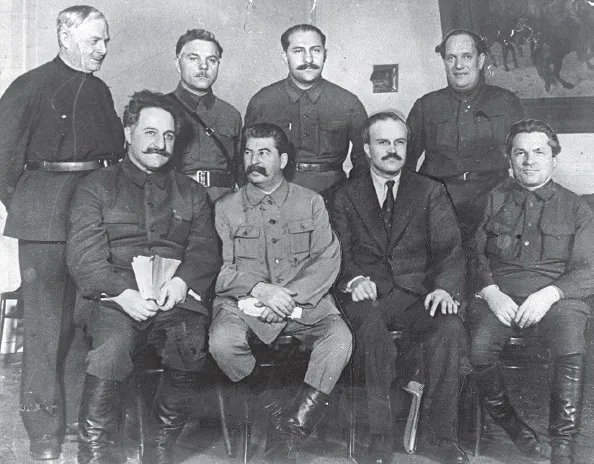
4. 1927 CPSU COMMITTEE CONGRESS Stalin cleared our most NON USSR persons in the first PURGES since 1923> The 15th Congress of the All-Union Communist Party (Bolsheviks) was held from December 2–19, 1927, in Moscow. It elected a Central Committee to govern party activities between congresses. Overview of the 15th Congress - **Attendees**: The congress had 898 delegates with a casting vote and 771 with a consultative vote, totaling 1,669 participants. However, not all delegates were elected to the Central Committee, which was the primary governing body between congresses. - **Central Committee**: The 15th Congress elected a Central Committee consisting of 71 full members and 50 candidate members, totaling 121 individuals. - **Ethnic Backgrounds**: Soviet records rarely emphasized ethnic backgrounds explicitly, and ethnicity was often self-reported or inferred. Jewish identity, in particular, could be complex, as some individuals of Jewish descent did not identify as Jewish, and Soviet policy downplayed religious or ethnic distinctions in favor of class identity. Additionally, antisemitic tropes like "Jewish Bolshevism" have historically exaggerated Jewish representation, requiring careful scrutiny of claims. Names of Central Committee Members. The Central Committee elected by the 15th Congress included prominent Bolshevik leaders. A complete list of all 121 members (71 full and 50 candidate members) is difficult to compile due to limited access to primary sources in English and the lack of comprehensive public records for all candidate members. Below is a partial list of key full members elected by the 15th Congress, focusing on those frequently mentioned in historical accounts: 1. **Joseph Stalin** – General Secretary, ethnic Georgian 2. **Nikolai Bukharin** – Editor of *Pravda*, ethnic Russian 3. **Alexei Rykov** – Chairman of the Council of People’s Commissars, ethnic Russian 4. **Mikhail Tomsky** – Trade union leader, ethnic Russian 5. **Kliment Voroshilov** – Military leader, ethnic Russian 6. **Mikhail Kalinin** – Head of State, ethnic Russian 7. **Vyacheslav Molotov** – Party official, ethnic Russian 8. **Lazar Kaganovich** – Party official, ethnic Jewish 9. **Sergei Kirov** – Leningrad party leader, ethnic Russian 10. **Stanislav Kosior** – Ukrainian party leader, ethnic Polish 11. **Anastas Mikoyan** – Party official, ethnic Armenian 12. **Grigory Ordzhonikidze** – Party official, ethnic Georgian 13. **Valerian Kuibyshev** – Economic planner, ethnic Russian 14. **Yan Rudzutak** – Party official, ethnic Latvian 15. **Nikolai Uglanov** – Moscow party leader, ethnic Russian 16. **Andrei Andreyev** – Party official, ethnic Russian 17. **Vlas Chubar** – Ukrainian party leader, ethnic Ukrainian 18. **Grigory Petrovsky** – Ukrainian party leader, ethnic Ukrainian 19. **Nikolai Shvernik** – Party official, ethnic Russian 20. **Emmanuil Kviring** – Party official, ethnic German This list is not exhaustive but includes key figures. For a complete list, one would need access to Soviet archives or the Russian-language source cited in Wikipedia: “Центральный Комитет, избранный XV-м съездом ВКП(б) 19.12.1927, члены” (http://knowbysight.info). Ethnic Backgrounds. Determining the ethnic backgrounds of all 121 Central Committee members is complicated by: - **Lack of Explicit Records**: Soviet documentation prioritized political loyalty over ethnicity, and many individuals did not publicly identify with an ethnic group. - **Jewish Identity**: Some individuals of Jewish descent were secular or assimilated, identifying as Soviet rather than Jewish. The Nazi or antisemitic definitions of Jewishness (e.g., based on ancestry) differ from self-identification or Soviet categorizations. - **Historical Bias**: Claims of Jewish overrepresentation, often tied to the "Jewish Bolshevism" myth, have been debunked or contextualized by historians. >>>>>

5. For example, a 1922 Bolshevik party census reported 5.21% of party members (19,564 out of 375,000) were Jewish, and in the 1920s, 6% of the 417 members of top party bodies (Central Executive Committee, Central Committee, etc.) were ethnic Jews.[](https://en.wikipedia.org/wiki/... Based on available data: - **Russians**: The majority of Central Committee members were ethnic Russians, reflecting the demographic dominance of Russians in the USSR (about 50–60% of the population). - **Other Ethnicities**: The committee included Georgians (e.g., Stalin, Ordzhonikidze), Ukrainians (e.g., Chubar, Petrovsky), Armenians (e.g., Mikoyan), Latvians (e.g., Rudzutak), Poles (e.g., Kosior), and Germans (e.g., Kviring), among others, reflecting the multi-ethnic nature of the Soviet leadership. - **Jews**: A small number of members were of Jewish descent, with estimates suggesting 3–6% of the Central Committee, consistent with broader party trends in the 1920s. Jewish Members and Count Identifying Jewish members requires careful consideration to avoid perpetuating myths or inaccuracies. Based on historical analysis and sources: - **Confirmed Jewish Members**: - **Lazar Kaganovich**: A prominent full member of the Central Committee and Politburo, Kaganovich was of Jewish descent and one of the few Jewish leaders to survive Stalin’s purges. (https://www.jpost.com/magazine... - **Lev Kamenev**: Although expelled from the party in November 1927 alongside Trotsky and Zinoviev, Kamenev was a Central Committee member earlier in 1927. He was of partial Jewish descent (Jewish father, Russian mother). His status at the 15th Congress is unclear, as he was part of the United Opposition. (https://www.jpost.com/magazine... - **Grigory Zinoviev**: Also expelled in November 1927, Zinoviev was of Jewish descent and a key figure in the United Opposition. He was not a Central Committee member at the congress due to his expulsion. (https://en.wikipedia.org/wiki/... - **Possible Jewish Members**: Other individuals, such as Grigory Kaminsky (elected in 1927 but later purged), were of Jewish descent but less prominent. However, sources do not confirm their Central Committee status definitively. (https://www.jpost.com/magazine... - **Estimate**: Historians suggest that 3–6% of the Central Committee (approximately 4–7 of the 121 members) were ethnic Jews, aligning with the 6% figure for top party bodies in the 1920s. Without a complete roster and biographical data for all 121 members, a precise count is impossible, but the number is likely small (e.g., 3–5 members, including Kaganovich and possibly Kaminsky). (https://en.wikipedia.org/wiki/... Challenges and Context - **Data Gaps**: The full list of candidate members is less documented, and biographical details for lesser-known figures are sparse. Accessing Soviet archives or Russian-language sources like http://knowbysight.info would be necessary for a complete analysis. - **Jewish Bolshevism Myth**: The notion that Jews dominated the Bolsheviks is a well-documented antisemitic trope. While Jews were overrepresented relative to their population share (2–5% of the USSR population), their presence in leadership was limited and declined after the 1920s due to Stalin’s purges. By 1927, Jewish influence was already waning, as seen in the expulsions of Trotsky, Zinoviev, and Kamenev. (https://en.wikipedia.org/wiki/... (https://www.jpost.com/magazine... - **1927 Context**: The 15th Congress marked Stalin’s consolidation of power, with the expulsion of the United Opposition (including Jewish leaders like Trotsky and Zinoviev). This reduced Jewish representation in the Central Committee compared to earlier years (e.g., 1917, when 6 of 21 Central Committee members were Jewish). (https://history.stackexchange.... >>>*>

6. Conclusion - **Names**: A complete list of all 121 Central Committee members is not readily available in English sources, but the key figures include Stalin (Georgian), Bukharin (Russian), Rykov (Russian), Kaganovich (Jewish), and others listed above. For a full roster, refer to Russian-language sources like http://knowbysight.info. - **Ethnic Backgrounds**: The Central Committee was predominantly Russian, with significant representation from Georgians, Ukrainians, Armenians, Latvians, Poles, and others. Jews constituted a small minority (estimated 3–6%). - **Jewish Count**: Approximately 4–7 members (3–5% of 121) were likely of Jewish descent, with Lazar Kaganovich as the most prominent confirmed Jewish member. Others, like Kamenev or Zinoviev, were expelled before the congress and not included in the new Central Committee. - **Recommendation**: For precise data, consult Soviet archives or the source “Центральный Комитет, избранный XV-м съездом ВКП(б) 19.12.1927, члены” (http://knowbysight.info). Historians like Zvi Gitelman or sources like *The YIVO Encyclopedia of Jews in Eastern Europe* may provide further clarity. (https://encyclopedia.yivo.org/... (https://en.wikipedia.org/wiki/...
