
How can humans realistically travel to another star, and why will it be an all-female crew that does it? In this thread: Sailing on light, nuclear pulses, using the sun as a telescope and how to travel to another solar system. The interstellar thread!

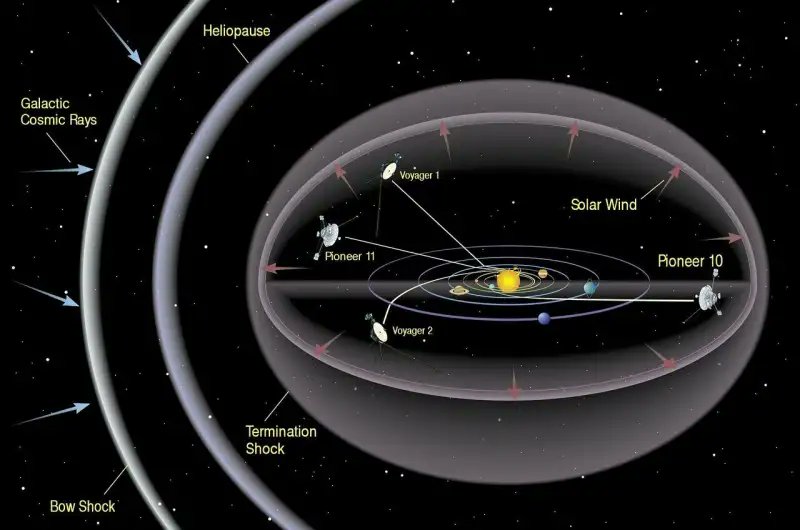
Slow starts… The furthest man-made object from Earth, Voyager 1, is one of the fastest. Launched in 1977, it performed gravitational slingshots off Jupiter and Saturn and is heading to interstellar space at 17 kilometres per second. How long until it reaches another star…?


Um… a long time. Voyager 1 is moving at 523 million km, or 3.5 AU, per year. Our nearest star from the sun, Alpha Centauri, is 278 THOUSAND AU away. If Voyager 1 was heading that way (which it isn't) it would take almost 80,000 years to get there. Damn. Can we go any faster?
Let's give ourselves a goal: Either a robotic probe or a colony ship to Alpha Centauri in good time! Eighty thousand years is too much and five years is almost lightspeed. Maybe something in the middle: A century to get there and either pass through (probe) or stop (colony).

First we'll rule out chemical rockets. The Tsiolkowsky rocket equation states that the mass of propellant rises exponentially with change in velocity. To go at interstellar travel speed with chemical rockets needs more propellant than exists in the universe!

We're going to explore: Ion drives. Nuclear salt water rockets. Orion! Daedelus & deuterium-He3 fusion. The fusion runway. Laser-pumped light sails. Spying on Centauri. An unusual generation ship.

Nuclear thermal rockets. With a specific impulse (Isp) of 800 seconds, versus 450 for the best chemical rockets, these have potential for interplanetary journeys, but are too thirsty for interstellar use. https://x.com/Jordan_W_Taylor/...
Ion thrusters. Accelerating Xenon ions in an electric or magnetic field, the ion thruster is a present-day technology with Isp ten times better than chemical rockets, but feeble thrust. Useful for the outer planets, but still too thirsty for interstellar missions!


Orion. The first properly nuts propulsion system on the list! Firing a nuclear shaped charge behind a giant ablative pusher plate over & over, Orion nuclear pulse propulsion offers big thrust, big size and ion thruster level Isp. But not quite good enough for interstellar…


Nuclear salt water rocket! Just add crazy. Highly enriched Uranium or Plutonium salts in boron-carbide coated neutron absorbing pipes are pumped into a rocket nozzle where a prompt fission reaction occurs. Basically, you’re trying to outpace nuclear fire. High thrust, high Isp…

The original NSWR concept used 20% enriched Uranium. Extend this to 90% and, if you don't explode, your exhaust plume could hit thousands of km per second. With a 90%-98% fuel fraction you could perhaps get to Alpha Centauri in a little over a century, in a scary way.

But what if you don’t want to ride Chernobyl to space? You have two realistic alternatives to the psychopathy of the nuclear salt water rocket: Fusion power or light sails. One of these is a more elaborate rocket, the other abstains from carrying fuel entirely!

Daedalus The product of a 70s study by the British Interplanetary Society, it’s a two-stage 54,000 ton vehicle with a 500 ton payload, designed to hit 12% of lightspeed and make the crossing in 50 years. It’s powered by inertial confinement fusion of Deuterium-He3 pellets.

Why Deuterium-He3 fusion? It’s difficult for two reasons: Firstly, fusion ignition hasn’t yet been demonstrated with D-He3 (unlike Deuterium-Tritium). Secondly, He3 is not available on Earth, but from the moon or gas giants: This scheme requires an industrialised solar system!

But D-He3 fusion produces a minimum of neutrons and a maximum of charged particles, which can be guided by a magnetic nozzle for thrust and energy recovery: Perfect for spaceflight! Daedalus would fuse D-He3 pellets with electron beams: 250 a second, for four years!

What about high-speed impacts? 12% of lightspeed makes even small particles dangerous. Daedalus would use a Beryllium shield (a material seen in fusion reactors), plus a particle cloud and repair robots. Not bad for a project from decades ago!

Sailing the photon breeze. But why bother with honking great rockets when there’s a more elegant solution: The photons in light may not have weight, but they have momentum, so spread a spin-stabilised light sail you catch light itself, and ply the cosmic trade winds!

A sail needs to be light, strong and able to withstand high temperatures. Carbon-carbon matrix can get below 5g/ square metre and can be assembled by unfolding inflating spars that are then cured in position. Carbon-carbon would need additional coating for optical wavelengths.

With a light sail a sun-sling manoeuvre could accelerate you fast enough to get to Alpha Centauri in a millenium… so the sun is too slow. What about lasers? Laser-pump a 3.6km diameter solar sail with 65 Gigawatts of laser power and a 1 ton probe can exceed 10% lightspeed!

It gets bigger: Bulk it up to colony ship size and let it brake to a halt by using a detachable front reflector and you need hundreds of thousands of Gigawatts: Many times more than our total power production on Earth. And a 100+km sail! Industrialised solar system needed!

Somehow, it gets worse… To create a perfectly collimated beamline over many lightyears requires a serious lens. For optical wavelengths, that's a fresnel lens the size of Texas in a slow orbit in the outer solar system. It's even worse if you use microwaves.

Still, solar sails are one of the more doable interstellar concepts: It's better than a 1% cargo fraction on a fusion rocket, or riding a barely-controlled fission reaction that could kill everyone on board. But maybe there's another way…

The last remaining fast concept that doesn't involve dicey antimatter: Use a fission or fusion pulse rocket as described earlier, but first use a linear accelerator to fling the fuel ahead of the starship, creating a long ‘runway’ to ingest to get up to speed.

Maybe just take the slow road? Everything gets exponentially easier if you don't have to speedrun it in 50 years. Allow the journey to take centuries and everything becomes possible. This means a generation ship: Get born, live, love & die on-board!

How big is the colony ship anyway? A colony needs the genetic variety of 1,000+ people to be viable, and assuming 0.2 tons of food and 0.3T O2 per person per year (water is recyclable), a 250 year voyage needs 500,000 tons of consumables or as much as the largest cargo ships.

But wait! Why not create a closed ecosystem instead? Nice idea, but every attempt thus far tried has failed, and without any possibility of relief efforts or new mass entering the system, that's too risky. But there's another way to minimise the vessel size…

We only need genetic variation, not population size. Start with ten women, assume in-vitro fertilisation and 3-4 generations alive at a time and you need 1,250 tons of consumables for the journey: Easily doable! Our interstellar pioneers might be all-female crew families.

How do we see where we're going? We can analyse the atmospheres of planets hundreds of lightyears away, but direct imaging is beyond our capabilities. But go 80 billion km out and you can use the sun as a giant gravitational lens. Difficult but a good test of our seriousness!

So there you have it: What's required to Go Interstellar! Either we go for gigantic energy expenditure or adopt a cathedral-builder mindset and plan for the centuries, with an interesting colony family structure! Leave Adam at home, we're taking Eve.
Thanks to the British Interplanetary Society and Paul Glister's Centauri Dreams for data used in this thread. If you liked this, try something really in-depth, linked below: How to cage a star on Earth. I hope you enjoyed this! https://substack-proxy.glitch....