
1/12 China’s Communist Party has unveiled its game plan for dealing with Trump’s shock 2nd term trade war. It just held the 1st official meeting of its Politburo since the launch of the Liberation Day tariffs. Here’s everything you need to know (🧵):
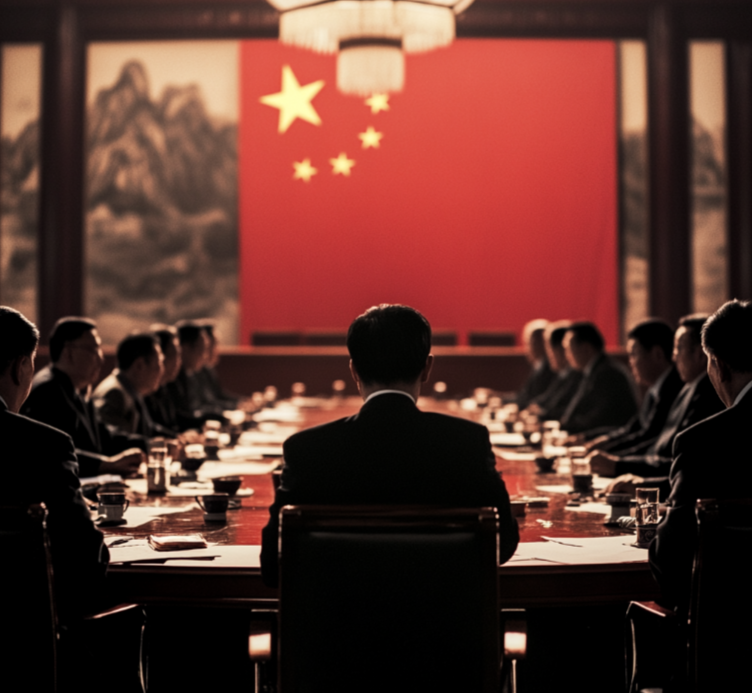
2/12 On 25 April, the Politburo met to “analyze and research current economic circumstances and economic work.” The event holds special significance, as the Politburo’s first official meeting since Trump roiled global markets with his Liberation Day tariff hikes.
3/12 The Politburo made reference for the first time to an “international economic and trade struggle” (国际经贸斗争). It also called for “further stabilising the foundations for China’s economy to continue to recover and improve” in the face of “the expanded influence of external shocks.”
4/12 The meeting of the Politburo signalled more active fiscal and monetary policy ahead to deal with the fallout of a trade war, with an especial focus on domestic demand and consumption. It also unveiled two new policy slogans - the “Two Unshiftings” and the “Four Stabiliations.” (Thanks for reading! Deepen your understanding of China's economy by following our official account on X, or signing up for our free email briefings read by analysts and executives at the World Bank and the Bank of England: http://chinabankingnews.com.)
5/12 The “Two Unshiftings” (两个坚定不移) refer to Beijing’s "unshifting" support for: - Globalisation and the opening up of the Chinese economy. - China’s own internal economic improvements.
6/12 According to Zhang Monan (张茉楠), researcher at the China Center for International Economic Exchanges, China is positioning itself as a champion of open economies and globalisation. “Amidst the advance of global trade protectionism, China has become an active advocate and vigorous supporter of globalisation,” Zhang said. “[China] is using its more open markets to attract global resources, as well as providing a more open platform for global partners to cooperation, and a more stable anchor for growth.”
7/12 The April meeting of the Politburo also highlighted the need for the “Four Stabilisations” (四稳) of “stable employment, stable enterprises, stable markets, and stable expectations.” China Central Television said the Politburo’s April meeting marks the first time it’s made reference to the “Four Stabilisations,” and that this “sends an intense signal on firmly stabilising the overall economy.”
8/12 Chinese commentators also highlight the Politburo’s plans to step up both fiscal and monetary stimulus in order to achieve the “Four Stabilisations.” This marks a continuation of Beijing’s “quantitative growth” policies that were first unveiled in September last year. (Thanks for reading! Deepen your understanding of China's economy by following our official account on X, or signing up for our free email briefings read by analysts and executives at the World Bank and the Bank of England: http://chinabankingnews.com.)
9/12 “The central government has put macro-economic policy in first place, which in actuality provides a baseline for the Chinese economy,” said Zhu Min (朱民), expert councillor from the China Center for International Economic Exchanges “This is extremely important. “It enables everyone to know that we have fiscal policy measures ahead and monetary liquidity, so that everyone can have confidence.”
10/12 The April meeting of the Politburo also stressed China’s commitment to growth in consumption, as the solution for its economic ills. It called for “raising the incomes of high, medium and low-income demographics, vigorously developing services consumption, and strengthening consumption in its role as a driver of economic growth.”
11/12 Zhang Monan (张茉楠), researcher at the China Center for International Economic Exchanges, says boosting consumption has emerged as a key preoccupation for Beijing since the pandemic, with an increasing focus on growth in “high-quality” consumption of services. “In recent years, China has actively driven a development strategy of expanding domestic demand, and the most important part of expanding domestic demand is expanding consumer demand.”
12/12 Source: CCTV. “焦点访谈|坚定不移办好自己的事 中央政治局会议为经济工作定向稳舵” (Thanks for reading! Deepen your understanding of China's economy by following our official account on X, or signing up for our free email briefings read by analysts and executives at the World Bank and the Bank of England: http://chinabankingnews.com.)