
These three conversion rate metrics I think highlight a common oversignificance of top 8/16/32 results. https://www.reddit.com/comment... Swiss tournaments are designed to create a kind of 'threshold effect' in final placement, biased by tiebreakers and bracket stratification in pairings.
In each round, players with similar win-loss records are paired together, where players are grouped into brackets based on their standing (e.g. x-0, x-1, x-2). This creates a feedback loop that amplifies small initial advantages/disadvantages in bracket pairings in later rounds.
As Swiss tournaments have a fixed number of rounds (~7-9 rounds for 100+ players), this requires creating hard cut-offs as players cannot "play into" top 32 without several additional rounds. This means players will often cluster near this threshold, making tiebreakers decisive.

Placement between these top 8/16/32 brackets is predominantly determined by your opponents' tiebreakers (OMW %). Often these differences are extremely marginal (<1%), which creates a kind of 'path-dependency' where early round results cascade into later pairings and tiebreakers.

This creates the most significant opponent-dependent bias, where final results bracketed by record (and sorted by OMW %) overlap in top 8/16/32 placements. These placements are completely arbitrary, and as a result, you'll often see x-0/x-1 and some x-2 results sneak into top 8.
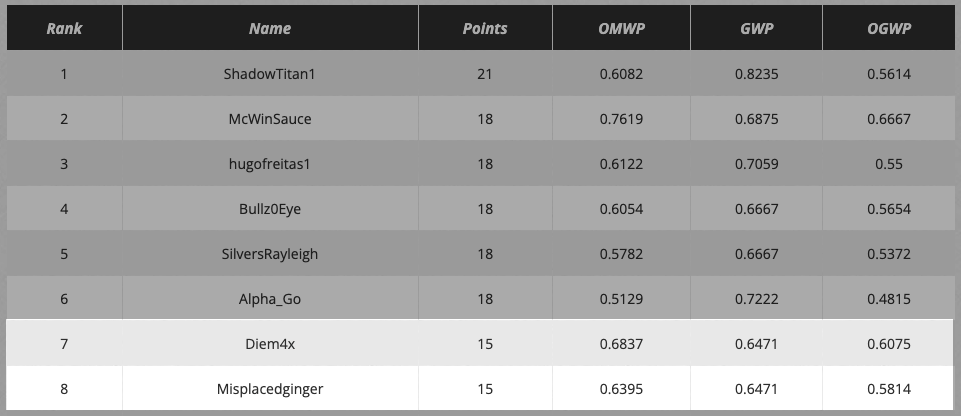
Overall, this distorts the top 32 results to over-represent players who either: 1) Avoided early losses (staying in high brackets) 2) Faced opponents with strong late-round performance (boosting tiebreakers) This is particularly dangerous when trying to analyze conversion rates.
As explained before, the path-dependency of bracket pairings and tiebreakers has a very strong non-linear scaling. Hence, computing conversion rates among only the top 32 results based on these top 8/16/32 brackets does not yield a conversion rate due to the match winrate alone.
Focusing on top 8/16/32 results ignores the non-linear relationship between winrates and tiebreakers. Proper analysis should instead model these threshold probabilities directly (i.e. the likelihood of going 5-2 with a given winrate), and include tournament size as a covariate.
