
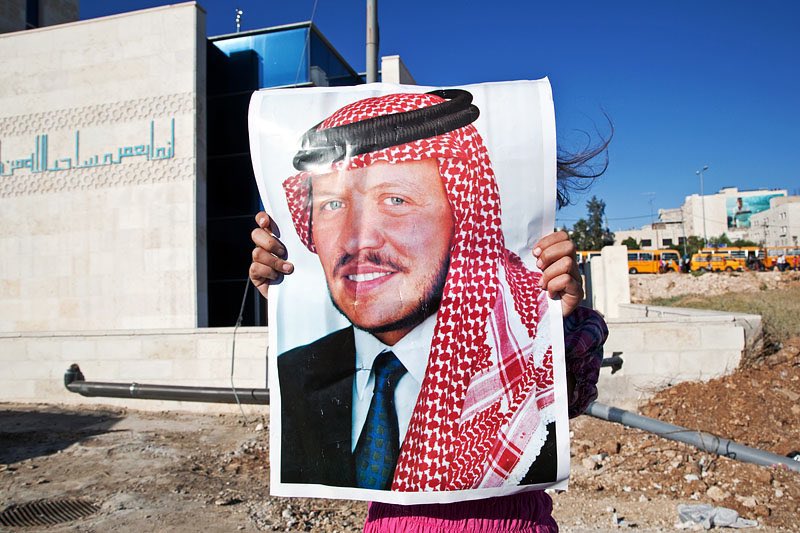
🇯🇴 JORDAN - BASICALLY FINEISM WITH ANGLO-ARAB CHARACTERISTICS Whenever I travel to a country that has a ‘dictator-y’ leader I make a point of asking people if they genuinely like their leader or if they just have to pretend to. This is never a properly scientific survey and sometimes people will say yes they are obliged to just pretend they do but quite often you will find more people insisting that they do actually like their ‘dictator-y’ leader than you might think. This is especially true in countries that are actually mostly well-run and so ‘Basically Fine’. Qaboos bin Saud of Oman, Lee Kuan Yew of Singapore and Paul Kagame of Rwanda are some of the leaders I found most universally popular. In Jordan whenever I asked people if they liked Abdullah II he would receive similar near universal praise. Here is a little trick in governance - if you are an actually mostly competent leader who doesn’t dislike your own populace you can get away with being a little ‘dictator-y’, if people like you enough they just let you do it. Plato said the best form of Government was a Philosopher King and that granted there is an argument to be made that political philosophy since then has been a footnote. I.E. “Ok, granted. Failing that, what is the second best form when this kind of leader isn’t available?” Very occasionally, a country is fortunate enough to not need to ask that question. The consensus in Jordan is Abdullah II is not a Philosopher King as such but he is a mostly competent King. You ask a Jordanian why they like him. “He bring many good things to Jordan, make strong country.” “Brother listen my brother he’s very good king yoo no very respected.” Jordan is not the world’s most developed country but by the standards of the region excluding the Gulf it is very developed. Amman is a fairly modern large city, there is good infrastructure, shiny shopping malls with yummy yummy in your tummy food and consistent economic growth. There are a lot of subtle, technical, pragmatic and ‘less in your face’ governance features that prevent Hashemite Jordan from devolving into a basketcaseistan like its neighbours - and in many respects these are the considerations that ‘Good Governance’ in the proper sense actually consists in. [1/2]
One of the defining features of Jordan versus its neighbours is its ethnoreligious stability, with a population of roughly 70% Sunni Muslim Arabs, 25% Bedouin or minority Arabs, and 5% Christians and other minorities, including Circassians and Druze. This demographic balance has been preserved without significant sectarian strife, a testament to that pragmatic approach. Jordan has ‘managed to hold together’ despite refugee inflows from surrounding countries like Syria, Iraq and Palestine and occasional refugee-derived incidents like Black September. It helps perhaps too that the refugees are mostly from the same ethnoreligious demographic backgrounds as the existing population, there is that demographic continuity. They make up 1.3 million of Jordan’s 11 million population. Even still, Abdullah has made a point of not ‘overshooting the compassion’. Though Jordan already had tight border policies before in recent years it has limited new entries even further and declined to take more refugees from surrounding conflicts deliberately so it can preserve its stability and continued development. Large refugee inflows are acknowledged as a burden to be avoided where possible. Enhanced border patrols and cooperation with the West has minimised their threat. Another element of Jordan’s ‘mostly competent pragmatism’ is economic reforms, consistent modest growth through free trade agreements and tourism development despite challenges like unemployment and a lack of oil. In all, Jordan’s GDP grew from $8.4 billion in 1999 to $48.7 billion in 2023. Similarly, crime. In 2022, Jordan had a homicide rate of approximately 1.1 per 100,000 people. Theft and robbery do exist, but at lower rates as compared to other countries. Violent crimes are rare. Crime when it does happen is harshly punished, the John Glubb hit them with a big stick approach. Abdullah survived the 2011 Arab Spring protests with limited political reforms, preserving the monarchy’s authority without authoritarian excess. At the same time, power did not become so devolved that it made effective government more needlessly difficult. There are still some restrictions on free speech, especially on anti-monarchy slander - but in practice very few Jordanians would exercise that right if it did exist. The culture is conservative but not crazy Islamist conservative (these people will get shut down) and by regional standards is it very accommodating. Anti-corruption initiatives further ensure incremental progress without destabilising the status quo and Jordan’s relatively open stance and reputation in the Middle East helped secure Jordan significant aid grants for development, further cushioning Hashemite hegemony. My experience in Jordan is that it isn’t going to particularly blow anybody away - though the scenery can be quite exciting sometimes. What it does do versus its neighbours is be Basically Fine. There are poor parts of Jordan to be sure but by a small miracle there is nonetheless a mostly decent stable and relatively developed country in the middle of a basketcase region. A more impressive achievement than you might think on first glance. [2/2]
See Also: