
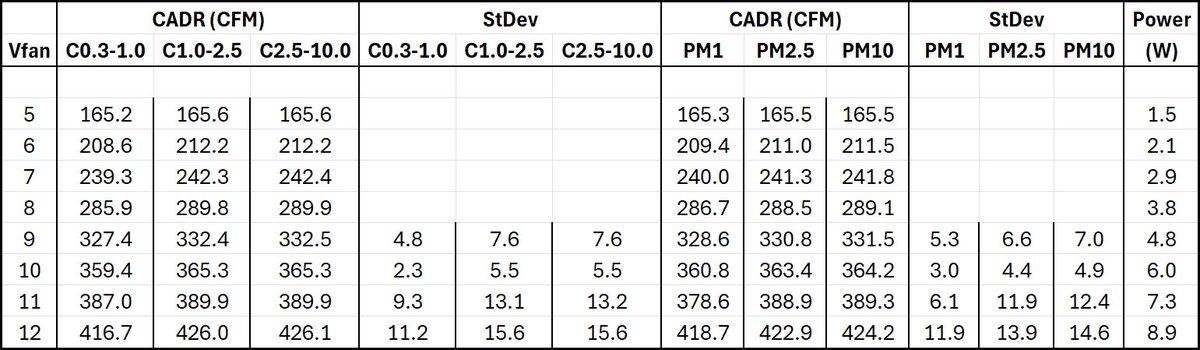
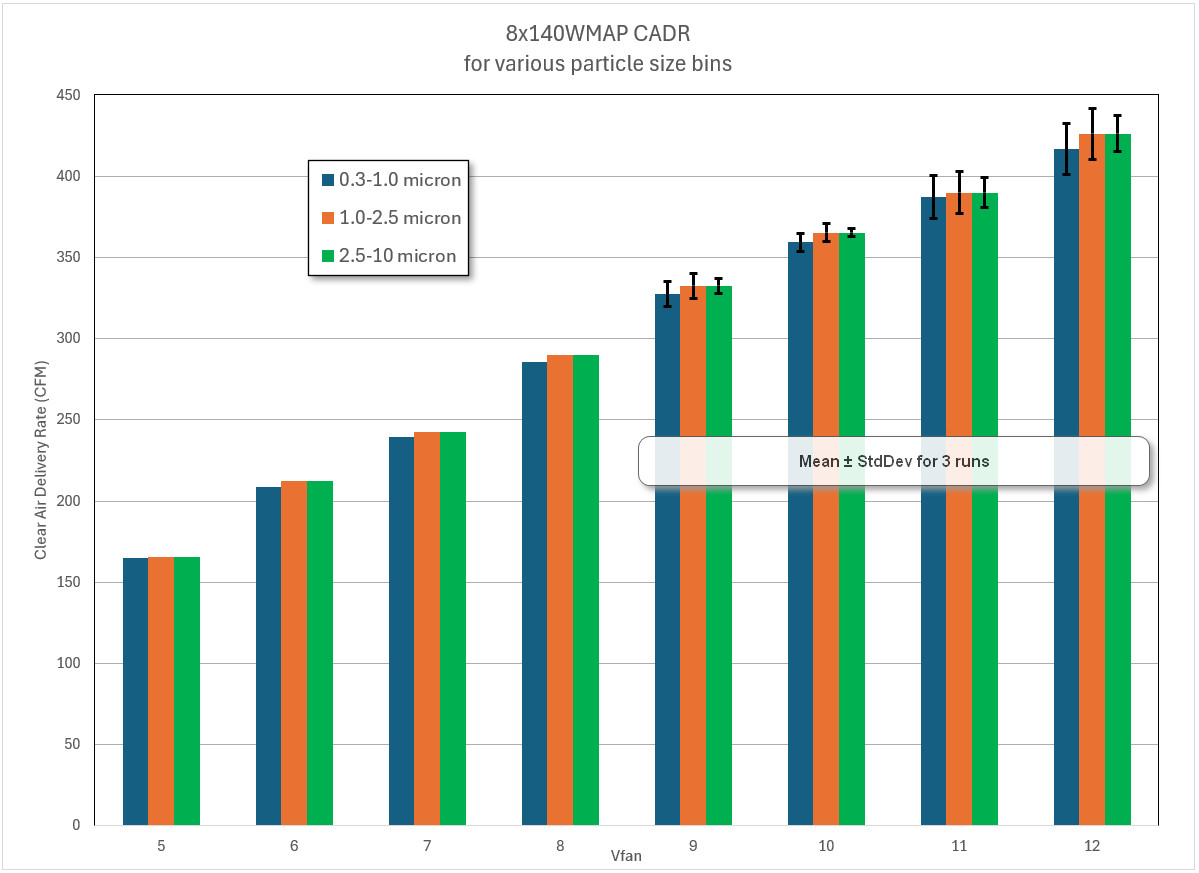
Finally! I built & tested an open-source concept model air purifier that should be good for schools. Lots of air (CADR > 420 CFM), quiet (<45 dBA), uses <9 W, and ‘cause it’s wall-mounted & down-blowing, it moves air in the right direction & takes up no floor space.👀my ALTs🧵⬇️

Configuration is important. Warm human aerosol rises toward the ceiling. The idea is to scavenge warm, dirty air from the ceiling, filter it, & blast it down along the wall, where it can spread out over the floor & convect back up past the occupants’ faces. See ALT for more.

I posted on 🦋 first. Some X folks I’d like to 👀. @robwiss @effiegreathouse @AirSupportBox @TonyColaneri @CRFoundationUS @safe_breathe @ThisHouseFresh @EndlessCleaners @OpenAeros @Engineer_Wong @linbasart @VentiloAngel @blouisBLT @sri_srikrishna @Washable95 Now back to tech →
I’m hoping somebody will figure out how to mass-produce a unit like this. Improve it. Surround it with an attractive perforated metal or plastic cover. Integrate it with a control box & timer on the wall below it. Now you know what kind of performance to expect. Check ALT.

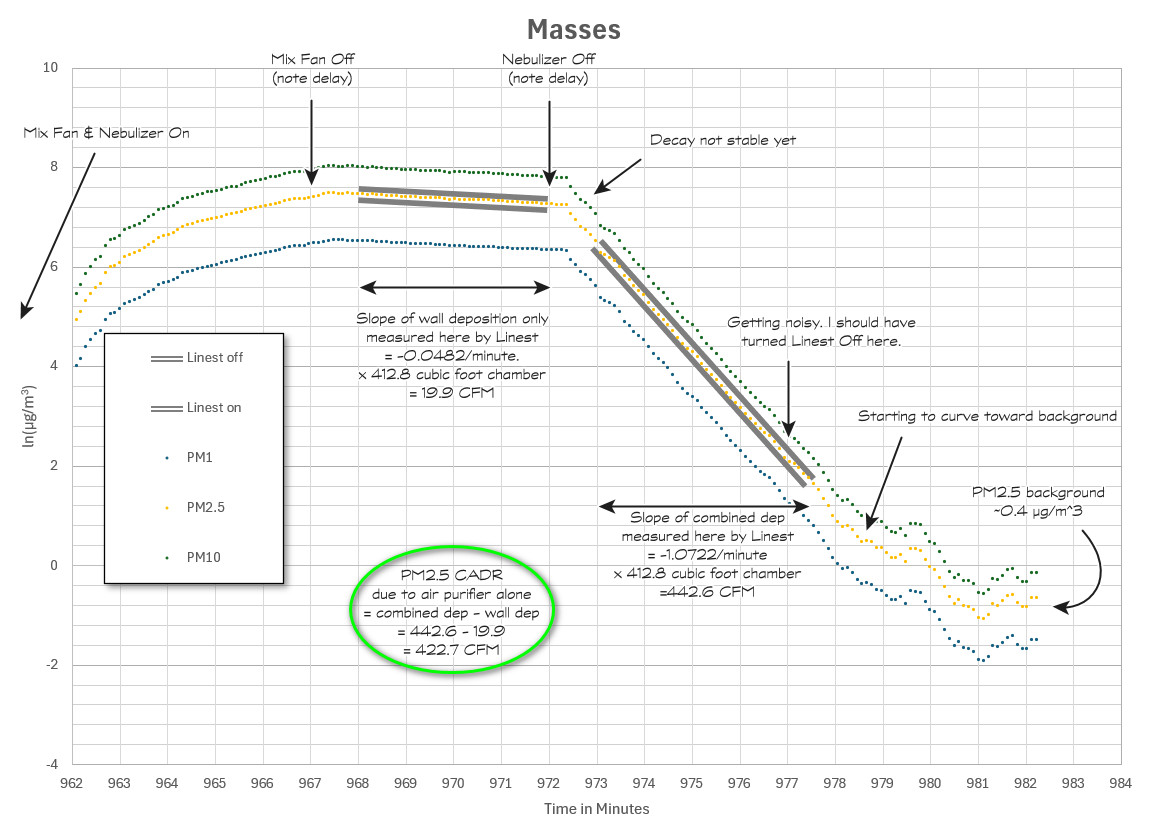
I feel pretty good about measurements. I tested CADR in a 412.8 cubic foot bathroom, filled with nebulized NaCl solution, and mixed with a small fan. I used a Sensirion SPS30 Particle Counter, controlled by an ESP32 μcontroller, streaming into μSoft Excel. See ALT 4 more stuff.
I measured noise, like CADR, with the 8 fans bolted to the underside of a shelf. Turned it on 6 times each V, letting it spin up for a minute ‘til pretty stable. About 46 dBA at 12V, but a bit different each time, especially at 9-11V. I suspected fan-fan interaction. See ALT.

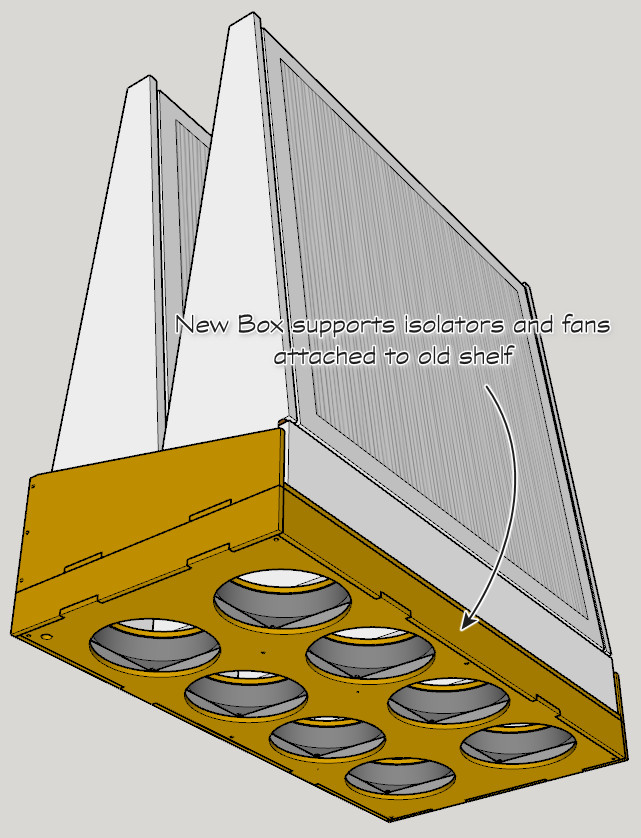
So I isolated the fans on closed foam weather stripping, 1/8” thick x 1/2” wide on edge. The fan rests on the edge of the foam, which rests on a new fan box base. The foam is held to the fan with electrical tape and to the base with double-sided woodworkers tape. See ALTs!


The isolation worked! Noise at 12V came down a bit (to 43.5 dBA from 45.7 dBA) but variability came WAY down, especially at 9-11V. But it still doesn’t come down as smoothly with voltage from 12V to 9V as I’d expect.
I can now do PWM control and measure RPM with a PicoScope, so I plan to explore a bit more in case it rings up at some RPMs. BTW, I’m thinking big but noisy units might specify CADR at a NOMINAL speed that’s <45 dBA, & also at a “TURBO” speed. In this case, top speed IS NOMINAL.
I hope to publish more detailed build instructions when the design settles a bit more (it’s grown like topsy). Basically, there are 2 assemblies; a fan assembly which mounts to the wall & provides a smooth shelf, and a filter assembly which rests on it, prolly held with magnets.
The filter ass’y is very light, weighing little more than the 4 filters. The foam frame is reusable & it should be easy to replace filters at desk level and drop in place from a ladder, or even using a T-shaped pole while standing on the floor. See ALTs for more comments.


My fan ass’y mounts high on a wall (bottom at ≥ 80” from the floor per ADA, & the filter ass’y plus ceiling clearance takes about 33” above that, so ceiling ≥ 9’5” (many rooms are higher). But a mod with filter ass’y horizontal would work for 8’ ceilings. See ALT for concept.

Each unit could be controlled from a shallow wall box with a power supply & timer, maybe in a box like those used for thermostats. That box could be plugged into a regular outlet, & only low voltage needs to go above the box. That could be done with surface-mount wiring.
Getting purifiers like these into schools won’t be easy, since you can’t just put it on the floor, and even that has proven to be a real challenge. But when cleaner air becomes required, something like this could be the way to go, since it’s out of the way, and does a great job.
With a few in schools, it’ll be harder for folks to claim better air standards are impossible to meet. With a little manufacturing engineering (by somebody more qualified than I) it should be very manufacturable and in quantity, affordable.