
A $1 billion company has operated for 53 years with ZERO managers. Workers buy $500,000 machines without approval. Hire their own colleagues. Set their own salaries. And they're outperforming every competitor in their industry. The coolest company you've never heard of 🧵

Morning Star supplies 10% of the world's ingredient tomato products with just 550 employees. It processes 30% of California's tomatoes. Your tomato ketchup may be made by tomatoes processed here. And they have achieved that with ZERO management layer. The question is HOW?

The foundation of their system is the CLOU (Colleague Letter of Understanding). Every January, each worker sits down with 7-12 peers who depend on their work and spells out EXACTLY what they'll deliver that year, with quantifiable metrics. These conversations can take days.

Their CLOUs contain performance indicators called "Steppingstones." A maintenance worker's might read: "I commit to 98% uptime for equipment X, with 2-hour response time to breakdowns." All 550 workers' metrics are public to the entire company.

Performance data is shared bi-monthly, creating complete transparency. No place to hide poor performance. No manager needed to enforce standards. Your peers—who depend on your output—apply the pressure directly.

When a finance colleague needs a computer, they don't submit a requisition form. They buy it. When production needs a new machine? Same thing. No VP signature required.
Even hiring has no central authority. Teams who feel overburdened simply decide to recruit someone. The entire group interviews candidates. New hires are selected by the unanimous agreement of the people who'll actually work with them. There is no HR department whatsoever.

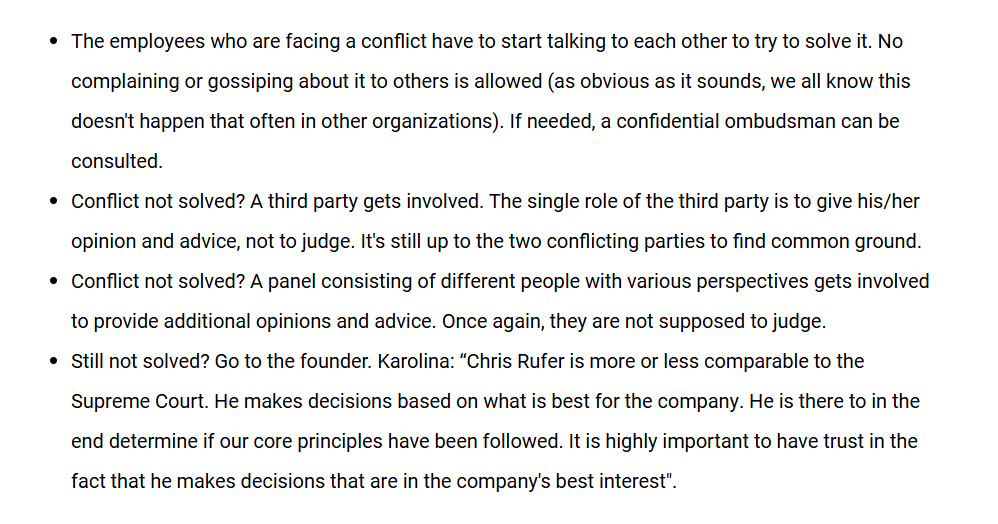
Their conflict resolution process is explicit: 1) Direct conversation 2) Nominated 3rd-party colleague mediator 3) Panel of respected peers 4) Chris Rufer as "Supreme Court." The founder is called in so rarely that most employees couldn't remember it happening.
Compensation works through a genuinely radical system: workers self-assess their contributions, then a local peer committee evaluates each person's impact. Your worth is determined by colleagues who've worked directly with you. But it has it's own challenges👇

Why don't more companies copy this? Harvard Business Review asked the same question. Most executives simply aren't willing to give up what Chris Rufer calls "the perks of power." Most have careers built on rising through hierarchy, not dismantling it.

Most telling: In a mature industry with ~1% growth, Morning Star has maintained double-digit growth for decades. While paying 15% above industry wages and eliminating the "management tax" that burdens competitors with 7-9 hierarchy layers.
During the complete collapse of the 2008 economy, they continued expanding operations. They've made 20+ major facility expansions with collective worker decision-making. Each project emerged directly from the concerns of front-line employees, not strategic planning committees.
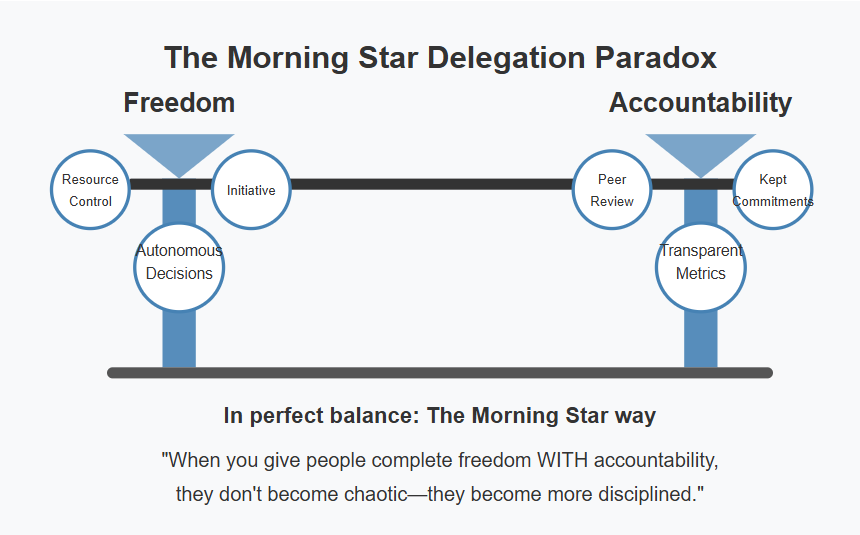
Here's the delegation paradox that Morning Star exposes: When you give people complete freedom WITH accountability, they don't become chaotic—they become more disciplined. In their system, one broken commitment impacts peers directly, creating natural regulation.
Several companies have tried to copy Morning Star's model and failed. W.L. Gore succeeded by capping units at 200 people so peer networks remained effective. Zappos tried with Holacracy and faced massive employee exodus. What's the difference? Culture built on genuine trust.
Two crucial elements make their system possible: 1) Radical transparency where all business data is available to everyone 2) A culture where "do everything you say you'll do" is treated as sacred. These create natural regulation that replaces manager supervision.
Most companies attempt "delegation" by letting employees make decisions within tightly constrained boxes. Morning Star shows that true delegation extends to million-dollar financial decisions, hiring choices, operations strategy—even the company's entire organizational design.

The lesson? Effective delegation doesn't mean giving tasks to people. It means giving them genuine authority, resources, and decision rights, then building systems of accountability that turn hierarchy into a network of mutual commitments between peers responsible to each other.
Look at the greatest organizations: Amazon doesn't control prices - algorithms do Apple doesn't run factories - suppliers do Google doesn't review content - users do They're not managing. They're delegating to market forces.
But most founders try to control growth instead of enabling it. Result? • Decisions slow down • Innovation dies • Talent leaves • Markets eat them
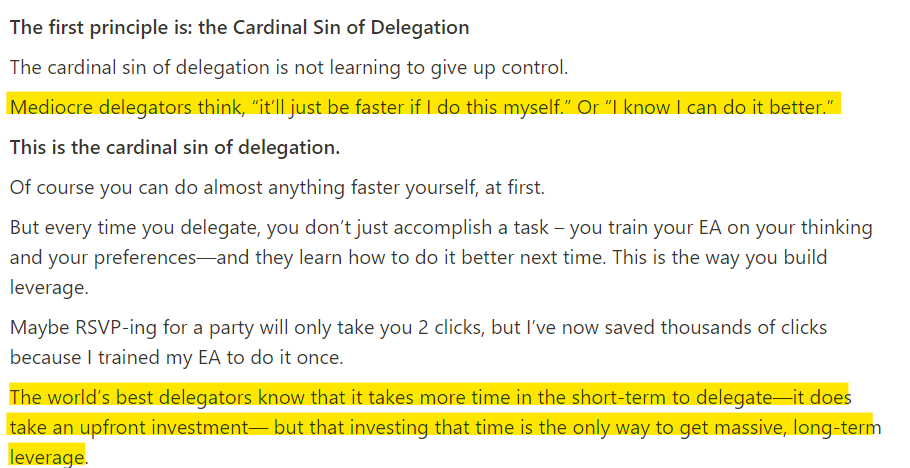
Top CEOs understand this. That's why they have 3-5 assistants handling: • Schedule coordination • Email management • Travel logistics • Daily operations They're not managing time. They're delegating it.
That's why Athena helps ambitious founders/CEOs gain back their time while scaling their company. Delegation is the scaling law of entrepreneurship, if you don't understand it early, you'll find it incredibly hard to scale. https://www.athena.com/?utm_so...