
Napoleon died 204 years ago today. He rose from obscurity, joined a revolution, became an emperor, tried to conquer Europe, failed, spent his last days in exile — and changed the world forever. This is the life of Napoleon, told in 19 paintings:

1. Bonaparte at the Pont d'Arcole by Antoine-Jean Gros (1796) Napoleon's life during the French Revolution was complicated, but by the age of 24 he was already a General. Here, aged just 27, he led the armies of the French Republic to victory in Italy — his star was rising.

2. The Battle of the Pyramids by François-Louis-Joseph Watteau (1799) Two years later Napoleon oversaw the invasion of Egypt as part of an attempt to undermine British trade. At the Battle of the Pyramids he led the French to a crushing victory over the Ottomans and Mamluks.

3. Bonaparte Before the Sphinx by Jean-Léon Gérôme (1886) One of many paintings made after his lifetime, here Gérôme gives us a metaphor for Napoleon's personal battle with history and his desire to become a legend. The crumbling Sphinx also represents Napoleon's eventual fall.

4. General Bonaparte in the Council of the Five Hundred by François Bouchot (1840) By 1799 tensions between Napoleon and the Republican government — their failures, his successes and ambitions — were unsustainable. Acting decisively, he led a coup and established a new regime.

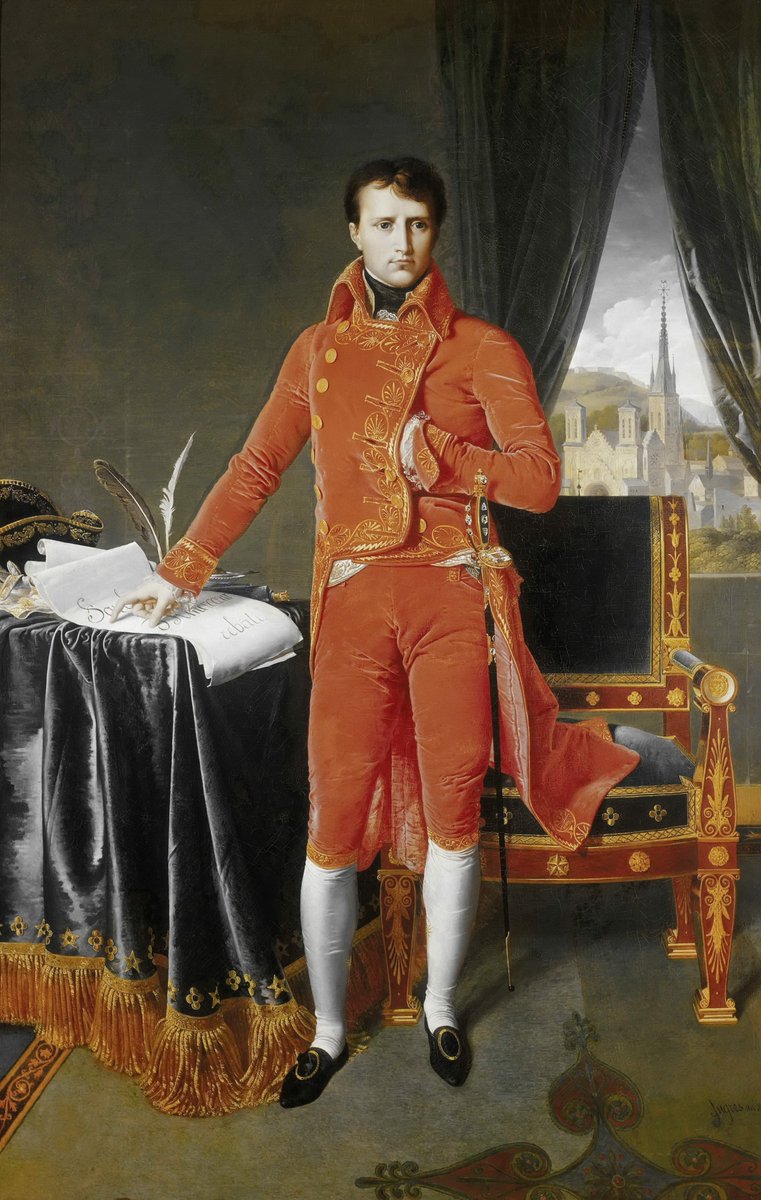
6. Bonaparte, First Consul by Ingres (1804) So in 1799 Napoleon was proclaimed First Consul of the French Republic — it was still a republic in name, but everyone knew who was in charge. The boy from Corsica had somehow become the most famous and feared man on the continent.
7. Napoleon Crossing the Alps by Jacques-Louis David (1801) Napoleon went on to lead his army over the Alps (to fight the Austrians in Italy) as Hannibal had done 2,000 years earlier. Jacques-Louis David then created the most enduring, iconic, and heroic image of Napoleon.

8. The Coronation of Napoleon by Jacques-Louis David (1807) But in 1804 Napoleon declared himself Emperor of France — the dream of the Revolution was crushed and France was no longer a Republic. Europe was in shock... did Napoleon's ambition have any limits?

9. Napoleon I on his Imperial Throne by Ingres (1806) Here we see a new side to Napoleon, perhaps even megalomaniacal, in the lavish robes of a royal ruler rather than the uniform of a republican leader. He wanted to emulate the likes of Julius Caesar and Alexander the Great.

10. Joséphine by François Gérard (1808) No story of Napoleon is complete without his first wife, Joséphine, here painted as Empress. Theirs was a passionate and complicated relationship that ended bitterly — he divorced her because she failed to produce an heir.

11. The Distribution of the Eagle Standards by Jacques-Louis David (1810) After becoming Emperor, Napoleon instituted reforms that emulated the Roman Empire — like giving golden eagles to his soldiers for battle standards. A master of public image and political symbolism.

12. The Battle of Austerlitz by François Gérard (1810) In 1805 Napoleon oversaw one of his greatest victories — the Battle of Austerlitz — against the Russians and Austrians. It reshaped European geopolitics and confirmed his status as the greatest military mind of the era.

13. The Entry into Berlin by Charles Meynier (1810) In 1806 Napoleon captured the Prussian capital, Berlin. There he created the "Continental System", a new economic order intended to ruin Britain and cement French dominance over Europe. At this point he seemed unstoppable.

14. Return of Napoleon to the Isle of Lobau by Charles Meynier (1812) The Battle of Aspern-Essling in 1809, against the Austrians, was Napoleon's first defeat for ten years. Meynier's painting of its aftermath nonetheless portrays him heroically — Napoleon would not be stopped.

15. The Emperor Napoleon in His Study at the Tuileries by Jacques-Louis David (1812) We see Napoleon as bureaucrat rather than general or emperor — an equally important role. His many reforms, legal and administrative, are still foundational in Europe over two centuries later.

16. Napoleon's Retreat from Moscow by Adolph Northen (1851) In 1812, having created the largest state in Europe since the Romans, Napoleon made a final move to establish total dominance. He invaded Russia with 500,000 soldiers — barely 100,000 returned. Catastrophic failure.

17. Napoleon I at Fontainebleau on March 31, 1814 by Paul Delaroche (1840) So the tide turned and in 1814 — after a vast coalition managed to defeat him — Napoleon was deposed. Delaroche imagines the moment, just after the Fall of Paris, when Napoleon's downfall was confirmed.

18. The Battle of Waterloo by William Sadler II (1815) But Napoleon made a startling return to power — known as "The Hundred Days" — and somehow took Europe by storm again. Until he was defeated at the Battle of Waterloo and the Napoleonic Wars were, finally, finished.

19. War — The Exile and the Rock Limpet by JMW Turner (1842) Napoleon was exiled to the island of Saint Helena in the South Atlantic. Turner imagines Napoleon — who once held the world in his grasp — isolated and contemplative, standing in a sea of blood. It was over.

The remains of Napoleon — who stayed on Saint Helena until the end of his life in 1821 — were brought to France in 1840 and interred at Les Invalides in Paris, where a grand tomb was built. And that's the life of Napoleon, who died 204 years ago today, as told in art.
