
🧵𝗟𝗲𝗽𝘁𝗶𝗻 𝗦𝗲𝗻𝘀𝗶𝘁𝗶𝘃𝗶𝘁𝘆 & 𝗠𝗲𝗹𝗮𝘁𝗼𝗻𝗶𝗻 𝗔𝗿𝗲 𝗜𝗻𝘁𝗲𝗿𝘁𝘄𝗶𝗻𝗻𝗲𝗱 Let's dive into why & how your light environment & a deficiency in melatonin can lead to leptin resistance = obesity, nuked metabolism, hypothyroidism, T2DM & chronic hunger. 🔖Bookmark


Melatonin production does not only prepare the body for restorative sleep, but it helps regulate energy homeostasis through food intake, energy storage & energy expenditure.

A melatonin deficiency is associated with obesity, T2DM & metabolic syndrome. Why is this?
Melatonin drives the photo-period dependent metabolic state of the body. The uncoupling of the light-dark cycle with metabolic functions results in metabolic syndrome & obesity.
It organizes the circadian rhythm of metabolic functions and yolks them to behavioural cycles (food intake & energy expenditure).
Melatonin inhibits orexigenic (appetite inducing) signals whilst enhancing anorexigenic signals resulting in a reduction in food intake.
For example, melatonin significantly reduces AgRP expression. Interestingly, AgRP neurons are capable of evoking a feeding response independently of suppression from the melanocortin pathway.
THIS IS IMPORTANT: Melatonin also regulates the circadian rhythm of leptin secretion in fat (WAT) and synchronizes it with leptin sensitivity.
How does it do this?
There are MT receptors on adipocytes which promote the secretion of leptin as well as the browning of white adipose tissue (WAT) into brown adipose tissue (BAT).
Melatonin also acts directly on hypothalamic nuclei to modulate leptin function such as the ARH (MT2 receptors detected).
Additionally, melatonin may act through the SCN which is rich in MT1 & MT2 receptors and has chronobiological effects. The SCN also has pathways projecting to the ARH establishing a circadian rhythm of leptin sensitivity.
Interruption of the SCN-ARH pathway results in impaired locomotor activity, thermoregulation and corticosterone secretion rhythms.
A great way to observe the effects of melatonin is to remove it. This can be done by performing a pinealectomy (removal of the pineal gland).
Removing the pineal gland in rats (PINX) results in leptin resistance, impairing leptin’s ability to control body weight and food intake. This process appears to be cumulative and progresses over time.
PINX rats develop hyperphagia and obesity over time, exhibiting central leptin resistance after several months.

AgRP, NPY & orexin are upregulated in pinealectomized (PINX) rats, these are all orexigenic factors.
PINX rats also have lower UCP1 & BAT intolerance to cold.
Uncoupling proteins (UCPs) are a family of proteins found in the inner mitochondrial membrane of cells.
They uncouple the electron transport chain (ETC) from ATP synthesis, leading to the production of heat instead of ATP. This allows excess calories to be burnt off as heat instead of stored as fat.
Interestingly, PINX rats do not respond to leptin injection (food intake, energy expenditure), suggesting leptin resistance has developed.
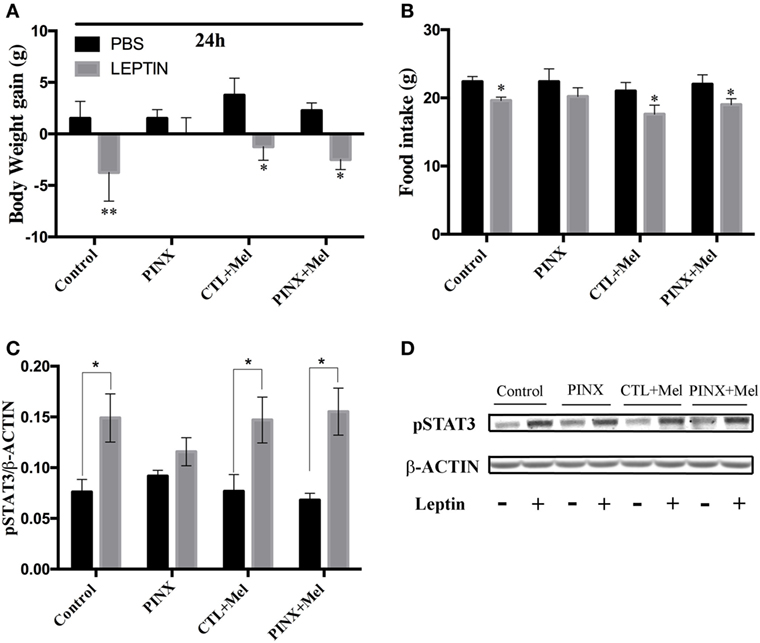
The ability of PINX rats to activate the leptin-STAT3 pathway in the hypothalamus was compromised, but restored upon melatonin treatment.

The STAT3 pathway plays a crucial role in transmitting the signal of the hormone leptin, which is produced by adipose tissue and plays a key role in regulating energy balance, appetite, and metabolism.
Melatonin treatment restores leptin sensitivity in pinealectomized rats.
Ultimately, melatonin is required to maintain leptin sensitivity, independent of body adiposity.
Thanks for reading! If you want to work with me on issues such as leptin resistance, metabolic health or health optimisation shoot me a DM.