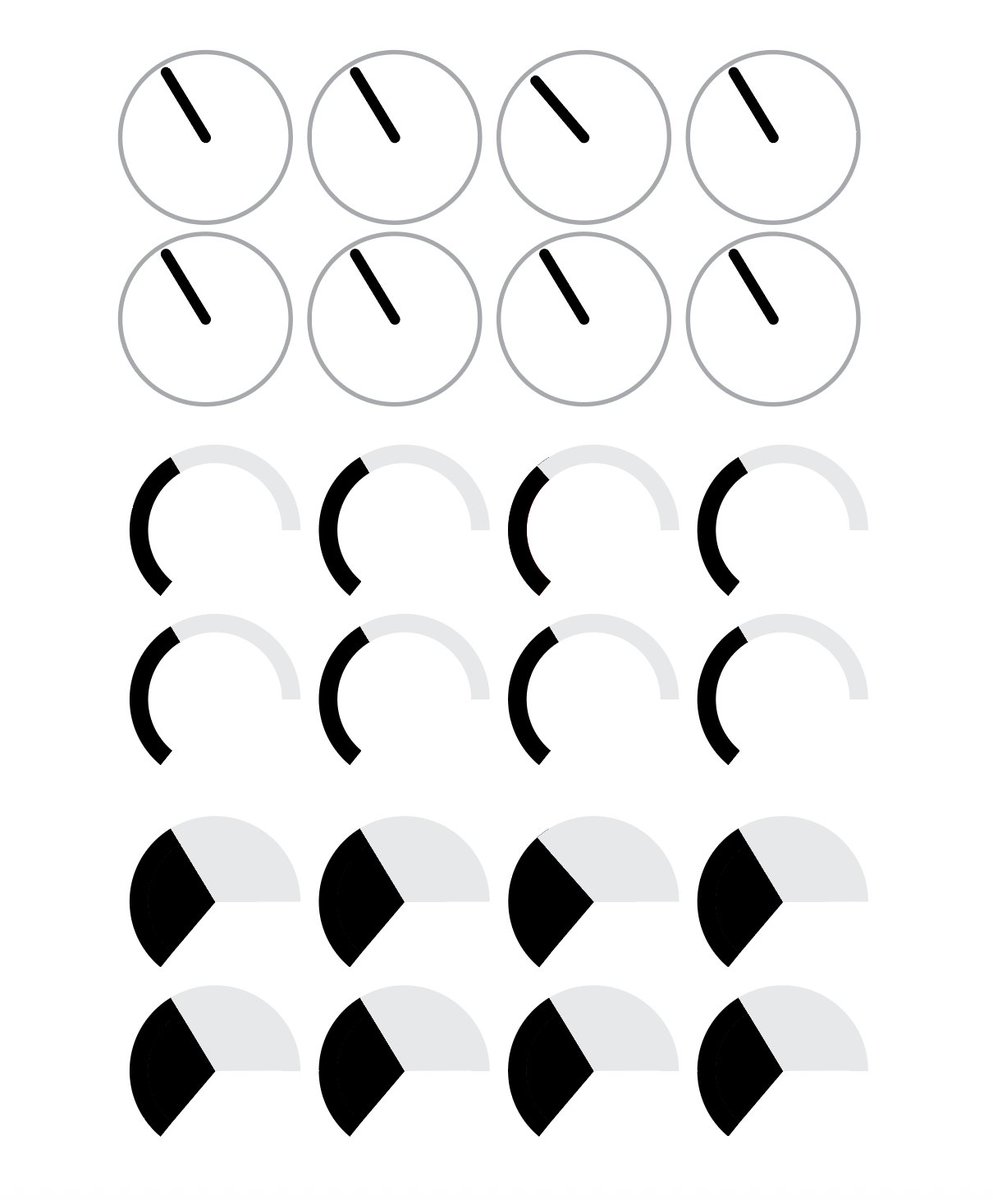
This is a great example. I am telling you, listen to me—it's the needle that matters, not the arc, for fast cognition in gauges. This is not disputable. So much noise was made in the comments in that quoted thread. I know it is correct.

We have two identical groups of 8 gauges with anomalous gauge at position (3,1). The degree of anomaly is identical in both groups ~ 8 deg. Humans have extreme hyperacuity with respect to detecting angular orientation of line segments—needle gauge is so much faster to read. The arc gauges all look the same even though the amount of deviation is the same, about 8 degrees. Even if you concentrate, it's hard to tell which one is off.

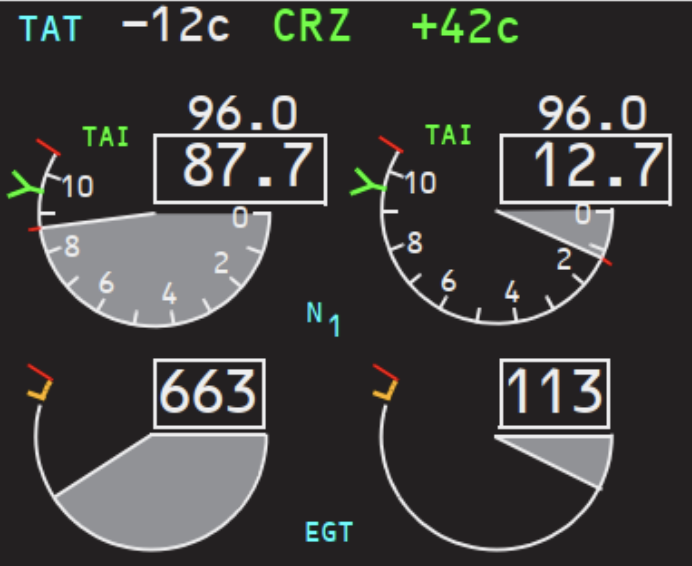
The above illustration only shows that anomalies in a group of gauges can be detected fast. But the speed + acuity has deeper implications, not just for relative comparison. Gauges usually have a graduated scale to combine it with vernier acuity which is for finer measurment. Boeing engine gauges take full advtange of this, notice the N1 limit (Green Y) and the N1 red line bugs that aid in decerning extremely fine misalignments of the needle. Shaded area is an alternative way to add contrast, the other being a tapered needle which is also used in some aircrafts. "Y" shaped bug indicates that N1 Limit is a configurable/adjustable limit—depends on what climb performance was set in the flight plan. "Y" shape because it can be adjusted in both directions! Meanwhile the EGT temperature limits are fixed (bottom gauges) as that's the property of the specific engine type.
It's amazing that the single-edged (filled arc to the center) version is somewhere in between. From what I understand, hypercolumnar acuity in V1 is specifically for line segments, i.e. with two sided contrast. Probably some evolutionary adaptation to detecting branches, not sure.