
Lp(a) Explained: Genetics, Risk, and What You Can Actually Do ❤️🔥🫀 🔗 all references and more info at the end 1/9) By now, you’ve probably heard the term Lp(a). But to get everyone up to speed, Lp(a) is a major causal risk factor for atherosclerosis. On a per particle basis,

2/9) The letter will progress in 7 chapters, the first three of which I'll review in this thread: 1. Defining Lp(a) 2. Guidelines on Measuring Lp(a) & Risk Thresholds 3. Medications in Development to Lower Lp(a) 🧪 4. How to Reduce Cardiovascular Risk if you have high Lp(a) 🫀 5.

3/9) Defining Lp(a) To understand Lp(a) you first need to understand a better-known lipoprotein particle, the "LDL particle." LDL particles are spheres that carry fat and cholesterol around the bloodstream. A core feature of both LDL and Lp(a) is an ApoB lipoprotein that gives
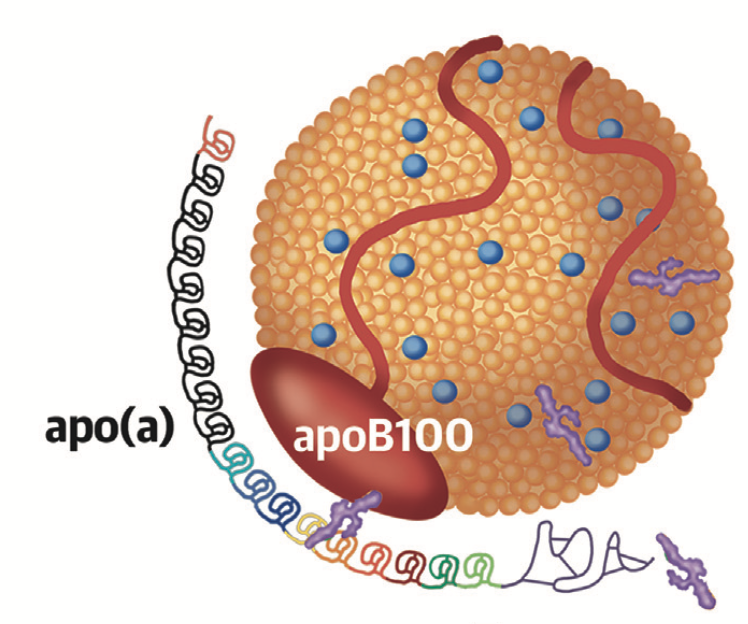
4/9) What does the apolipoprotein(a) tail do? While the functions of apolipoprotein(a) aren’t fully understood, this protein tail does inhibit the breakdown of blood clots, effectively making the blood more “clotty.” Specifically, lipoprotein(a) particles could, via its tail,

5/9) Lp(a) levels are ~90% Genetic 🧬. Blame your "Kringles" Anyway, it’s not helpful to whine about how evolution screwed me. It’s more important for you to understand that, in this case, your genes strongly determine your Lp(a) levels. Concentrations of lipoprotein(a) are

6/9) In general, there is an INVERSE association between the number of Kringle repeats, i.e. size of the apolipoprotein(a) tail, and Lp(a) levels. Simply: Longer Lp(a) tail ~ Lower Lp(a) levels. This is because Lp(a) particles with longer tails are more likely to be degraded

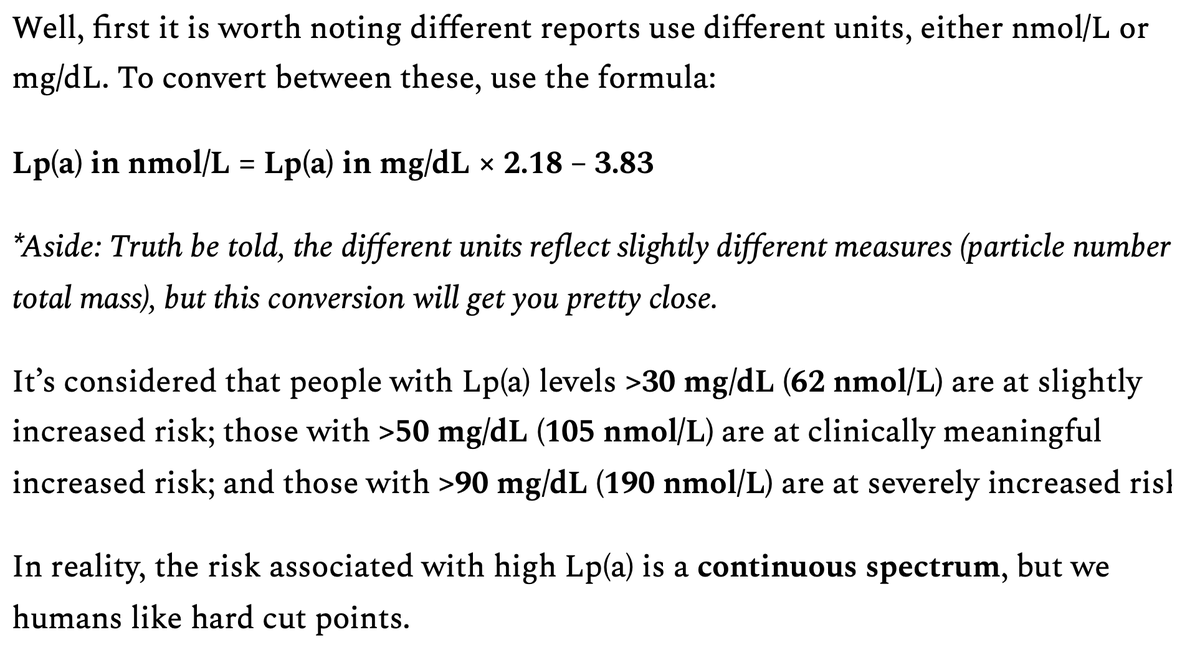
7/9) Guidelines for Measuring Lp(a) and Risk Thresholds Now that you understand what Lp(a) is, should you measure it? Yes. Guidelines from the United States, Europe, Canada, China, and India all suggest measuring Lp(a) at least once to include in overall risk assessment. Now,
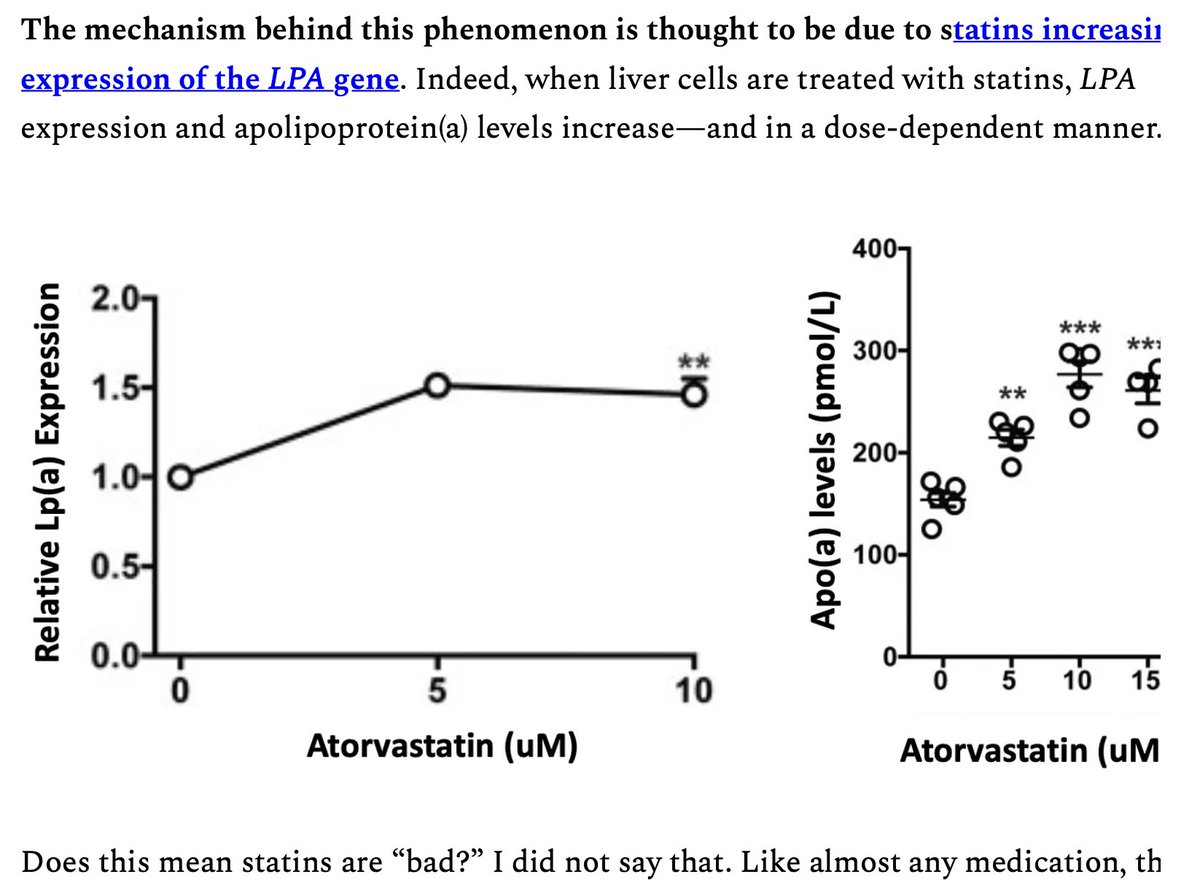
8/9) Medications in Development While there are no medications currently prescribed to lower Lp(a), there are several in development. These work by either decreasing the expression of the LPA gene coding for the apolipoprotein(a) tail, or by preventing the tail from attaching to

9/9) Is your interest piqued? We're just getting started. If you want to know: ❤️🔥How to Reduce Cardiovascular Risk ❤️🔥How Statins Increase Lp(a) and What this Means ❤️🔥Oxidized Phospholipids: The Cargo of Lp(a) ❤️🔥Nuance Notes for the Nerds See today's StayCurious Newsletter!

@nicknorwitz How effective are L carnitine and niacin in lowering Lp(a) ? What's your view on statins increasing Lp(a
@shashiiyengar I address some of this in the full letter. Please have a look. https://staycuriousmetabolism.... As a teaser, niacin does appear to lower Lp(a) ~25%; however, (i) it's not clear that translates to reduced risk and (ii) there may be an interaction with different LPA variants, resulting in
@nicknorwitz Wow! Learned a lot about LP(a) !! My husband lowered his with niacin and carnivore. It went from 185 to 45 in six months. Bio toxins (mold toxicity) were also at play. Please address mold and environmental stressors!!
@nicknorwitz Replace poly and monounsaturated fats with more saturated fats and Lp(a) often drops substantially.
@nicknorwitz I'm a bit suspicious that is it that genetic. Dr Shaw Baker's LP(a) is 2 mg/dL. I think it's been his diet and life style that got it there.
@nicknorwitz I suggest caution with the claim of 6x atherogenicity of Lp(a). The paper advancing the claim depends on Mendelian randomization. The technique requires perfect insight into genetic expression (incl. epigenetics) and perfect mapping of variation to outcomes. Neither is apparent.
@nicknorwitz I have been waiting for someone of Nicks calibre to explain Lp{a} and possibly some beneficial treatments, I have a score of 205 nmol/l with a CAC score of 400, 66 years of age following a mainly Ketogenic diet. Monash University in Melbourne Australia are doing studies on the
@nicknorwitz I remember that some lady have spoken with Dave Feldman in some YT video where she stated that her Lp(a) shifted substantionaly with diet changes. Ask Dave about that, he will remember. Video was about him taking photos of every meal and measuring lipids on daily basis
@nicknorwitz I have it at 256 nmol/L I am terrified
@nicknorwitz Nick, Lp(a) is a repair molecule, found in all arterial plaques. It indicates injury is already there, it's not causal. Come on man.
@nicknorwitz A small addendum: Early antibody studies (e.g., Rath & Pauling, 1990) suggested an apo(a)‐like antigen in scorbutic guinea-pigs, but whole-genome sequencing of Cavia porcellus and subsequent proteomic screens have failed to identify any LPA gene or apo(a) peptides. Authoritative
@nicknorwitz Don’t take statins, eat right and exercise. Simple. We all have to die from something.
@nicknorwitz Lysine and Proline have been demonstrated to reduce Lp(a)
@nicknorwitz Which LPA gene variant is the most at risk?
@nicknorwitz "Lp(a) is a major causal risk factor for atherosclerosis" Assuming "causal" does not mean "associative", then I'm prompted to watch for evidence of causation.
@nicknorwitz Unfollowed due to annoying “paid” requirement.
@nicknorwitz Are you the one with cluster headaches too?