
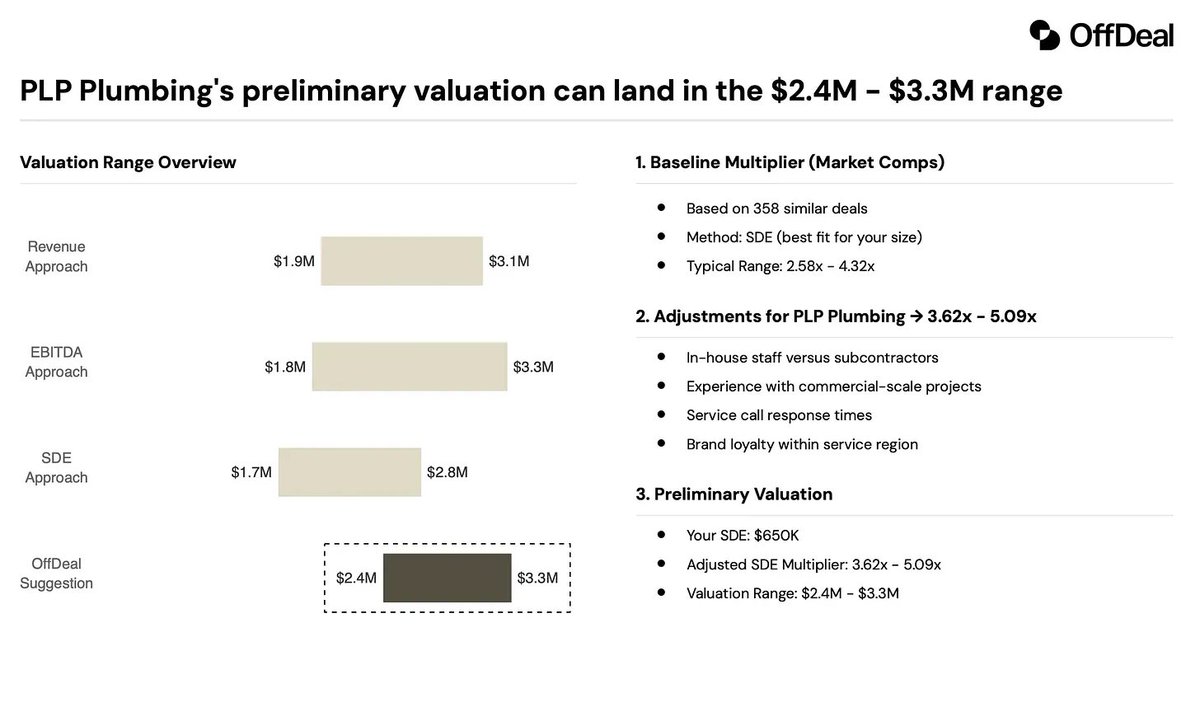
Last year I raised $5M to build a brand new investment bank from scratch. Not software for banks or a fintech marketplace - a real M&A advisory firm. This is a very long post explaining what we're doing, why, and how it's going (sorry, I don't like threads). OffDeal: The First AI-Native Investment Bank Tech only drives step-change in productivity when it is fused to appropriate org design, incentives, and culture - this is why we launched OffDeal as a full-stack investment bank, rather than a software product for incumbent banks. Our first battleground is lower-middle-market M&A—deals in the $5-50 m range that big banks ignore because $300k-700k fees can’t support a bloated legacy deal team. A two-person pod plus AI does make money at that ticket size, and the high deal velocity gives us dozens of live reps each quarter. Early traction is decent - 3 deals closed in our first few months by 1 M&A banker - 20 active exclusive sell-side mandates with expected fees of $6.5M - Signing 1-2 new sell-sides per week and accelerating - Two 2-person M&A pods, hiring more - $20M fee pipeline generated in 2025 alone Here’s how our system performs in practice: Operating model: Pod x Platform To achieve significant operating leverage we had to do two things: 1) Refactor the atomic unit of a deal team into a two-person pod. Current throughput: - 15-20 meetings booked per BD banker per week - One pod runs 8-10 sell-side M&A processes in parallel - Junior bankers involved in high-value tasks since day 1 2) Develop a fully-vertically integrated software stack. - Unified data store - a Postgres DB with 2.5M+ SMBs, with products/services/biz model/past deal activity etc all indexed. - Live context - as soon as any prospect is engaged all call transcripts, SMS, emails etc write back to the same data store. - AI interfaces - AI pulls directly from the data store to draft pitch decks, CIMs, answer DDQs etc. These AI-native workflows can only reach their full potential in an AI-native organizational structure and work culture that is AI-first. The Unreasonable Customer Service A common misconception is that AI replaces humans. The opposite is true: by eliminating busy work, our bankers spend significantly more time on high-value client interactions - the technology allows us to deliver more value to our clients than before. When marginal cost of analysis approaches zero, you can do things legacy teams label “nice-to-have”. Two recent engagements show this in action. Example 1 - Plumbing Company - OffDeal AI flagged that that gross margins were too low, prompting banker to use Deep Research to analyze pricing for every local plumbing co within a 50 mile radius, which uncovered that our prospect was severely undercharging for their services. Prospect signed with OffDeal same day. Example 2 - Montessori School - Banker used OffDeal AI to identify 10K+ similar operators in the US, and screen it down to a short list of 1.8K most relevant buyers in minutes. Personalized outreach + NDAs sent the same afternoon; 71 NDAs returned within two weeks; 4 firm offers - deal closed in <45 days. In both cases, tasks that would have been uneconomic- or impossible - for an incumbent investment bank were completed at near-zero marginal cost and within hours, not weeks. The compounding advantage Product and deal teams work side-by-side. When a prompt mislabels a metric or a buyer filter needs refinement, engineers hear it in real time and ship a fix the same day. Because every application is internal, we can release features at “good-enough” and harden them through live use rather than long test cycles. This creates a rapid product feedback loop. Where we’re headed - Short-term. Remain in SMB M&A until our processes and software reach maturity - Mid-term. Move up-market, competing for $100m+ deals. - Long-term. Move even more up-market ($1bn+ deals) and/or add adjacent advisory services—capital raises, debt advisory - on the same platform, aiming for a full-service franchise. The thesis stays constant: an AI-native org, culture, and software stack can match—then exceed—incumbent capability with a fraction of the labour. Long road ahead To be clear, this - like any full-stack startup - is a brutally hard business to build: - Many competencies, zero excuses. We must stand up data infra, AI tooling, M&A playbooks, and a brand - all at once. - Long lead, lumpy revenue. A deal must be sourced, launched, and closed before a dollar lands - all while we carry months of payroll. The capital curve is steeper than pure software. - Skepticism by default. Industry insiders often view a VC-backed investment bank run by “tech outsiders” as Silicon-Valley hubris. Until we post results, we’re assumed wrong. The upside: those same hurdles make the model tough to copy. Clearing them builds a barrier to entry and an operating moat incumbents—or fast followers—can’t easily match. I have a lot more to say and share on this topic, but this is already a ridiculously long post. If you made it this far - thank you! Let me know what you think of you'd like to connect. Happy building!
full thesis can be read here - https://www.fullydistributed.c...