
Chapter 2 of the Orderflow Series most traders confuse motion w/ information they watch volume and think it tells them something meaningful volume is just the measurement. liquidity is what allows or not the movement to happen A thread: 👇
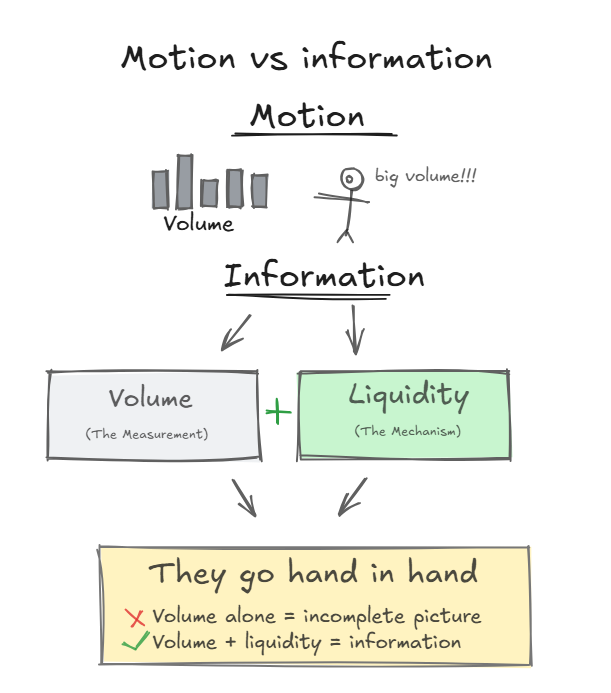
1/ if you read the previous thread you understand markets are auctions now. but what determines whether an auction succeeds or fails? liquidity. this is the mechanism that makes everything work
2/ what liquidity actually means: liquidity is essentially the availability of the other side to trade with when you want to buy, liquidity is the sellers waiting when you want to sell, liquidity is the buyers waiting
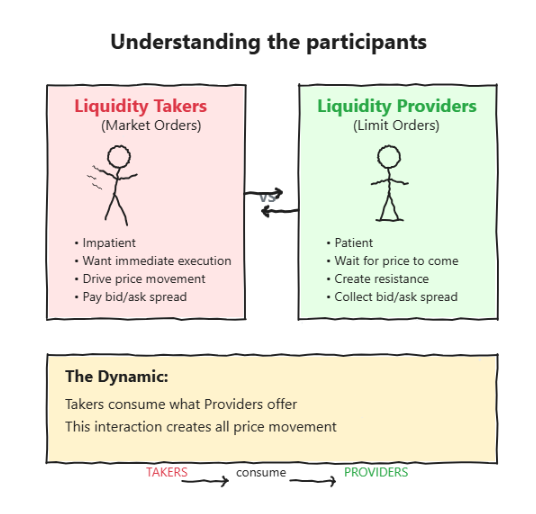
3/ heres what you must understand: every trade is 1-to-1. always. for every buyer theres a seller for every seller theres a buyer but the key question is: whos more impatient/motivated? - the impatient side takes liquidity - the patient side provides liquidity
4/ when you place market order = youre taking liquidity when you place limit order = youre providing liquidity this dynamic creates all price movement
5/ why price moves or stays put: when price struggles to advance: liquidity takers cant overwhelm the liquidity providers when price moves easily: liquidity takers are consuming available liquidity faster than its being replenished when price accelerates: theres little to no
6/ understanding the participants: liquidity takers (market orders): impatient participants who want immediate execution they drive price movement they pay the bid/ask spread for immediacy liquidity providers (limit orders): patient participants who wait for price to come
7/ i always like to use a floor and a hammer as an analogy limit orders = floors/ceilings of a building market orders = hammer trying to break through youre on top floor. want to move down. what do you need? enough hammer force to break the floor (market orders overwhelming
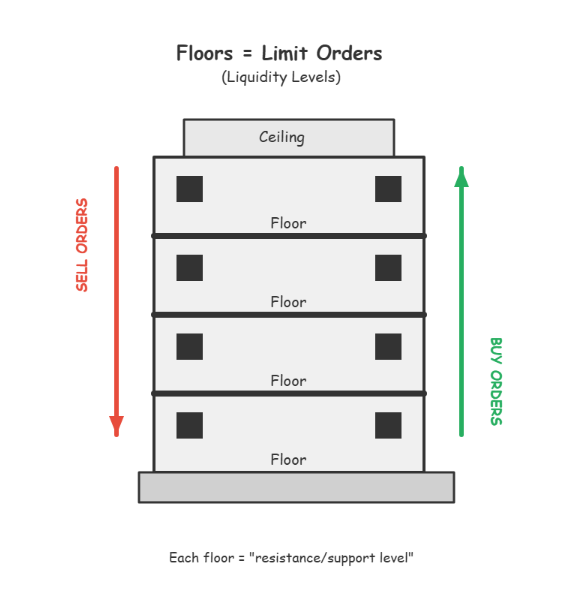
8/ if hammer is weak and floor is thick: hammer strikes floor floor holds hammer bounces back if hammer is strong and floor is thin: hammer breaks through floor movement continues to next floor
9/ what happens after breaking structure: easier movement until next structure (less resistance in between floors) return path becomes easier too (you created hole in ceiling/floor) imbalance gets created (consumed liquidity, left void) price has memory bc liquidity has

10/ the time element: building structure takes time time regulates all opportunity in markets the longer price spends at a level, the more liquidity builds there time creates opportunity for more participants to enter time allows structure to thicken
11/ example: price drops from 4500 to 4450 in 5 minutes consumed all limit orders between 4499.5-4450.5 created void in building structure but also price spent a lot of hours at 4500 before dropping that time created thick structure at 4500 future attempts to break 4500 are
12/ reading auction behavior properly: stop reacting to individual candles. start observing auction mechanics: before movement: how much liquidity stacked? how aggressive are market orders? during movement: is hammer getting stronger? are floors thicker? after movement:
13/ thick structure + weak hammer = failed auction thin structure + strong hammer = successful auction no structure + any hammer = acceleration
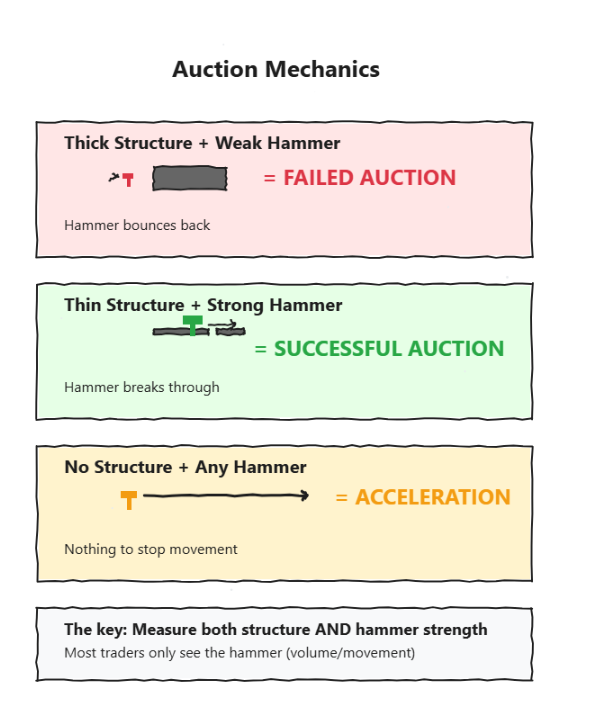
14/ why not understanding this leads to disaster: you see movement and assume momentum but you never measured the structural thickness you never assessed the hammer strength you never identified the holes youre buying the little hammer thinking its a breakout.
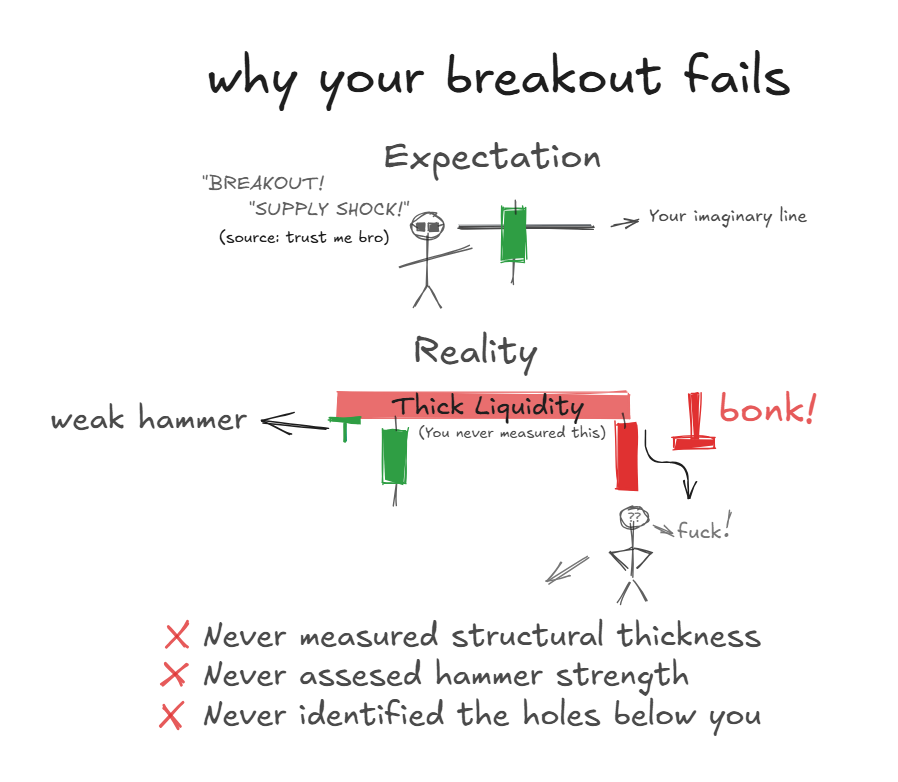
15/ real example: price hits 4500 resistance big green candle appears you buy thinking "breakout" what actually happened: market orders hit thick structure at 4500 structure too thick for hammer force hammer exhausted bonk
16/ practical scenarios: failed auction: price pushes to 4505 then retreats to 4490 (structure too thick) successful auction: price breaks 4505 and continues to 4520 (structure thin enough) acceleration: price rockets from 4500 to 4550 w/ minimal volume (no structure)
17/ different market environments: balanced auction: thick structure both directions, price rotates (facilitation working) trending auction: thin structure in trend direction, breaks relatively easily one way (searching for value) volatile auction: holes everywhere, rapid
18/ connecting to auction theory: remember: "what is the market trying to do?" answer: facilitate trade. liquidity is HOW it facilitates trade. the market is always trying to advertise for the other side price moves up = advertising for sellers price moves down =
19/ so to wrap it up - youre no longer guessing about price direction - youre reading auction mechanics bc now you know: - why certain levels hold while others fail - why price returns to fill gaps - where price will encounter friction vs flow easier
20/ the foundation is set: you understand what drives price movement and what prevents it you know mechanics of how auctions succeed or fail
21/ but one critical piece remains: who is swinging the hammer? who is building the structure? what participant types create what behaviors? bc different participants behave very differently algorithmic vs discretionary market makers vs dealers
22/ find out in the next chapter. understanding WHO participates and HOW they behave. bc knowing WHO matters as much as understanding WHAT. /end hope u enjoyed it. regards, @tradestream_xyz intern