
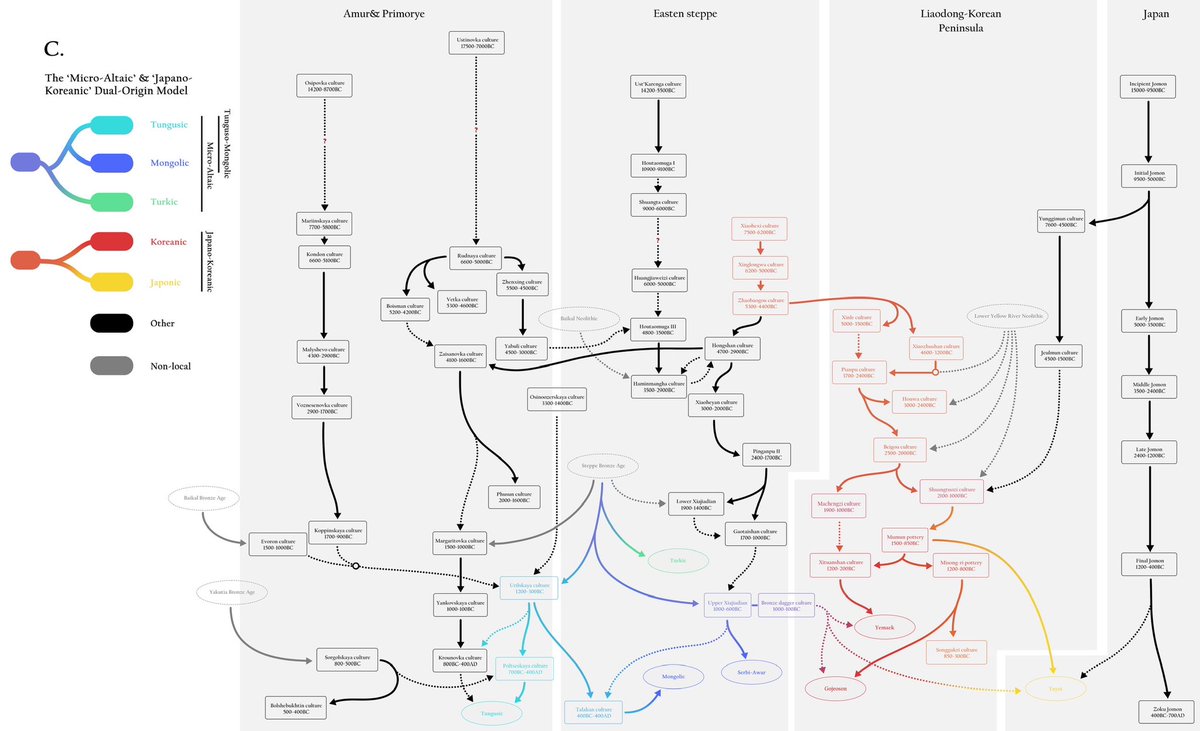
Four major theories regarding the link between Turkic, Mongolic, Tungusic, Koreanic and Japonic. A: Transeurasian farmer theory B: Steppe theory C: Micro Altaic theory (with Japano-Koreanic excluded) D: Diffusion theory



a1) The Transeurasian model theorize that today’s Northeast Asian languages share a common local ancestor in the Neolithic, with the earliest attested culture being the west Liao river Xiaohexi culture (7000-6200BC), it theorize that the language persisted throughout the multiple
a2) waves of migrations from both the steppe and east Asia, sometimes possibly as a “mother tongue”. It can be linked to the spread of millet and rice cultivation around northeast Asia and the eastern steppe.
b1) The steppe model a.k.a. the Altaic model puts the date of separation in the much later Bronze Age, between 2500-1500BC, with many contemporary cultures in Mongolia/ Baikal being the possible origin. It theorize that the proto-Altaic people
b2) arrived as Bronze Age nomads, imposing their culture and language on the local Neolithic population, while the local farmer’s languages became the variety of linguistic substrates that exist in today’s Northeast Asia.
c) The “Micro-Altaic” excludes the Japano-Koreanic to explain the core differences between them and the main Altaic branches (Turkic, Mongolic and Tungusic). While the similarities are explained by diffusion events between Altaic and Japano-Koreanic during the Bronze& Iron Age.
d) The Altaic Aprachbund model theorize that these languages are not genetically related, but only became similar by way of convergence. There are many sub-theories regarding the individual origin of these languages, here I’m showing a more extreme one, where none of them are
d2) related to each other at all, the Koreanic being local, while Japonic, Mongolic, Turkic, Tungusic arrived through different events of migration, and then converging with each other during the Bronze& Iron Age.
@ElamiteJ40760 I think the 3rd model is most plausible so far. Hongshan and post-Hongshan cultures (I dont think we have pre-Hongshan samples yet) had a fair bit of YR-like admix and haplogroup N-M128, which is absent among Micro-Altaic groups, but present among Koreans and Japanese.
@ElamiteJ40760 What do you mean Steppe Bronze Age? Deer stone or Munkhkhairkhan cultures? Because they couldn't speak Micro-Altaic languages, Because they mainly carry Amur-EN ancestry like Angangxi/Hamin/Devil's Gate cave
@ElamiteJ40760 Stelle theory ftw