
Your brain has been fooling you your entire life. This Nobel Prize winner spent 40 years proving it. Here are the 10 mental traps controlling every decision you make: 🧵


After surviving the Holocaust, Daniel Kahneman became obsessed with understanding human behavior. Why did some people help Jews while others turned them in? Why did seemingly rational people make wildly irrational choices? The answer would take him decades to uncover.
In 1969, Kahneman met Amos Tversky. Together, they discovered our brains operate in two distinct modes. They called them 'System 1' and 'System 2.' This discovery would revolutionize economics, psychology, and how we understand human behavior.
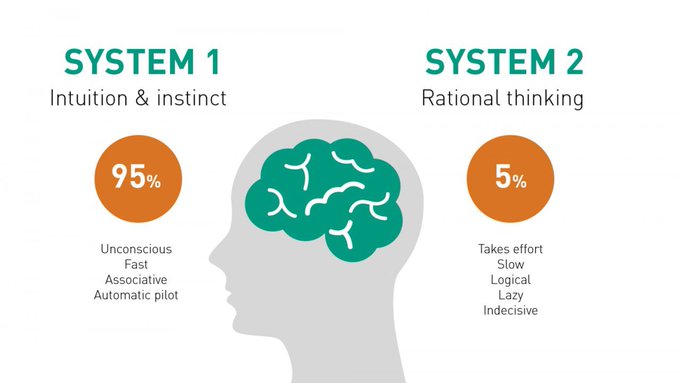
System 1: This is lightning-fast, intuitive thinking. That no-effort, automatic kind. It's how we make snap judgments. System 2: This is slow, analytical thinking.—used for complex problems & questioning assumptions. It takes mental effort. But here's the interesting part...
System 1 is in charge 95% of the time. And while this quick thinking helped our ancestors survive ("Is that a tiger?"), it creates massive blind spots in modern life. These blind spots are called cognitive biases. Here are the 10 most powerful ones Kahneman discovered:
1. Anchoring Bias Your brain latches onto the first piece of information it receives. If you see a $1000 watch first, a $400 watch seems cheap. See the $400 watch first? It seems expensive. This is why stores show you expensive items before revealing "deals"...
2. Loss Aversion Humans feel losses 2x more intensely than equivalent gains. Losing $100 hurts more than finding $100 feels good. This explains why investors hold onto losing stocks too long - the pain of accepting the loss is worse than the potential gain.
3. Availability Bias We overestimate the likelihood of events we can easily recall. After hearing about a plane crash, flying seems more dangerous - even though driving to the airport is statistically far riskier. Our memory tricks us into false probability calculations.
4. Confirmation Bias We seek information that confirms our existing beliefs and ignore contradictory evidence. This is why two people can look at the same data and reach opposite conclusions. Their brains are literally filtering for different information.
5. Planning Fallacy We consistently underestimate how long tasks will take. This isn't just poor planning - our brains are wired to be optimistic about future scenarios. That's why "it'll only take 5 minutes" usually means 15-20.
6. Hindsight Bias After an event occurs, we believe we "knew it all along." This makes us overconfident about our ability to predict future events. It's why everyone "knew" the 2008 crash was coming... after it happened.
7. Framing Effect How information is presented changes how we decide. "90% fat-free" sounds better than "contains 10% fat" "Save $100" is more appealing than "Avoid a $100 loss" Same information, different frames, totally different decisions.
If you enjoyed reading this thread, please : Like and Retweet the first tweet with your audience. Follow us @LearnWithSubhan for more content like this
If you enjoyed reading this thread, please : ✔ Like the thread❤️ ✔ Retweet the first tweet. ✔ Follow me @LearnWithSubhan for more such content.
@LearnWithSubhan Fascinating insights! Can't wait to learn more.
@LearnWithSubhan Mental traps
@LearnWithSubhan impressive
@LearnWithSubhan Interesting read, thanks for sharing
@LearnWithSubhan Great share
@LearnWithSubhan Fascinating insight into our minds!
@LearnWithSubhan Informative
@LearnWithSubhan That's a fascinating perspective!
@LearnWithSubhan Amazing share
@LearnWithSubhan I’ve always trusted my brain to guide me, but learning that it’s been fooling me my whole life feels like a betrayal. A Nobel Prize winner dedicated 40 years to proving how our minds distort reality—misleading us with biases, skewed memories, and snap judgments. It’s humbling to
@LearnWithSubhan Subhan: Thank you for this. 50 years ago I abandoned my new undergraduate degree in Psychology to pursue a graduate degree and then career in biomedical systems engineering. Psychology did not satisfy my passion for understanding how things work coupled with opportunities to
@LearnWithSubhan @threadreaderapp unroll
@LearnWithSubhan Well summarised, thanks very much! Obviously from his book : Thinking, fast and slow😊
@LearnWithSubhan Outstanding share
@LearnWithSubhan Great tool
@LearnWithSubhan Interesting perspective, tell me more!
@LearnWithSubhan thanks for sharing
@LearnWithSubhan Great share
@LearnWithSubhan Great share
@LearnWithSubhan Great share
@LearnWithSubhan Knowledge is power!
@LearnWithSubhan Great share