
Hi everyone, As the private sales for RGB Studies are slowly ending, I want to talk a bit about the inspirations behind the project & why it’s such an important body of work in my practice. It's going to be a bit long :)
First, I want to give a heartfelt thank you to @sammdec who designed & built the contracts & website for RGB Studies & helped me so much to bring this project to life. This project couldn't have happened without you Sam :) thank you for your help, patience, expertise & kindness!
@sammdec Now, let's dive in. RGB Studies is a project in which each artwork uses a unique moiré technique: 2 images overlap, creating an optical illusion. Here, the moiré pattern technique is used to create digital animations rendered with only 3 primary colors: red, green, & blue.
@sammdec This moiré technique mimics an optical illusion embedded in the structure of our screens, where each pixel is composed of 3 primary color diodes (RGB). I consider this optical illusion a foundation of our visual experiences on screen, & so it became a foundation of my project.
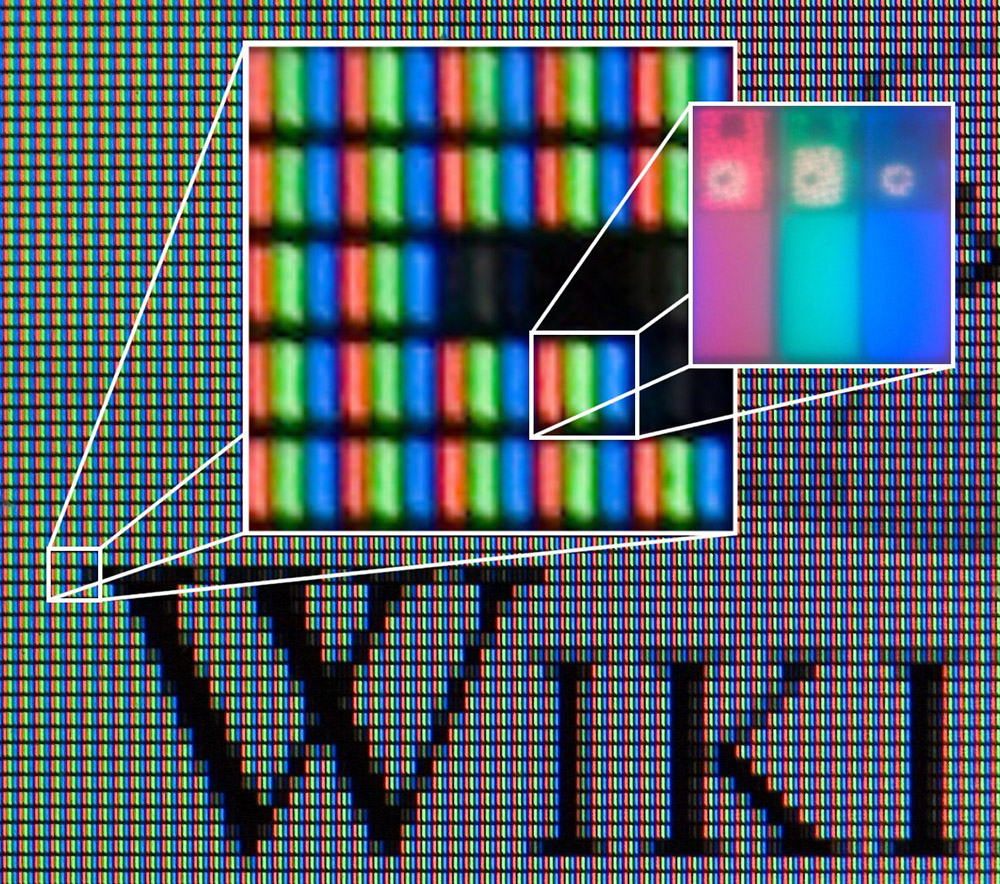
@sammdec RGB is also informed by George Seurat’s pointillist paintings, in which 1000s of colored dots end up forming a cohesive image. In RGB, I use a similar imaging method but with individual pixels of color instead of paint; adjusted to the context of screens & screen-based graphics.

@sammdec Each work in RGB is first drawn on screen as an image in greyscale, like a drawing. It is then converted to bitmap, distorted, duplicated, & overlaid on top of RGB lines. This process converts the static image into an animated digital moiré, through lots of trials & errors.

@sammdec Described as such, the process behind RGB Studies seems straightforward. It is not. It took me years to get results using this technique, especially for figurative works. This is also why I spent 18 months on the first RGB series - LANDSCAPES - which I will now talk about.
@sammdec The first series from RGB Studies consists of 90 digital animations featuring archetypal landscape imagery. Mountains, valleys, forests, rivers, & coastlines appear in a haze, drawing ethereal topographies of imaginary places through motion, color & light.
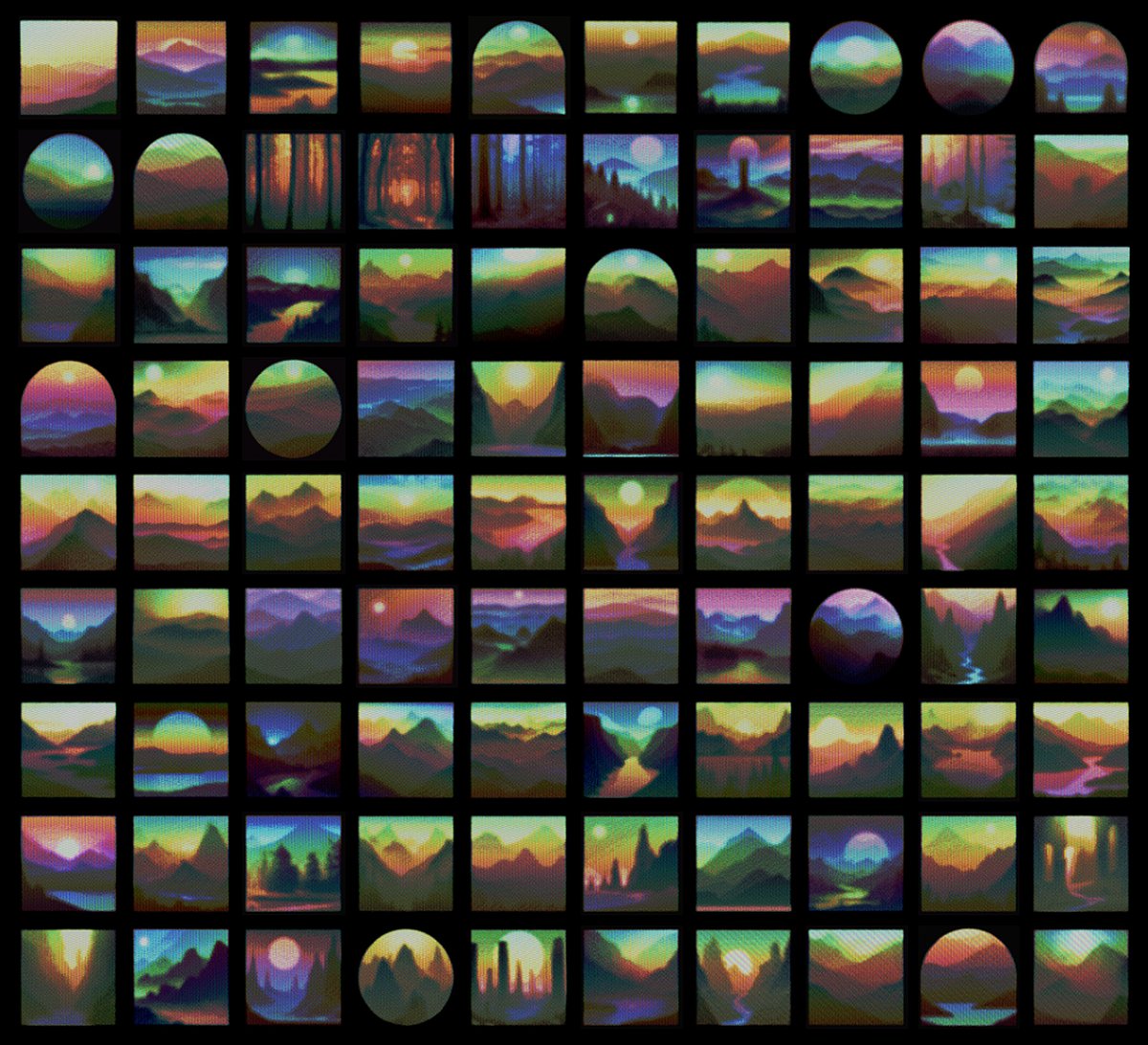
@sammdec I wanted to create a visual representation of memories from different places: hazy, but also vivid & alive, like an electric signal. I often think of GIFs as animated time-capsules or moving postcards. This series was an opportunity to bring this poetic take on GIFs into life.
@sammdec Formally, the series also explores atmospheric perspective—an artistic technique found in Greco-Roman frescos, early Chinese landscapes & Italian Renaissance paintings—to signify depth. Scenes gradually disappear in the distance using brightness, contrast, and saturation.
@sammdec I tried to reimagine these traditional modes of representation using processes specific to computer imaging and screen-based graphics: visual information becomes reinterpreted as pixelated textures, kinetic motions, & prismatic colors to represent landscape & atmosphere.

@sammdec The most challenging aspect of this series was to express & "represent" natural forces within them: sun, wind, rain, mist filtering through the atmosphere. This meant adjusting the moiré pattern motion & amplitude to each artwork, since it was always a different composition.
@sammdec After 18 months, this process culminated in the creation of the LANDSCAPES series. I created more than 200 works before selecting 90 of them which became the final series. But, my first experiments on RGB Studies began 15 years ago...I’ll take some time to talk about these now.
@sammdec In 2011, I created a series of 6 animations - TIDES - my first experiment using moire patterning and RGB rendering. The project TIDES was trying to emulate reflections, motions & light effects on the water surface. At the time, the works were presented online as flash animations.
@sammdec These first experiments on RGB Studies were not really “RGB”: I used another set of 3 colors. The color combination worked well to create an impression of liquid surface. Two years later, I remastered the animations as animated GIFs & finally used a RGB palette for them.
@sammdec In 2015, I worked on a new series of animations for a major exhibition at the Vancouver Art Gallery. These were the first works exploring figurative landscapes using the RGB method. The works were inspired by the landscapes of British Columbia & projected on the museum's walls.

@sammdec In that series, the works were designed to be lined up horizontally to create an endless landscape. I wanted to explore the connection with traditional wallpapers & decorative arts, which was influential in my work. The show also included artworks by Sara Ludy & Sylvain Sailly.

@sammdec Following this exhibition, I kept coming back to RGB Studies. I designed new animations & prints, but it felt like the research was still missing something & I wasn’t satisfied with the formats of the works. Once again, I set the project aside, revisiting it at regular intervals.

@sammdec In Dec 2023, I decided to focus entirely on this research until I could finally figure out what was missing. I started working on both abstract & figurative works using different formats. Eventually I settled for a square format which appeared optimal for most of my compositions.
@sammdec At the end of 2024, I began working with @sammdec on the website + contract for RGB Studies, which took a few months to put together. The website is meant to archive, display, distribute & document this project under optimal conditions, without depending on a 3rd party platform.

@sammdec In Nov 2024, I showed the 1st artwork from this new research with @nguyenwahed at Paris Photo. Paradoxically, this piece was not a square format. Later on, this artwork was collected as a large Diasec print & NFT (TokenID1 of RGB Studies) by a wonderful collection in Switzerland.

@sammdec @nguyenwahed In April 2025, another artwork from RGB Studies was shown as an installation for a group exhibition at the Villa Beatrix Enea in Anglet, France. This was the opportunity to come back to my favorite medium: video projection, which is among the best way to show these works imo.

@sammdec @nguyenwahed Last month, I showed a new landscape piece from RGB Studies in 16/9 format at @heft_gallery for the exhibition Ground Work. This is the largest RGB piece to date (1920x1080px) & it proved to be quite a challenge. Despite this, it turned out great & went to an amazing collector.
@sammdec @nguyenwahed @heft_gallery All this is to say, RGB Studies will take many shapes & forms in the future, & that’s what I’m most excited about. With this project, I finally managed to really touch upon what truly drives my art practice visually & conceptually. This doesn’t happen very often in one’s career.
@sammdec @nguyenwahed @heft_gallery You can view RGB Studies here: https://rgbstudies.net/ Minting is deactivated on the website; the remaining works will be sold through private sales only. Thank you so much to all who have collected already, & I always welcome / look forward to chat with new collectors :)