15 most thought-provoking Paradoxes in Physics. A thread 🧵
1. Fermi Paradox Given that our star and Earth are part of a young planetary system compared to the rest of the universe — and that interstellar travel might be fairly easy to achieve — the theory says that Earth should have been visited by aliens already.

2. Boltzmann Brain It's more likely for a single brain to spontaneously and briefly form in a void (complete with a memory of having existed in our universe) than it's for the universe to have come about as the result of a random fluctuation in a universe in thermal equilibrium

3. Feynman sprinkler Feynman inverse sprinkler is a sprinkler-like device which is submerged in a tank and made to suck in the surrounding fluid. The question of how such a device would turn was the subject of an intense and remarkably long-lived debate.

4. Heat Death Paradox It was a reductio ad absurdum argument which was used when the universe was believed to be eternal. If the universe was really infinitely old then why, according to the second law of thermodynamics had it not already reached thermal equilibrium.

5. Black hole Information paradox According to general relativity, anything that falls into a black hole is lost forever, yet quantum mechanics insists that information must be preserved (unitarity). Hawking’s calculation showed black holes emit purely thermal radiation,

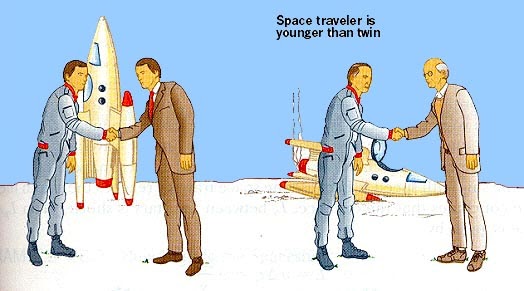
6. Twin paradox In physics, the twin paradox is a thought experiment in special relativity involving identical twins, one of whom makes a journey into space in a high-speed rocket and returns home to find that the twin who remained on Earth has aged more.
This result appears puzzling because each twin sees the other twin as moving, and so, as a consequence of an incorrect and naïve application of time dilation and the principle of relativity, each should paradoxically find the other to have aged less.
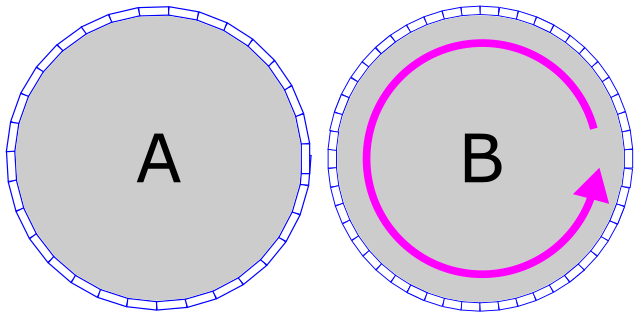
7. Ehrenfest Paradox It relates to the relativistic description of the geometry of a rotating rigid disk. Ehrenfest has formulated this paradox in 1909 in the context of Einstein’s special relativity theory (SRT) published in 1905.
The paradox is that there is a discrepancy between the Euclidean circumference vs. the circumference calculated by Special Relativity Theory based on Lorentz concentration.
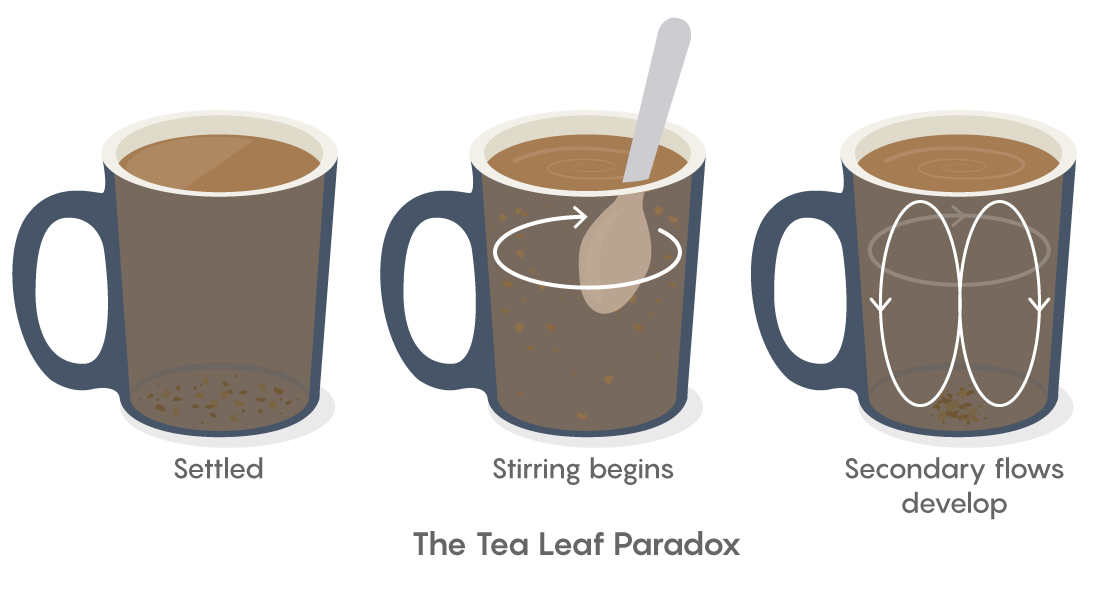
8. Tea leaf paradox The tea leaf paradox is a phenomenon where tea leaves in a cup of tea migrate to the center and bottom of the cup after being stirred rather than being forced to the edges of the cup, as would be expected in a spiral centrifuge.
9. Aristotle's Wheel Paradox A wheel is depicted in two-dimensional space as two circles. Its larger, outer circle is tangential to a horizontal surface, while the smaller, inner one has the same center and is rigidly affixed to the larger.
Assuming the larger circle rolls without slipping for one full rev., the distances moved by both circles are the same. The distance travelled by the larger circle is equal to its circumference, but for the smaller it is greater than its circumference, thereby creating a paradox.

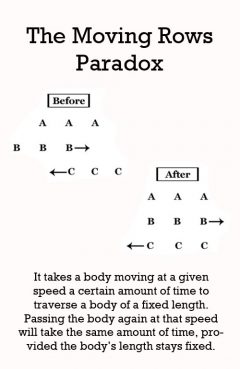
10. The Moving Rows Paradox Concerning the two rows of bodies, each row being composed of an equal number of bodies of equal size, passing each other on a race-course as they proceed with equal velocity in opposite directions, the one row originally occupying the space between
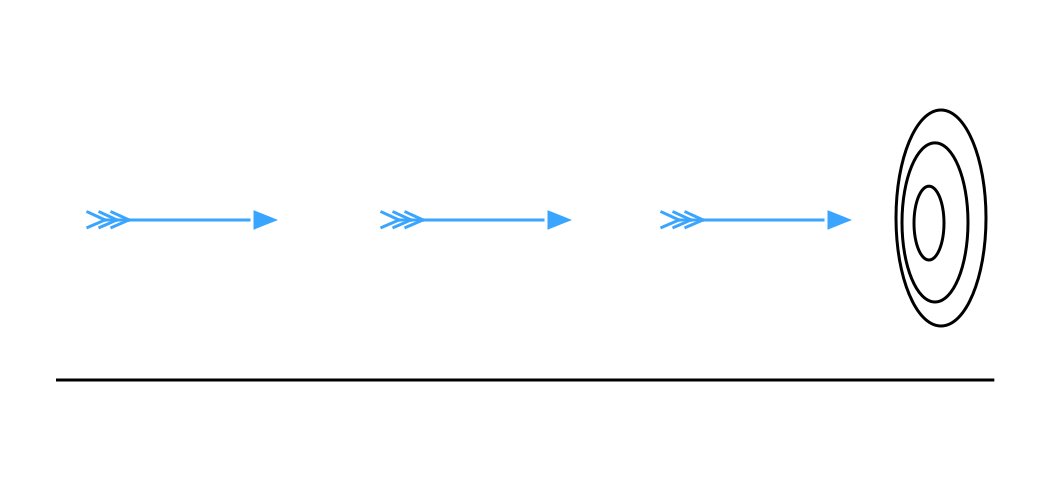
11. Arrow Paradox If everything when it occupies an equal space is at rest at that instant of time, and if that which is in locomotion is always occupying such a space at any moment, the flying arrow is therefore motionless at that instant of time and at the next instant of time
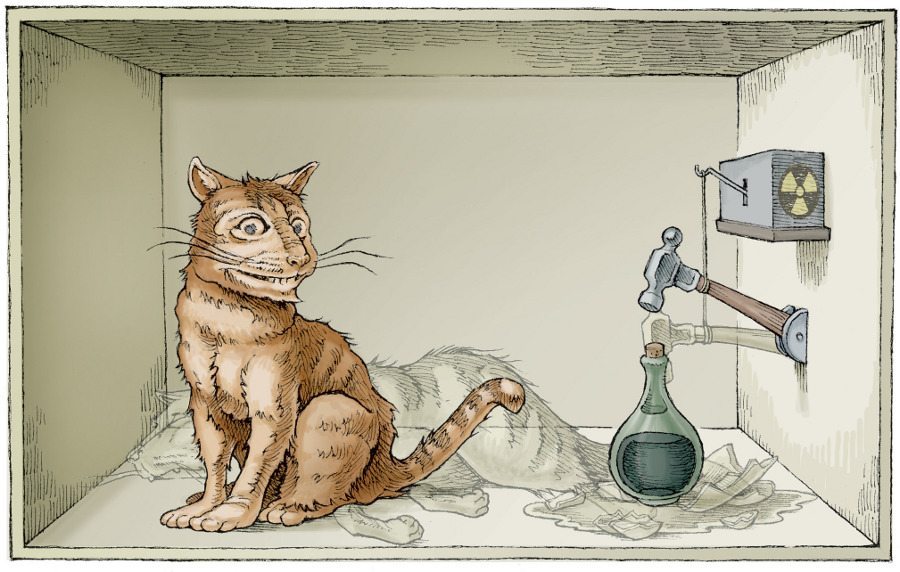
12. Schrodinger's cat It's a thought experiment that illustrates a paradox of quantum superposition. A hypothetical cat may be considered simultaneously both alive and dead as a result of its fate being linked to a random subatomic event that may or may not occur.
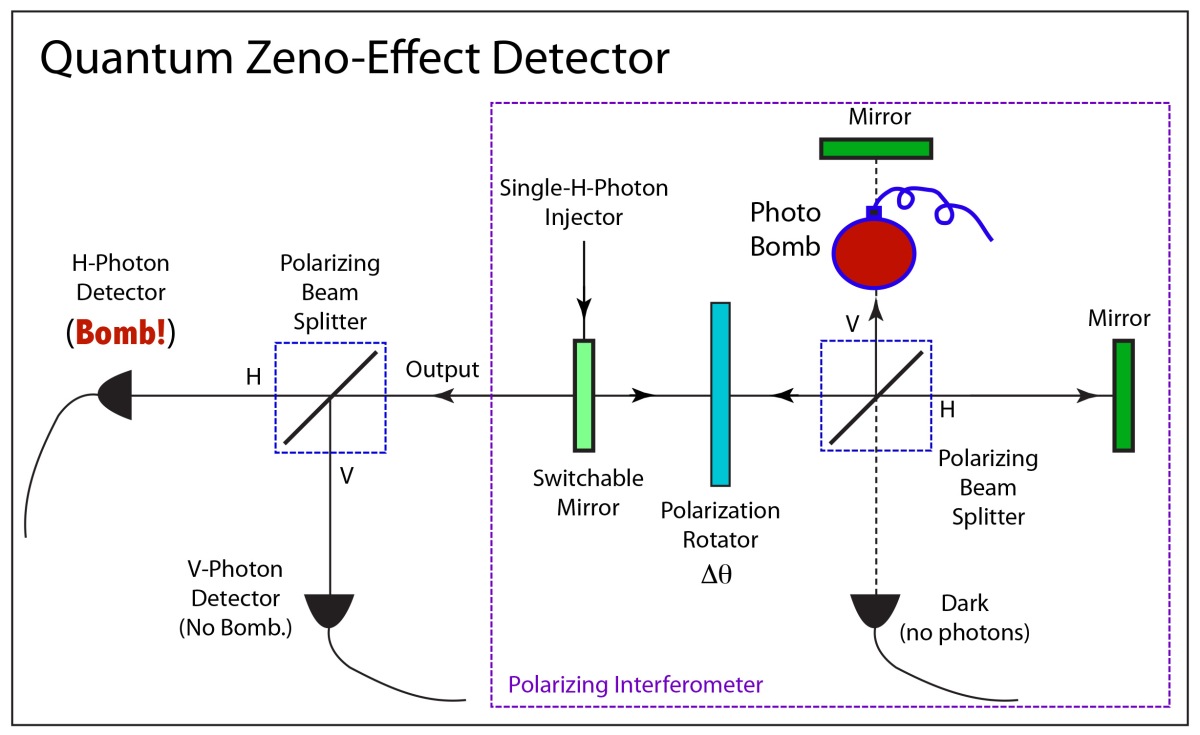
13. Quantum Zeno Effect (Turing paradox) The quantum Zeno effect (also known as the Turing paradox) is a feature of quantum-mechanical systems allowing a particle's time evolution to be arrested by measuring it frequently enough with respect to some chosen measurement setting.
14. EPR Paradox The paradox involves two entangled particles according to quantum mechanics. Under the Copenhagen interpretation of QM, each particle is individually in an uncertain state until it is measured, at which point the state of that particle becomes certain.

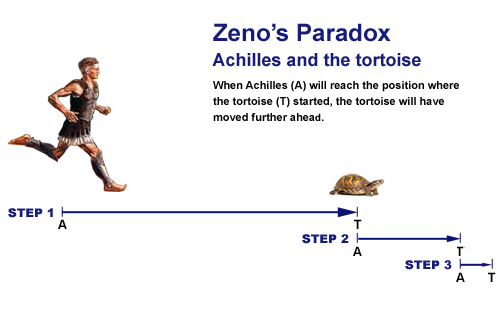
15. Dichotomy Paradox Simply stated, Zeno’s Dichotomy Paradox posits that it is impossible to travel from point A to point B because there are an infinitely divisible number of spaces in between, and it is impossible to traverse an infinite amount of space.