
The Hindu Philosophical Universe. Did you know ancient India offered not one but multiple systems to explore truth, consciousness & cosmic law? 🧵#Thread Let’s decode the 6 Darshanas of Sanātana Dharma,each a complete path to truth.👇
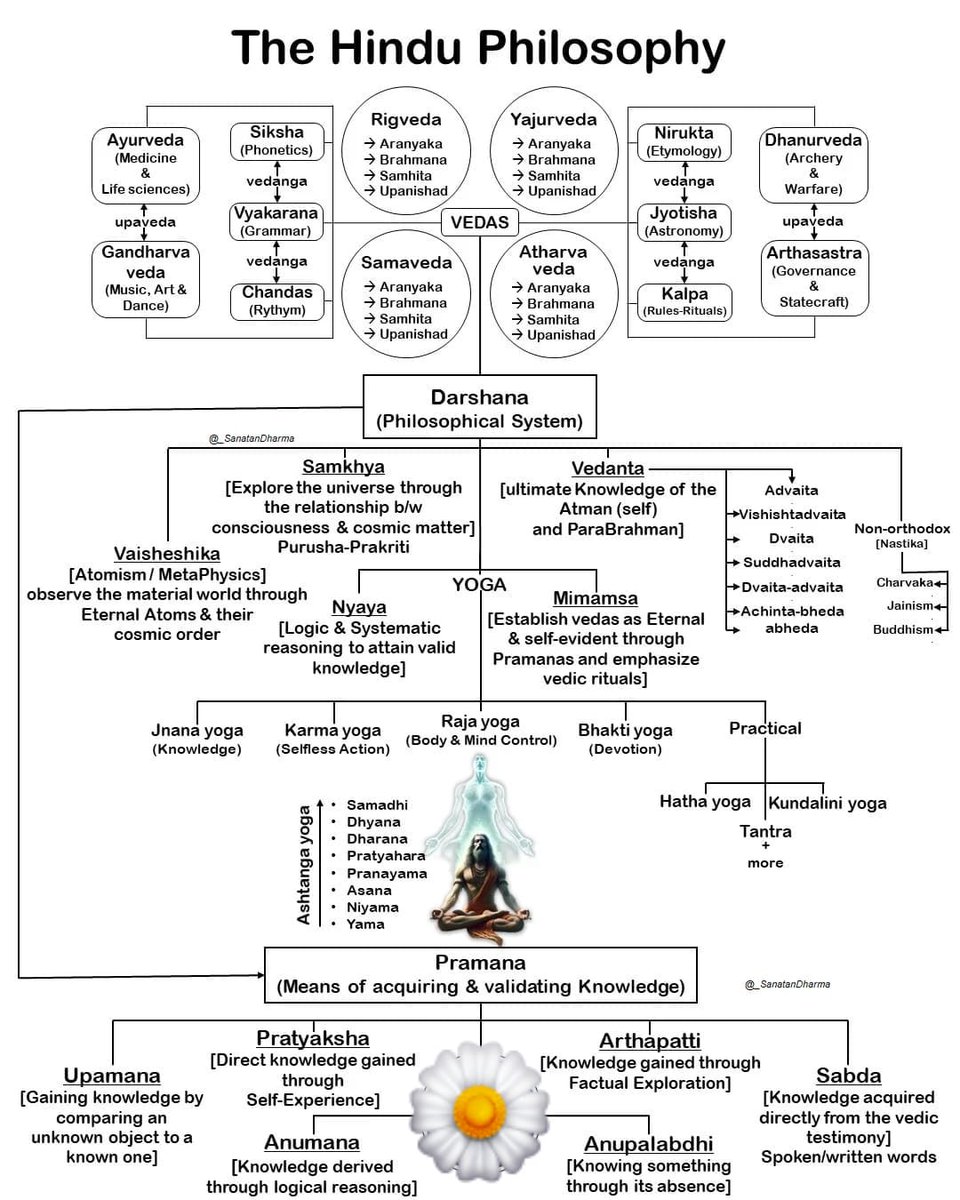
1- What is Darshana? Darshana- “vision” or “to see clearly.” They’re the 6 classical Vedic philosophies. They don’t contradict-they complete each other. Each offers a unique lens to understand Self, Universe, and Dharma.
2-Sankhya – Cosmic Duality Oldest Darshana. Explains reality via 2 eternal truths: Purusha (Consciousness) Prakriti (Nature/Matter) You are not body or mind you're the witness. No God here just pure awareness & matter interaction.
3- Yoga : The Path of Integration. Rooted in Sankhya but adds God (Ishvara). Patanjali’s Ashtanga Yoga: 1. Yama 2. Niyama 3. Asana 4. Pranayama 5. Pratyahara 6. Dharana 7. Dhyana 8. Samadhi Goal: union of self with supreme.
4- Nyaya – The Logic System . Focus: How do we know what we know? Nyaya gives tools for valid knowledge through: Logic Debate Inference Observation Basis for Vedic rationalism. No blind belief here-only verified truths.
5. Vaiseṣika – Ancient Atomism. Teaches that all matter is made of eternal atoms. Classifies all reality into 7 categories: Substance Quality Action Generality Particularity Inherence Non-existence Foundation of Hindu metaphysics.
6. Mimamsa – Ritual as Science . Upholds Vedic rituals & duties as eternal and self-sufficient. Key ideas: Vedas are unauthored (apauruṣeya) Dharma-action guided by scripture Rituals generate unseen results (Apurva) Great for karma yogis.
7-Vedanta – Knowledge of the Self. Means “end of the Vedas” (Upanishads). Explores Brahman (Absolute Reality) & Ātman (Self). Multiple schools: Advaita – Non-dualism Dvaita – Dualism Vishishtadvaita – Qualified Non-dualism Path to Moksha.
8- 4 Major Paths of Yoga . As per Bhagavad Gita: Jnana Yoga – Knowledge Karma Yoga – Selfless action Bhakti Yoga – Devotion Raja Yoga – Body–mind discipline Different routes. One destination: liberation (Moksha).
9- Pramaṇa – Valid Means of Knowledge . Hindu philosophy recognizes 6 Pramaṇas: 1. Pratyakṣa – Direct experience 2. Anumana – Inference 3. Upamana – Analogy 4. Arthapatti – Postulation 5. Anupalabdhi – Absence 6. Sabda – Scriptural testimony Epistemology-sharp & deep.
10-Practical Yogas – Beyond Theory Hatha Yoga – Physical control Pranayama – Breath mastery Kundalini Yoga – Awakening Shakti Tantra – Sacred rituals & energy Nada Yoga – Sound-based healing Hinduism- science of the seen & unseen.
11-Sabda : Sound as Divine Wisdom. In Sanatana Dharma, sacred sounds aren’t poetry they’re codes. Mantras vibrate with cosmic intelligence. The Vedas are sabda pramaṇa-heard by Rishis, preserved orally. Sound, knowledge, transformation.
12- Hindu Philosophy- Infinite Vision. These are not beliefs. They’re frameworks to experience truth-mental, physical, spiritual & universal. Each Darshana is a doorway to wisdom. Together, they form the galaxy called Sanatana Dharma.
13-🔁 RT this if it expanded your perspective. Follow @_SanatanDharma for more decoded ancient Indian wisdom: Darshanas Ayurveda Vedas Yoga Tantra Bhagwat Gita Which Darshana do you want a deep-dive on next?