
Does the Qur'an Mistake 'Mary' for 'Miriam'? Why does the Qur'an call 'Mary' the 'Sister of Aaron'? A Thread 🧵| #quran #islam #mary

In this thread, I'll explain whether or not the Qur'an mistakes 'Mary' for 'Miriam', the daughter of Amram and Jochebed, and the older sister of Moses and Aaron. I'll also explain why the Qur'an calls 'Mary' the 'Sister of Aaron', which appears in Q19:28.
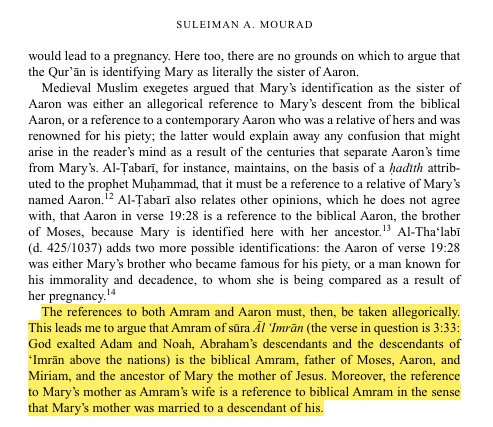
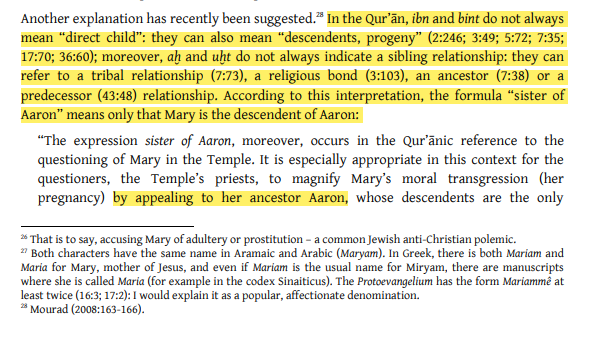
Prof. Suleiman Mourad argues that "the daughter of" doesn't mean a literal daughter but rather lineage. In Christian canonical sources, the term son does not always denote a direct child: in Matthew 1:1, for example, Jesus is identified as Jesus the Messiah, the son of David, the
In the Qur’an, too, the terms ibn and bint (and their derivatives) do not only mean “direct child,” but are also used in the sense of “descendents,” as in the cases of Bani Isra’il in verses 2:246, 3:49, and 5:72, which indicates the Israelites as a people, and not only Jacob’s


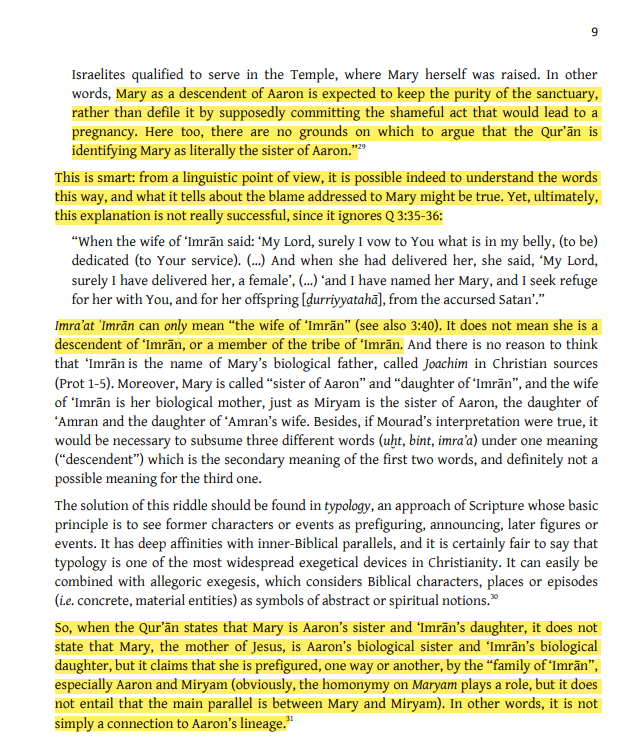
Dye, who's on the more revisionist view, doesn't view it as literal either but also disagrees with Mourad. Dye believes that the solution should be found in typology, which is where former characters or events "prefigure, announcing, later figures or events". When the Qur'an
Traditionally speaking however, it also appears that the question of the 'sister of Aaron' was a debate in earlier periods. There's a hadith where it states, "When I came to Najran, they (the Christians of Najran) asked me: You read" O sister of Harun" (i. e. Hadrat Maryam) in
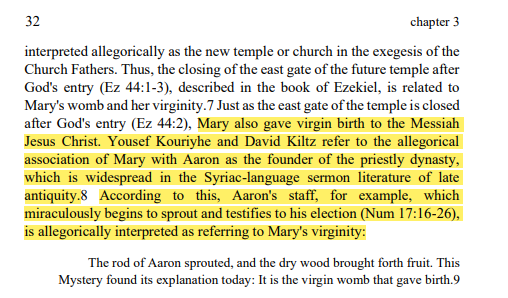
I want to talk about intertextuality for a little bit also, the idea that Mary as the 'sister of Aaron' is not just found in the Qur'an. In a homily, "Prayer for the Feast of the Blessing of the Seeds by Mary", states that Mary is "Aaron's rod" mentioned in Numbers 17 where it
The next intertextuality is "Prayer for the Feast of Joseph's Dream", this one also has Mary with Aaron's rod from Numbers 17. This one states, "Aaron's rod, which blossomed without watering, clearly describes you, who gave birth to the eternal Word of the Father without mating.
Other ones are "Hymns to the Nativity of Jesus (De Nativitate) 1:17" (4th c.), Life story of the Mother of God Mary (5th c.) (I want to mention that this one seems to connect Mary with insignia of the temple). In Pseudo-Ephrem's "Didactic poem about the Mother of God (Sermo de
According to Zishan Ghaffar, Aaron's staff, for example, which miraculously begins to sprout and testifies to his election (Num 17:16-26), is allegorically interpreted as referring to Mary's virginity ( (Yousef Kouriyhe, David Kiltz, Hymns on the Birth of Jesus (De Nativitate)

Nicolai Sinai makes an interesting point about the Protevangelium of James (13:1-16:3) where it states how the reproaches attributed to Joseph and the priests in the Protevangelium each refer to Mary's stay in the temple ("Why have you stooped to this, you who were brought up in
Wensincks conclusion, supported by the figurative speech of the Quran and the Islamic tradition: Maryam is called a sister of Hārūn and the use of these three names Imrān, Hārūn and Maryam, has led to the supposition that the Kur'ān does not clearly distinguish between the two
In Michael Marx's chapter, Arabic phraseological convention of using terms like ukht (sister) or bint (daughter) refers to membership in a group or lineage at least in this case. The Qurʾan consistently links Mary to an Aaronid genealogy, weirdly this is something not found in

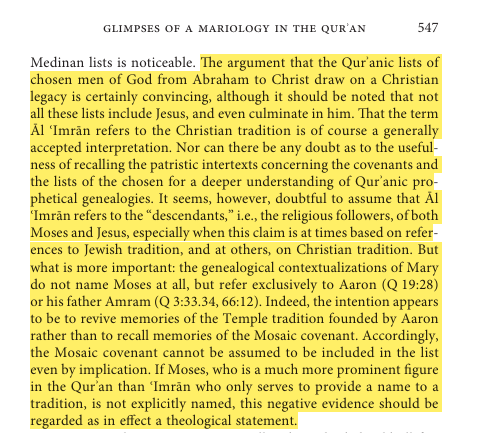
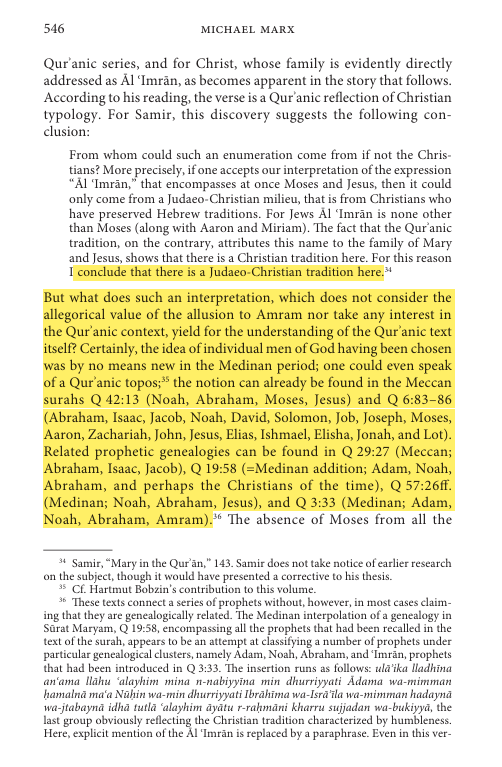
To conclude, the idea of Mary as the 'sister of Aaron' is not literal, rather, it is reviving the memories of the temple tradition founded by Aaron and promoting her lineage, a tradition commonly found in Syriac sources but also in the Gospels. However, none of the options make
Please follow/repost for more so I can continue researching and making posts like this. Join: https://discord.gg/QuP9qRDKTh (more resources) Join: https://jordanjournal.substack... (substack)
Credit to @GhaffarZishan & the rest above
@JordanAcademia0 All the arguments here are completely invalid because this was asked from the Messenger ﷺ and he explained they named themselves after righteous predecessors so it's not the same Hārūn, 'alayhis salātu wassalām, being referred to, rather her brother was named the same name.

@JordanAcademia0 Or we could avoid all the linguistic and historical acrobatics and just admit that Muhammad ﷺ made a mistake ? Did any of Mary’s parents or grandparents were called (sister / brother of Aaron). And shouldn’t there be more than one “sister of Aaron” at that time and till now ?
@JordanAcademia0 The amount of lies Muslims will tell themselves to preserve the belief that the language of the Quran is uncreated is an insult to the religion.
@JordanAcademia0 Mughira ibn Shu’ba reported: When I came to Najran, the Christian monks asked me, “You recite the verse, ‘O sister of Aaron,’ (19:28) but Moses was born long before Jesus by many years.” When I came back to the Messenger of Allah, PBUH, I asked him about it and he said,
@JordanAcademia0 If we entertain the idea that the Mother of Jesus is the sister of Aaron. What exactly would be wrong with that? Besides it going against authorities outside of the Quran. I fail to see a reason why this would be 'wrong'. It would throw a spanner in to the church's narrative.
@JordanAcademia0 @threadreaderapp unroll
@JordanAcademia0 May Allah reward you but it is not permissible to photograph the form of the prophets, and photographing the form of Mary (peace be upon her and her son) with her hair and neck visible is a very dangerous matter Delete the image.
@JordanAcademia0 Great work Yet Again.
@JordanAcademia0 Luke 1:5 In the time of Herod king of Judea there was a priest named Zechariah, who belonged to the priestly division of Abijah; his wife Elizabeth was also of the daughters of Aaron.
