
🧵 "What really determines tissue perfusion?" – and why most explanations get it wrong. Let’s sort out MAP, CVP, CCP, autoregulation, vasopressors, and the flow that actually reaches your organs. 👇
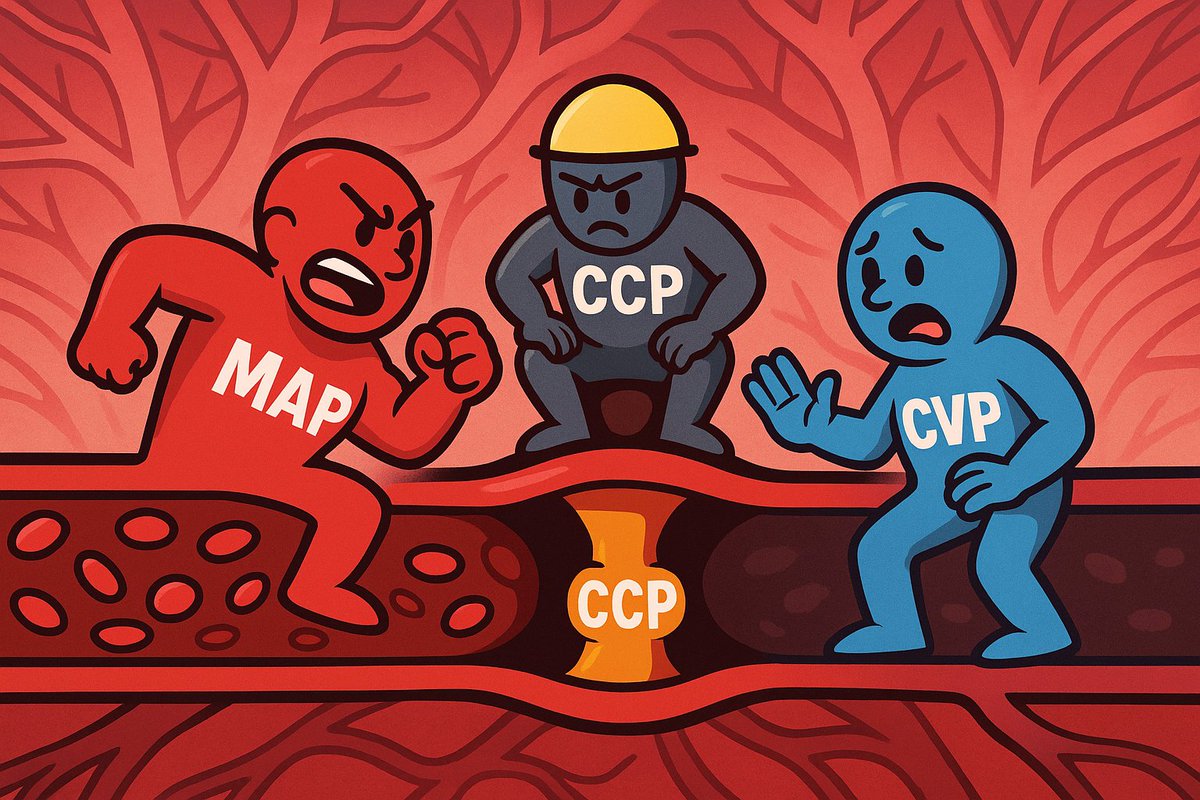
1/ You’ve probably heard: “Perfusion pressure = MAP − CVP” Or sometimes: “Perfusion = MAP − CCP” But both are context-dependent. Let’s unpack what truly drives tissue perfusion — and why it’s more dynamic than most realise.
3/ The simplest model: Flow = (MAP − Venous Pressure) / Resistance Where: MAP = pressure in Venous pressure = pressure out Resistance = mostly arteriolar tone Simple. But misleading.
4/ The problem? 🧠 Resistance isn’t fixed. Tissues actively adjust arteriolar tone to preserve flow — even when MAP changes. This is called autoregulation.
5/ Autoregulation allows tissues to keep flow constant over a range of MAP values. If MAP drops → arterioles dilate If MAP rises → arterioles constrict The goal is to preserve capillary flow, despite pressure changes upstream.
6/ So within that range, flow stays stable even when the driving pressure (MAP) changes. The tissue is controlling its own flow. And it doesn’t care what’s happening downstream — as long as venous pressures are low.
7/ But autoregulation has limits. If: • MAP falls below the lower threshold • Arterioles can’t dilate further Then flow begins to fall — it’s now pressure-dependent. 🧠 Autoregulation can’t help if the input pressure is too low.
8/ So what about venous pressure (e.g. CVP)? It doesn’t trigger autoregulation. It just quietly opposes flow. And when it rises, it narrows the perfusion gradient — with no compensatory response. In this setting, venous pressure becomes the key limiter of flow.
9/ That’s why venous congestion is dangerous. You can have a “normal” MAP but still under-perfuse tissues as the pressure gradient drops. And there’s no mechanism to compensate Flow falls — silently.
10/ Now let’s add another piece: 🩸 Critical Closing Pressure (CCP) This is the pressure below which a vessel collapses and flow stops, even if venous pressure is lower. It reflects: • Vascular tone • External tissue pressure
11/ If vascular tone is very high (e.g. excessive vasoconstriction), or external pressure is elevated (e.g. brain swelling, oedema, compartment syndrome), CCP rises. Now, even if MAP is "normal", there’s no flow unless it's above CCP.
12/ This is the vascular waterfall. When vessels collapse like a choke point, flow becomes: Flow = (MAP − CCP) / Resistance CVP no longer matters — the collapsed segment sets the outflow pressure.
13/ So when does CCP matter? • In high tone states • With external compression (e.g. raised ICP) • And potentially with overuse of vasopressors, which can raise CCP via excessive arteriolar constriction
14/ So what really determines tissue perfusion? It’s not MAP alone. Not MAP − CVP. Not MAP − CCP. It’s how... • MAP • Venous pressure • Resistance • CCP ...all interact And how the tissue responds (or can’t).
15/ So beware simple formulas. Perfusion isn’t about plugging numbers into a neat equation. It’s about context — autoregulation, tone, congestion, and where the choke points lie. And understanding that changes how you manage shock, fluids, and pressors.
16/ Coming soon: 🔹 A full thread on Critical Closing Pressure 🔹 How vasopressors, tone & compression affect it 🔹 Why MAP alone doesn’t guarantee flow Follow to catch it. #MedX #CriticalCare #Physiology #Haemodynamics
Start here ⬇️ https://x.com/icmteaching/stat...
@icmteaching Great, Ash. Thanks for sharing!
@IM_Crit_ 🙏🏼
@icmteaching @khaycock2 @ThinkingCC @iceman_ex @IM_Crit_ @Wilkinsonjonny @ross_prager @nickmmark https://acrobat.adobe.com/id/u...

@carlosguit @khaycock2 @ThinkingCC @iceman_ex @IM_Crit_ @Wilkinsonjonny @ross_prager @nickmmark Thanks Carlos - I'm going to be explaining some of those very things you have discussed in the article in the next few days.
@icmteaching @khaycock2 @ThinkingCC @iceman_ex @IM_Crit_ @Wilkinsonjonny @ross_prager @nickmmark Thank you for this. I look forward to you expanding on CCP.
@icmteaching @khaycock2 @ThinkingCC @iceman_ex @IM_Crit_ @Wilkinsonjonny @ross_prager @nickmmark Extremely well made thread, thank you so much !