
🧵 What is Critical Closing Pressure — and why does it matter for perfusion? A thread to clear up one of the most misused and misunderstood ideas in circulatory physiology. 👇
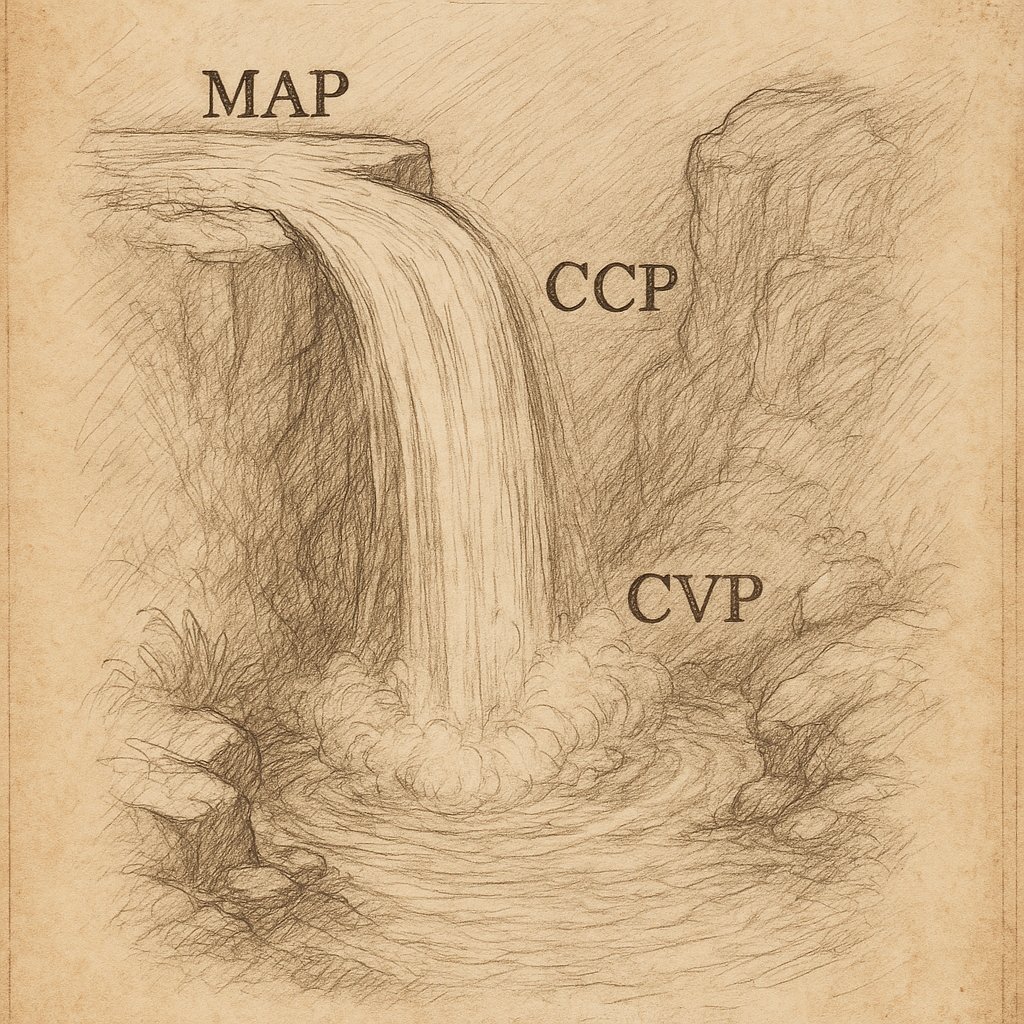
1. We talk a lot about MAP, CVP, and perfusion pressure. But there’s a hidden threshold that can choke flow completely — even when there’s still a gradient. It’s called Critical Closing Pressure (CCP). And it’s time to make sense of it.
2. What is CCP? CCP is the arterial pressure below which a vessel collapses and flow stops, even if CVP is lower. It’s not theoretical. It’s real, measurable, and clinically important — when the conditions are right.
3. The problem with the literature 🧠 CCP is one of those concepts where the more you read, the less sense it seems to make. That’s because the literature defines it in contradictory ways: – Some call it a dynamic threshold that changes with tone or pressure (correct) – Others
4. What this thread will do This thread will clarify: – What CCP actually is – When it limits flow – When it doesn’t – And how to recognise it clinically Let’s fix the mess 👇
5. How collapse happens Blood vessels are collapsible tubes, not rigid pipes. If the pressure inside falls below the surrounding pressure, they can collapse — and flow stops. This defines CCP — the pressure below which the vessel can no longer stay open.
6. What determines CCP? CCP reflects: – Vascular tone (smooth muscle constriction) – External pressure (e.g. oedema, ICP, PEEP) – Organ structure (capsule vs compliant tissue) It’s not a pressure you reach — it’s a threshold that appears when conditions favour collapse.
7. Typical values? 📊 CCP is not zero — even in healthy people. – It’s been measured at ~20–40 mmHg in various beds – In sepsis or vasodilation, it may drop – With high-dose vasopressors, oedema, or significant compression → it may approach or exceed 50 mmHg in some cases When
8. Clinical implications of CCP values So a MAP of 40 mmHg might still perfuse some organs… …but not others like the kidney, where CCP may be high and autoregulation may have already failed. 🧠 In normal physiology, arteriolar pressure is always above CCP — keeping vessels
9. Starling resistor model To understand CCP, think like an engineer. A Starling resistor is a collapsible tube surrounded by external pressure. Flow only happens when: • Inlet pressure > external pressure • Inlet pressure > outlet pressure That's CCP physiology in action.
10. The vascular waterfall 💧 This is where the vascular waterfall comes in. If a vessel collapses midstream, flow becomes: • Independent of downstream pressure (CVP) • Limited only by MAP − CCP The “waterfall” is that choke point — the collapsed segment.
11. But the waterfall isn’t always there 🧠 The vascular waterfall isn’t a structure — it’s a state. It only exists if a segment has collapsed. If the vessels are open, there is no waterfall — just standard pressure–flow relationships.
12. When is CCP relevant? CCP becomes flow-limiting when: – MAP falls near CCP (e.g. shock) – CCP rises (e.g. vasopressors, ICP, PEEP) – External pressure exceeds intraluminal pressure Otherwise, CCP does nothing.
13. Oedema and CCP In encapsulated organs (e.g. kidney, brain), oedema can't expand freely → interstitial pressure rises → CCP rises. This can choke capillary inflow — even if MAP is normal. In compliant tissues, this usually doesn’t happen.
14. Vasopressors and CCP At appropriate doses, vasopressors increase VR, raise MAP and improve flow. At excessive doses, they can raise vascular tone enough to increase CCP and collapse small vessels. More MAP doesn’t help if CCP has risen too.
15. Different organs, different CCPs Some beds collapse early (kidney, skin). Others are preserved longer (gut, liver). This explains shock patterns and organ-specific dysfunction. Blood flow redistributes based on where CCP is lowest.
16. Interface 2 This is Interface 2 (macro → micro) in this newly proposed shock model. https://x.com/icmteaching/stat... CCP blocks flow before it reaches the tissue — or at the delivery interface. Recognising this changes management
17. Recognising CCP at the bedside 🛏️ We can’t directly measure CCP in clinical practice — but we can often suspect it. This is often part of what's called haemodynamic incoherence — when macro parameters (like MAP or CO) look fine but the microcirculation is still impaired.
18. What to do about it The solution isn't always “raise the MAP.” You might need to: – Reduce tone (less pressor) – Reduce external pressure (less PEEP) – Relieve oedema (diuresis?) – Think: not just “raise MAP above CCP” — but also “lower CCP when possible”
19. Summary of pressure gradients Normal circulation: 🔹MAP → arterioles = flow set by metabolic need, maintained via autoregulation 🔹Arterioles → venules = capillary flow — governed by the pressure gradient across the bed, but modulated by arteriolar tone (until
20. Common misconceptions Many sources say: “Perfusion = MAP − CCP” That’s only true if collapse has occurred. In open systems, flow is governed by autoregulated resistance, not CCP. CCP doesn’t subtract from MAP unless it's actively blocking flow.
21. Your confusion is valid If you’ve read about CCP and thought: “This doesn’t add up.” You’re not wrong. Much of the literature blurs concepts — rarely distinguishing when CCP does vs doesn’t apply. You’re right to push back.
22. Sidebar — Pmsf vs venous pressure 📌 Pmsf is a theoretical pressure: the value all vascular pressures would settle at if flow stopped. Venular pressure may approximate Pmsf — but they are not the same. Pmsf is often misused in models of capillary flow, where venular
23. Bottom line 🩸 CCP is real. 🧠 It matters. But it’s not always there — and it doesn’t always limit flow. If you understand when CCP appears, you’ll make better decisions at the bedside. #MedX #Physiology #Haemodynamics #CriticalCare
Start here ⬇️ https://x.com/icmteaching/stat...
Follow up thread ⬇️ https://x.com/icmteaching/stat...
@icmteaching @iceman_ex @Wilkinsonjonny @ThinkingCC @khaycock2 @AndromedaShock @edu_kattan @ICS_updates @Assoc_Anaes Eloquently written! This applies to the brain too, especially cerebral venous sinus drainage. We discussed it a bit here: https://pubmed.ncbi.nlm.nih.go... . Great tweetorial breaking this complex concept down! 👏
@icmteaching @iceman_ex @Wilkinsonjonny @ThinkingCC @khaycock2 @AndromedaShock @edu_kattan @ICS_updates @Assoc_Anaes A significant limitation in physiological understanding arises when Poiseuille’s law is inappropriately applied to human anatomical structures. This law, derived for rigid, non-collapsible tubes, fails to account for the fact that blood vessels, bronchi, and alveoli are dynamic
@DiegoEscarraman @iceman_ex @Wilkinsonjonny @ThinkingCC @khaycock2 @AndromedaShock @edu_kattan @ICS_updates @Assoc_Anaes Absolutely agree — and that’s exactly why I framed the physiology using Starling resistors and critical closing pressure. Poiseuille’s assumptions don’t hold in dynamic, collapsible systems. Transmural pressure governs collapse, and once Pin < Pext, resistance skyrockets — just
@icmteaching @iceman_ex @Wilkinsonjonny @ThinkingCC @khaycock2 @AndromedaShock @edu_kattan @ICS_updates @Assoc_Anaes Your thread was beautifully written. Thank you. TCDs, when combined with multimodality neuromonitoring, can estimate critical closing pressure and provide a diastolic closing margin. Here's our work in this space: https://www.frontiersin.org/jo...
@icmteaching @iceman_ex @Wilkinsonjonny @ThinkingCC @khaycock2 @AndromedaShock @edu_kattan @ICS_updates @Assoc_Anaes Great post! BJJ a game of creating vascular waterfalls
@icmteaching @iceman_ex @Wilkinsonjonny @ThinkingCC @khaycock2 @AndromedaShock @edu_kattan @ICS_updates @Assoc_Anaes Interesting stuff! So if I understand correctly, CCP is a variable characteristic of the vessel itself? Occlusion occurs if either the internal vessel pressure ⬇️ below CCP, or if the pressure external to the vessel ⬆️ above CCP. 🤔
@Kevin34050619 @iceman_ex @Wilkinsonjonny @ThinkingCC @khaycock2 @AndromedaShock @edu_kattan @ICS_updates @Assoc_Anaes Great question — yes, CCP is a dynamic threshold that reflects the internal pressure needed to keep a vessel open. If Pinside < CCP, the vessel collapses. And CCP can rise either due to external pressure (e.g. oedema, PEEP) or vasoconstriction — both of which make collapse more